Last week, six photographs and one video were featured in NASA’s “Astronomy Picture of the Day” (APOD) selection. The Great Orion Nebula revealed its veils of dust, while silvery clouds illuminated a Swedish field, and an amateur telescope captured Ganymede eclipsing Io. Near its inferior conjunction, Venus appeared as a thin crescent with “horns.” In the constellation Cepheus, the Ghost Nebula emerged from the darkness; in Iceland, steam from fumaroles rose into the aurora; and an Italian astrophotographer assembled a complete palette of the Moon’s colors over a period of ten years.
The Orion Nebula (M42): A stellar nursery in the hunter’s “sword”
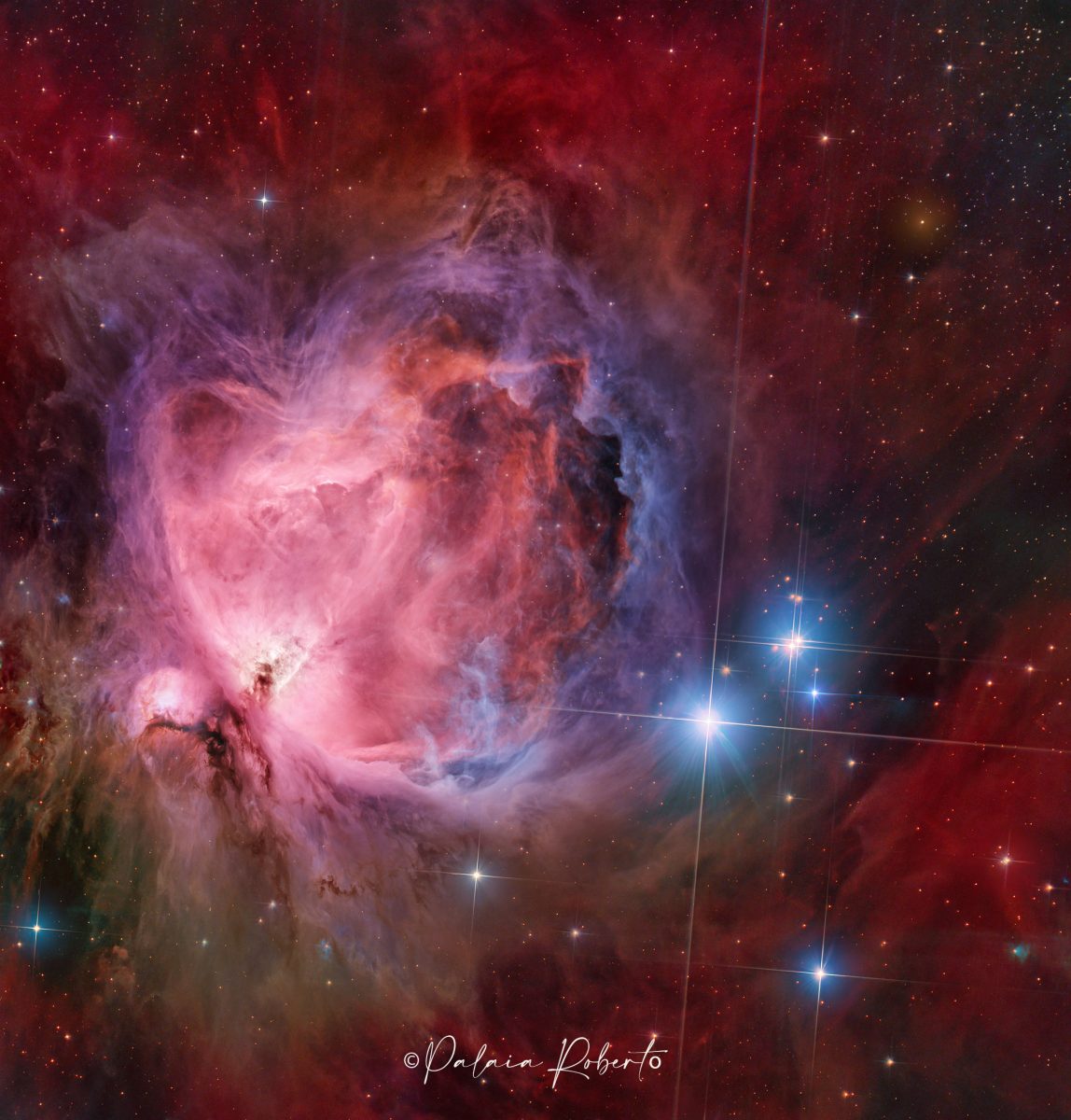
The Orion Nebula, also known as M42, is located approximately 1,500 light-years from Earth. It is the nearest region in which massive stars are forming and is among the most renowned nebulae in the night sky. It can be readily observed with the naked eye just below the three stars of Orion’s Belt, within the celestial hunter’s “sword.” The nebula spans approximately 40 light-years and lies in Orion’s Arm, the same spiral arm of the Milky Way in which the Sun is located.
The ultraviolet radiation emitted by hot, young stars causes the gas surrounding them along the edge of a giant molecular cloud to glow. Roberto Palaia captured a deep-field image and assigned colors to individual channels to emphasize the hydrogen emission. The photograph reveals delicate strands and expansive veils of dust and gas that are obscured by the bright glow in conventional images.
At the center of M42 is the Trapezium open cluster, surrounded by regions where star formation is ongoing. These regions contain abundant hydrogen and young stars, as well as protoplanetary disks illuminated by radiation from nearby stars. Newly formed stars also emit high-velocity jets of material. The image was included in a selection published on October 26.
Silvery clouds over Sweden
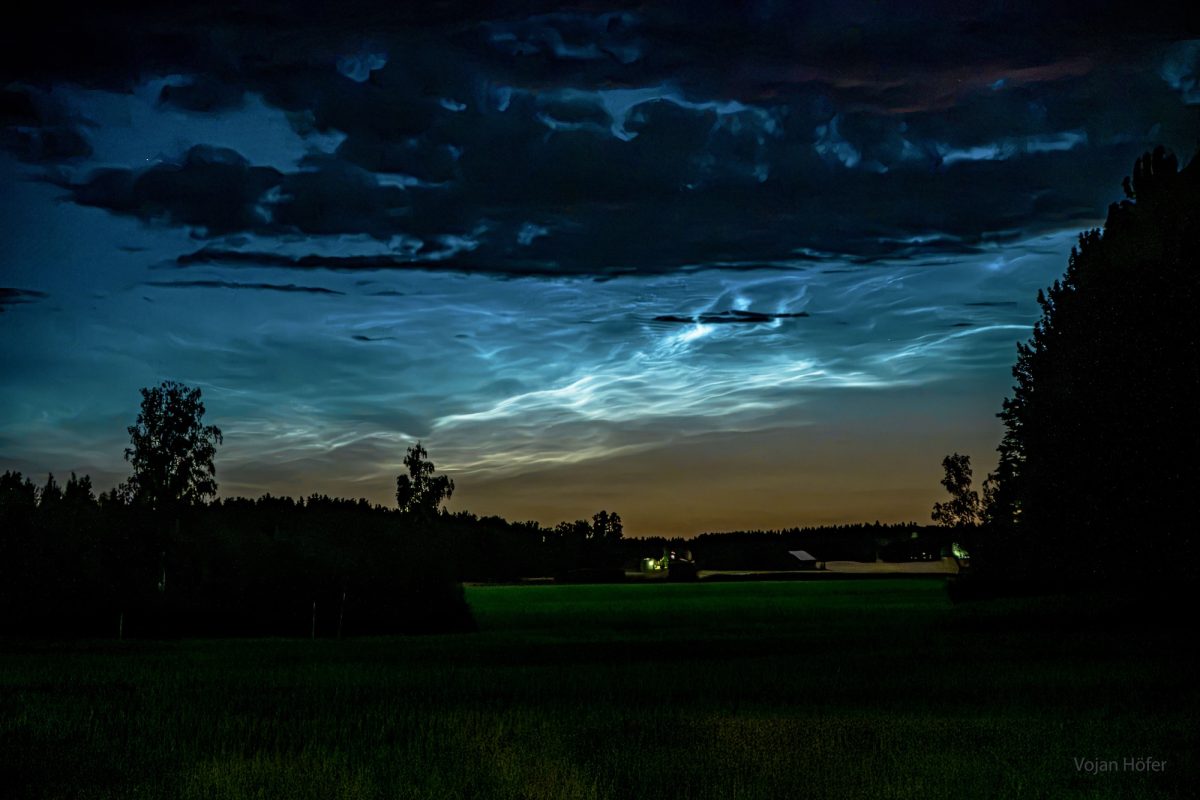
After night has fallen on Earth, the Sun continues to shine at high altitudes. Its rays emerge from beyond the horizon and illuminate the clouds; the highest clouds may even glow against the dark sky. These are known as noctilucent clouds, or polar mesospheric clouds.
Silver clouds form in the mesosphere at an altitude of approximately 80 km and consist of minute ice crystals. During the day, they are not visible against the bright sky, while late at night, they are no longer illuminated by the Sun. They are most readily observed during summer, shortly after sunset, at latitudes between approximately 50° and 70°.
This network of blue clouds was photographed in early August 2026 near the Swedish city of Linköping. A green field occupies the foreground, while the black silhouettes of trees line the horizon. Much of our understanding of silver clouds has emerged only over the past twenty years, and the mechanisms underlying their formation continue to be actively studied. The photograph was featured in the selection on October 27.
Ganymede eclipses Io: A mutual eclipse of Jupiter’s moons
A total of 115 moons have been discovered orbiting Jupiter. Saturn holds the record in the Solar System, with 293 known moons. On October 20, 2026, two of Jupiter’s Galilean moons aligned with Earth. Michael Wong recorded a video in which Ganymede, the largest moon in the Solar System, briefly obscures Io, a volcanic moon.
When one celestial body passes in front of another, partially or completely obscuring it, the phenomenon is known as a mutual occultation. Galileo’s moons rarely occult one another because Earth must view their orbits precisely edge-on. This alignment occurs once every six years, when Jupiter experiences an equinox and its equator faces both the Sun and Earth.
A dark spot is visible on the right side of Jupiter’s disk. This spot is the shadow of Ganymede cast across the gas giant’s clouds. From the perspective of a hypothetical observer within the shadow, a solar eclipse would be occurring. The video was published as part of a compilation on October 28.
Venus’s horns: The planet’s phases near inferior conjunction
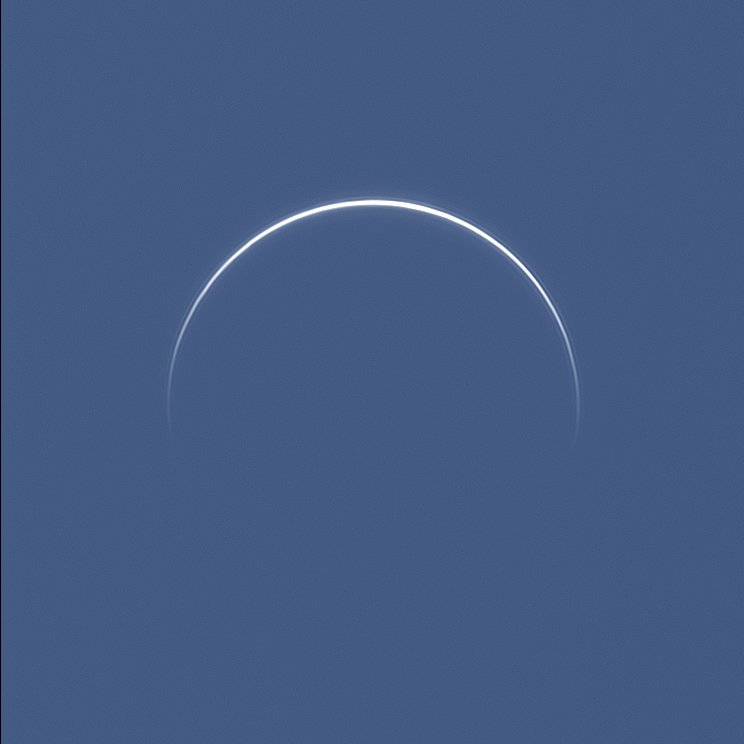
The thin, luminous crescent depicted in the photograph is Venus. Like the Moon, Venus exhibits phases. Thierry Legau photographed the planet in late October, when it was positioned nearly directly between the Sun and Earth. This inferior conjunction occurs approximately once every 19 months and is analogous to a new moon, when the Moon passes between Earth and the Sun.
During the new moon phase, the Moon is entirely dark. Venus is surrounded by a dense atmosphere that refracts and scatters sunlight as it passes behind the planet. Consequently, the illuminated crescent extends beyond the boundaries of a typical phase, forming an arc that spans more than half a circle. Astronomers refer to the tips of this arc as “horns.”
Venus’s crescent is visible through a small telescope or binoculars at twilight. Individuals with exceptionally keen eyesight may occasionally discern it with the naked eye. On the days of conjunction, Venus appears close to the Sun in the sky; therefore, binoculars should be directed toward it only after the Sun has completely set below the horizon.
Variations in Venus’s brightness associated with its phases were likely first systematically documented by Babylonian astronomers. Comparable observations were also preserved by other cultures, most notably the Maya in the Dresden Codex, the oldest known book from that civilization. The image was featured in the October 29 selection.
The Ghost Nebula in the constellation Cepheus
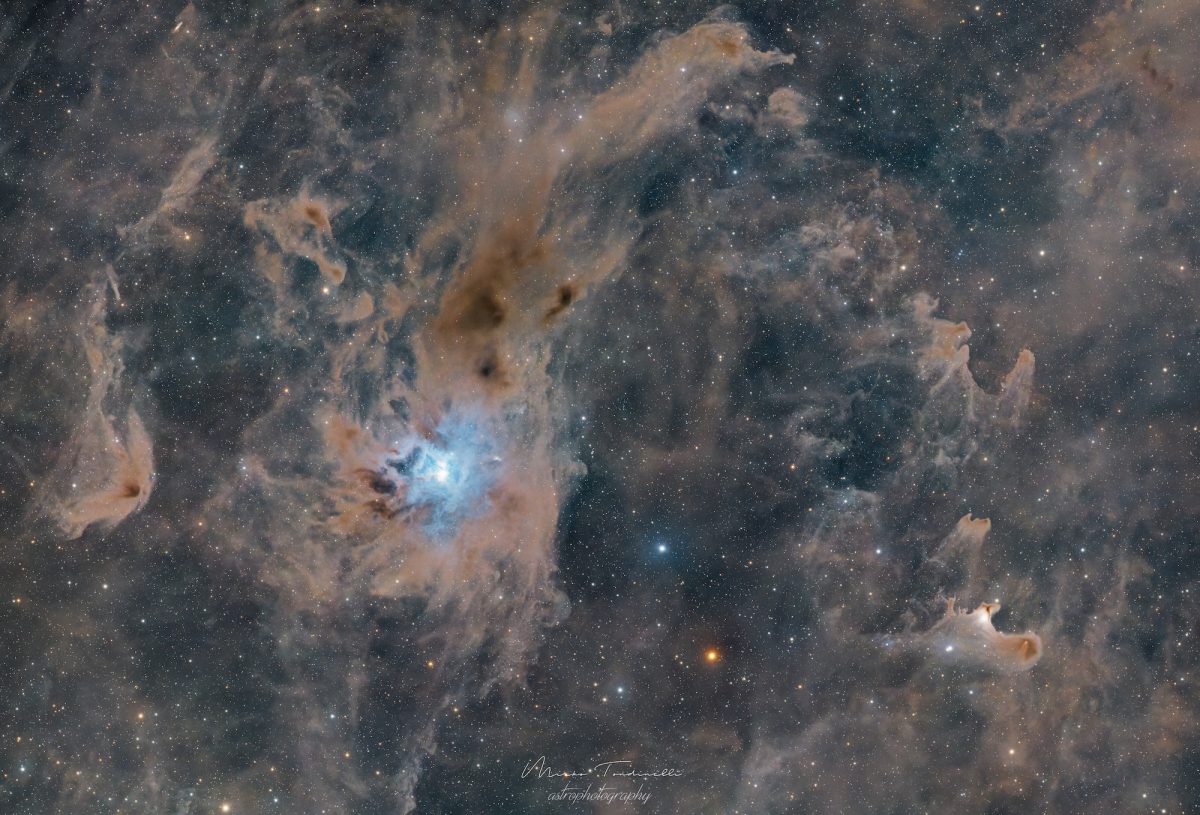
The whimsical silhouettes in this image drift across the night sky within the royal constellation of Cepheus. They are clouds of cosmic dust, faintly illuminated by the reflected light of stars. These clouds lie above the plane of the Milky Way, at the edge of the Cepheus Flare molecular cloud complex, approximately 1,200 light-years away.
The brightest of these nebulae is located in the lower-right corner of the frame. This is the vdB 141 nebula, also known as Sh2-136 and nicknamed “The Ghost.” It spans more than two light-years. The reddish patches within The Ghost indicate dense clumps of gas and dust contracting under the force of their own gravity. This is how stars form.
To the left of the frame’s center, the Iris Nebula (NGC 7023) shines brightly. Dust within the nebula reflects the blue light of hot, young stars. Using a wide-field telescope, Mirko Tondinelli captured a region of the sky nearly six full Moons across. The image was featured in the selection on October 30.
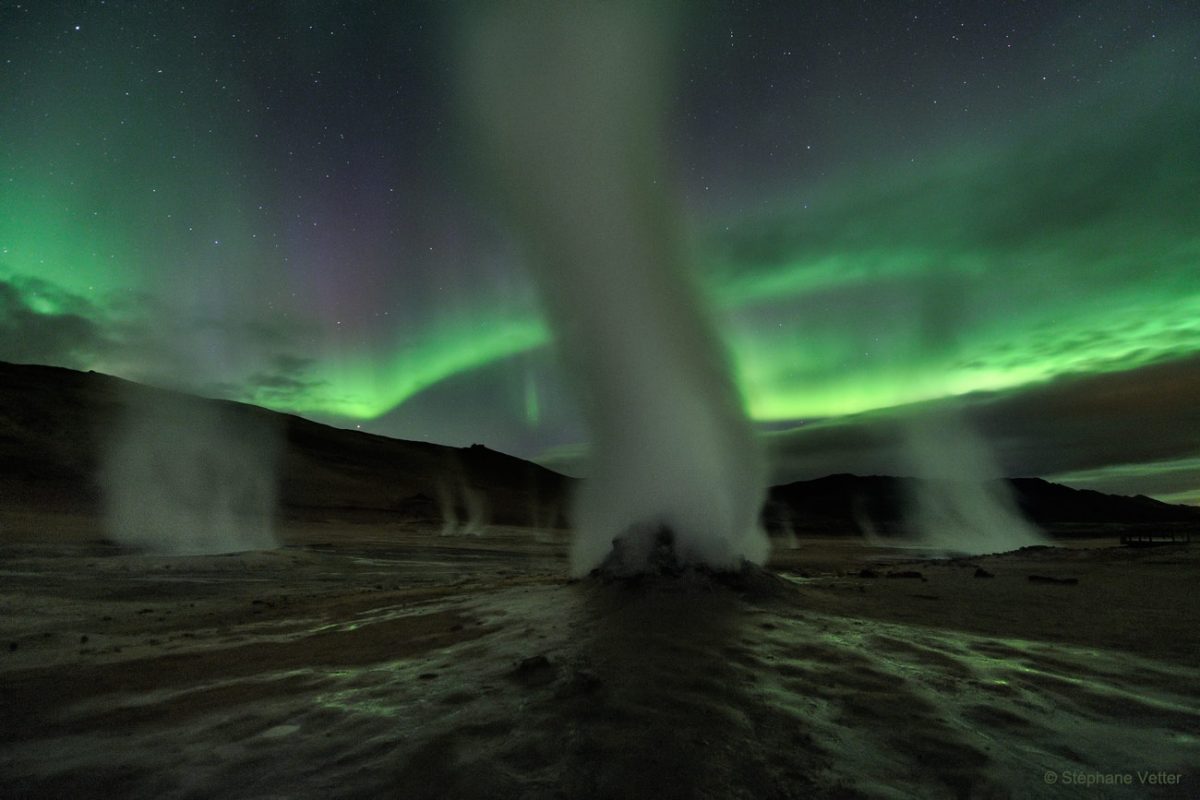
The Northern Lights above Iceland’s fumaroles
The landscape depicted in this photograph evokes a scene from a horror film set on an alien planet, despite having been captured on Earth. Stéphane Vetter photographed Hverir, a geothermal area situated amid the volcanic terrain of northeastern Iceland. Fumaroles emerge from fissures in the ground, releasing steam and volcanic gases, including hydrogen sulfide, which has a distinctive odor.
The sky above Hverir was illuminated by a green aurora caused by solar activity that triggered geomagnetic storms. Charged particles, guided by Earth’s magnetic field, entered the upper atmosphere at high latitudes. The green glow is produced by oxygen atoms at altitudes of approximately 100 to 250 km. Plumes of steam rising from the fumaroles contrasted strikingly with the aurora and, in the darkness, appeared ghostlike.
The Sun has only recently begun moving away from the peak of its 11-year cycle, so auroras are expected to remain frequent for some time. The photograph was published on October 31, Halloween.
The colors of the Moon: from red to blue
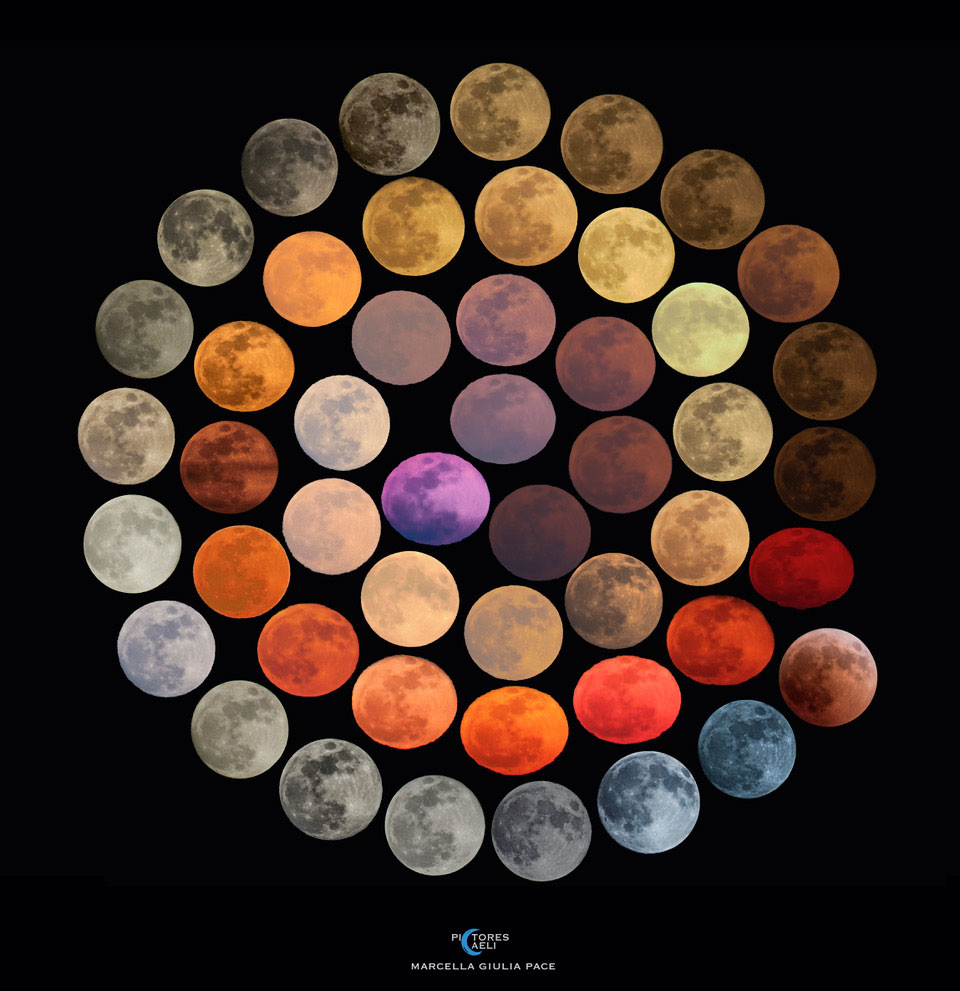
The Moon’s color varies depending on the night and the time of observation. Beyond Earth’s atmosphere, the Moon — which shines by reflecting sunlight — appears gray with a slight brownish tint. Marcella Giulia Pace spent ten years photographing the full Moon in various locations throughout Italy and arranged the photographs in a spiral pattern.
A red or yellow Moon is most often observed near the horizon. Its light passes through a thick layer of the atmosphere, where some of the blue light is scattered, particularly when fine dust is present in the air. A blue Moon is much rarer and typically appears when larger dust particles are present in the atmosphere. The source of the purple tint in one of the photographs is uncertain; several effects may have combined to produce it.
The final image in the series was captured during the total lunar eclipse on July 27, 2018, the longest of the 21st century. During the eclipse, the Moon passed into Earth’s shadow and appeared dim red, illuminated solely by light refracted through Earth’s atmosphere. The photograph was featured in the November 1 selection.