

Two weeks prior, the Chinese spacecraft “Tianwen-2” entered orbit around Earth’s quasi-satellite, the asteroid Kamoʻoalewa. On July 4, it will endeavor to land on its surface and retrieve a sample of material. What is currently known about this mission and its objectives?
Kamoʻoalewa’s quasi-satellite
On Saturday, July 4, humanity might receive a sample from another celestial body. Naturally, this is contingent upon the successful landing of the Chinese spacecraft “Tianwen-2″ on our planet’s quasi-satellite, the asteroid Kamoʻoalewa, and the absence of any mishaps. This undertaking represents one of the most ambitious missions of our era.
The inception occurred in 2016 when the Pan-STARRS 1 telescope — a component of the Pan-STARRS automated system designed for monitoring potentially hazardous asteroids — discovered the asteroid 2016 HO3 in proximity to Earth. It was subsequently named Kamoʻoalewa. The name, derived from Hawaiian, signifies “a part of something that sways.”
It quickly became evident that it was not merely a near-Earth asteroid but a quasi-satellite of our planet. Unlike standard satellites, which are captured by a planet’s gravitational pull and orbit around it, a quasi-satellite shares a similar orbital path while maintaining a distinct, independent trajectory.

However, if an asteroid possessed an identical rotational period to our planet but maintained a slightly different orbital path, it would consistently remain at approximately a constant distance from the planet. If this distance were minimal, its movement through space would closely resemble rotation.
In fact, there are six known quasi-satellites of Earth; however, 2016 HO3 is the most stable among them. Initial investigations suggested that it would only remain in orbit around our planet for a few centuries. Nonetheless, subsequent analyses revealed that it would persist there for at least another million years.
Kamoʻoalewa possesses a diameter ranging from 40 to 100 meters, and its rotation period about Sun spans from 365 to 366 days. Its orbital eccentricity is 0.1. The aphelion distance is 1.1037 astronomical units (AU) from the Sun, whereas the perihelion distance is 0.8981 AU. Consequently, the distance from Kamoʻoalewa to Earth varies from 38 to 100 lunar distances.
Incidentally, the prevailing theory concerning the origin of this asteroid is that it is a fragment of the Moon. Researchers hypothesize that it may have been ejected into space as a result of a collision between an asteroid and our Moon, which subsequently led to the formation of the Giordano Bruno crater. Consequently, it presents a practical target for space missions.

«Tianwen-2» mission
Concurrent with the discovery of Kamoʻoalewa, China was in the process of actively developing its space exploration program. In 2018, scientists proposed a concept for an unmanned mission, subsequently named “Zheng He” in recognition of the celebrated navigator.
The mission was organized to investigate two celestial targets within a single flight. The primary target was the asteroid Kamoʻoalewa, while the secondary target was a notable object in the Main Belt: 133P/Elst–Pizarro. As its name indicates, it was originally classified as a comet; however, subsequent research demonstrated that it is, in fact, an asteroid.
Objects of this nature, such as quasi-satellites, are not particularly rare. Numerous objects within the main belt possess reservoirs of volatile compounds. Occasionally, these substances vaporize, causing the asteroid to display cometary activity.

Initially, the launch of “Zheng He” was scheduled for 2022 or 2024. However, in 2021, it became apparent that its construction was delayed, leading to the postponement of the launch to 2025. Subsequently, the name was changed to “Tianwen-2,” and the second mission target was designated as 311P/PANSTARRS, a notable main-belt comet.
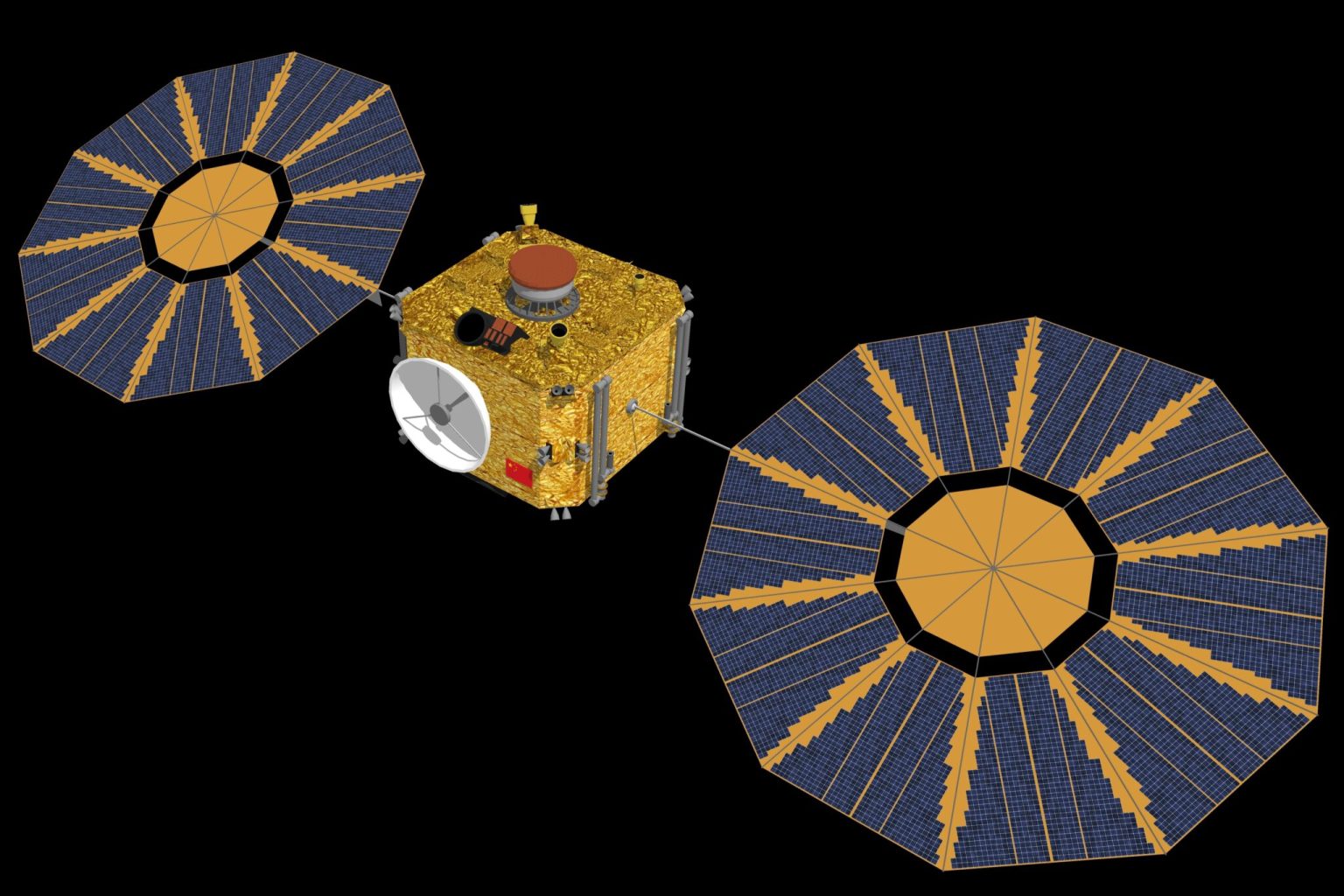
“Tianwen-2” is a spacecraft with an approximate mass of 2,100 kg. It comprises two sections: an orbital module and a capsule designed for returning asteroid samples to Earth. In addition to the capsule, the spacecraft is outfitted with a variety of instruments intended for remote observation of celestial bodies.
- An optical and infrared spectrometer may be employed to identify water and volatile compounds;
- a thermal emission spectrometer enables the determination of both the chemical composition and the physical characteristics of asteroid surfaces;
- a multispectral camera allows for visual examination of a surface at different wavelengths;
- the medium-angle camera enables the capturing of images with a resolution of 0.3 meters;
- a radar equipped with two data transmission channels enables us to observe beneath the asteroid’s surface to a depth of up to 35 meters;
- a magnetometer capable of detecting magnetic fields with a full range of ±65,000 nT, a dynamic range of 2,000 nT, and a resolution superior to 0.01 nT;
- an analyzer for charged and neutral particles, designed to accommodate ions with masses up to 150 atomic mass units and energies ranging from 5 eV to 30 keV, as well as electrons with energies spanning from 5 eV to 10 keV;
- an analyzer of volatile compounds and dust particles originating from the surface of the object under study. The device detects volatile compounds with atomic masses up to 150 and dust particles with masses ranging from 10⁻¹⁰ to 0.4 g.

Furthermore, the “Tianwen-2″ spacecraft will be capable of employing its autonomous navigation system for scientific research purposes. All of these instruments are powered by two fan-shaped solar panels, each with an area of 17 square meters.
To maneuver in space, Tianwen-2 employs a hybrid propulsion system comprising approximately 20 thrusters. Some are conventional chemical thrusters utilizing standard fuel, while others are electric thrusters, which produce considerably less thrust but operate with greater fuel efficiency. An onboard tank containing 237 liters of xenon serves as the power source for the electric thrusters.
Mission plan
The “Tianwen-2” spacecraft was launched into space on 28 May 2028 from the Xichang Space Center utilizing the “Long March 3B” launch vehicle. It marked China’s first mission intended to operate for a duration exceeding ten years. Nevertheless, it is evident that this will not be the final such mission. The name of the “Tianwen” program translates as “Questions to the Sky,” reflecting China’s ongoing inquiry into the cosmos.

However, China must first successfully complete its current mission. The spacecraft has been in flight for just over a year and, during that time, has completed one orbit around the Sun along with our planet and its quasi-satellite.
On July 7, the spacecraft ultimately achieved orbit around Kamoʻoalewa and has been progressively reducing its orbit while conducting comprehensive studies of the asteroid using all available instruments. The subsequent step involves sample collection; however, scientists have yet to determine which of the two proposed options will be utilized.
The primary inquiry pertains to whether Kamoʻoalewa’s surface is stable and solid or composed of loose material. In the former scenario, the spacecraft will execute a complete landing. Conversely, in the latter scenario, it will merely make brief contact, aiming to collect a sample during that fleeting moment.

Subsequently, the spacecraft will navigate several kilometers away to commence remote observation of the quasi-satellite. Researchers remain eager to determine whether it constitutes a fragment of the Moon.
The research will proceed until April 24, 2027. Subsequently, Tianwen-2 will activate its thrusters and navigate toward Earth. On November 29 of that year, at a distance of 23,000 km from our planet, the spacecraft will release a capsule containing samples, which will then descend onto the territory of the People’s Republic of China.
The spacecraft will employ a gravity assist maneuver around Earth to increase its velocity. Subsequently, it will proceed away from the Sun toward the primary asteroid belt. In early 2035, the spacecraft is scheduled to arrive at its second target — asteroid 311P/PANSTARRS — and is expected to enter its orbit for a duration of no less than three months to facilitate a comprehensive study.