

The most distant known fast radio burst occurred in a tiny dwarf galaxy with a very young stellar population. Such an environment is difficult to reconcile with the hypothesis that these bursts originate from neutron star mergers. Instead, it supports the case for magnetars, young objects with extraordinarily powerful magnetic fields. The galaxy could only be seen using the James Webb Space Telescope.
A Record Distance
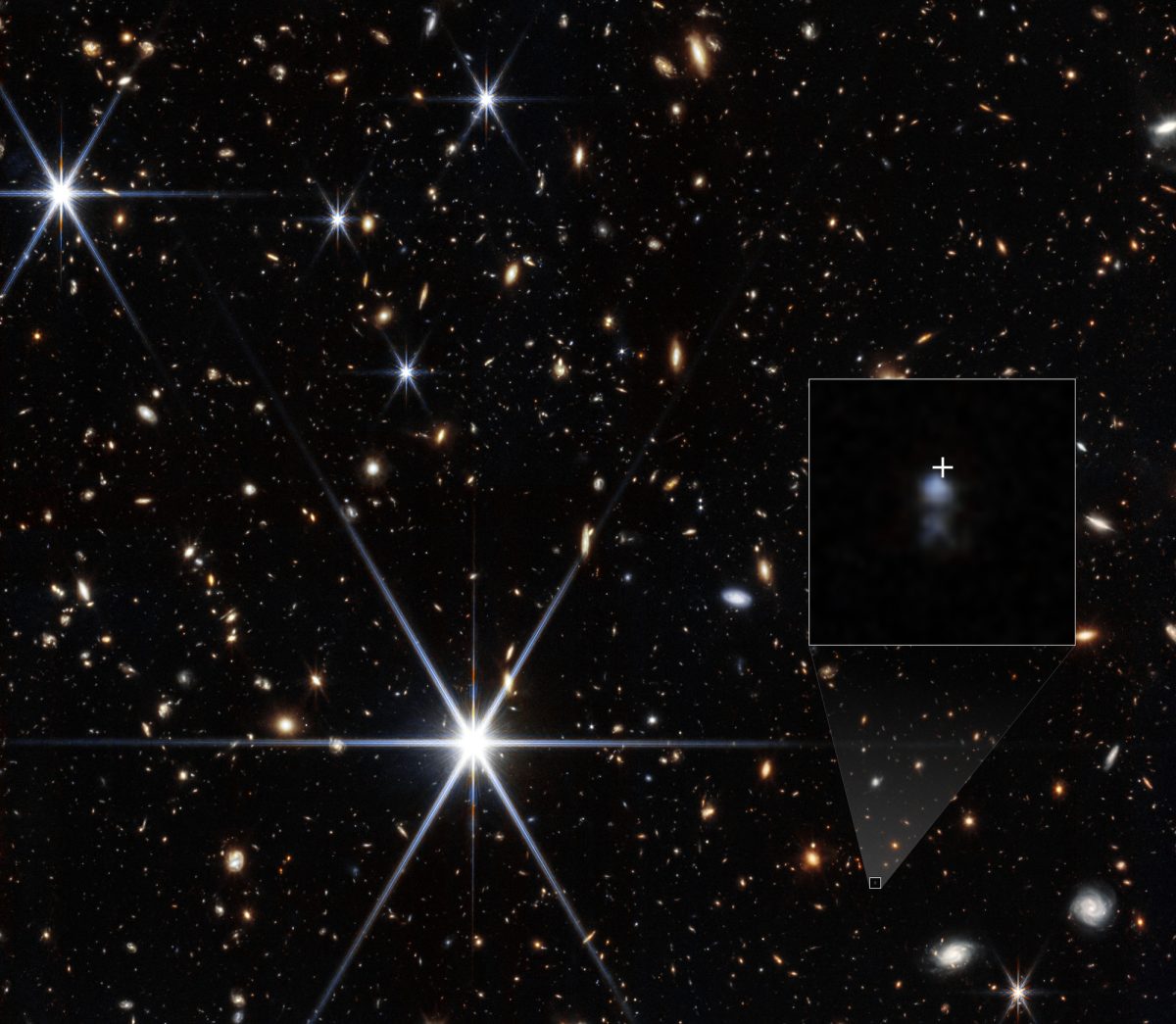
The burst was detected on March 4, 2024, by South Africa’s MeerKAT radio telescope as part of the MeerTRAP project. It was designated FRB 20240304B. The radio data indicated an enormous distance, but even the largest ground-based telescopes could not detect a galaxy at that location in the sky.
Astronomers then turned to James Webb. Images from its Near-Infrared Camera (NIRCam) revealed a faint galaxy at the precise location of the burst, while a spectrum from its Near-Infrared Spectrograph (NIRSpec) allowed researchers to determine its redshift. The value was 2.148, meaning the burst occurred just 3 billion years after the Big Bang, according to NASA.
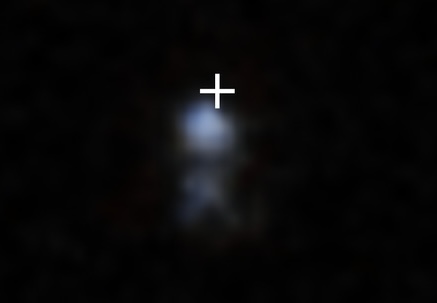
Because of the expansion of the Universe, this galaxy is now approximately 17.5 billion light-years from Earth. The distance in light-years exceeds the Universe’s age in years because the space between galaxies continued expanding throughout the radio waves’ journey toward us. For the same reason, the observable Universe has a radius of around 46 billion light-years, even though it is only 13.8 billion years old.
The radio waves from this burst took approximately 10.8 billion years to reach Earth. The previous record holder, FRB 20220610A, detected by Australia’s ASKAP radio telescope, had a redshift of around 1, and its signal traveled for approximately 8 billion years.
An Unexpected Galaxy
Most galaxies in which fast radio bursts had previously been detected are massive. This one turned out to be a dwarf, with a mass approximately a thousand times smaller than expected, although NASA does not provide an exact value. At the time of the burst, it was actively forming stars.
Judging by its star formation rate at the time, most of its stars formed in just 30 million years. The galaxy existed during the era known as cosmic noon, when star formation in the Universe reached its peak. According to study leader Manisha Caleb of the University of Sydney, the team expected a large, well-developed galaxy but instead found a tiny dwarf.
A Merger or a Magnetar?
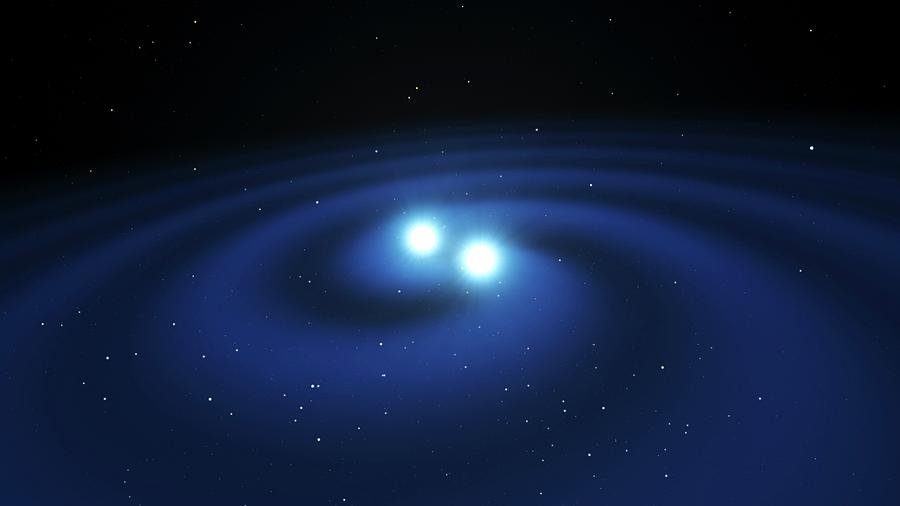
One hypothesis links fast radio bursts to the merger of two neutron stars. However, a pair of these stars takes billions of years to spiral together, so the bursts should occur mainly in old galaxies with mature stellar populations.
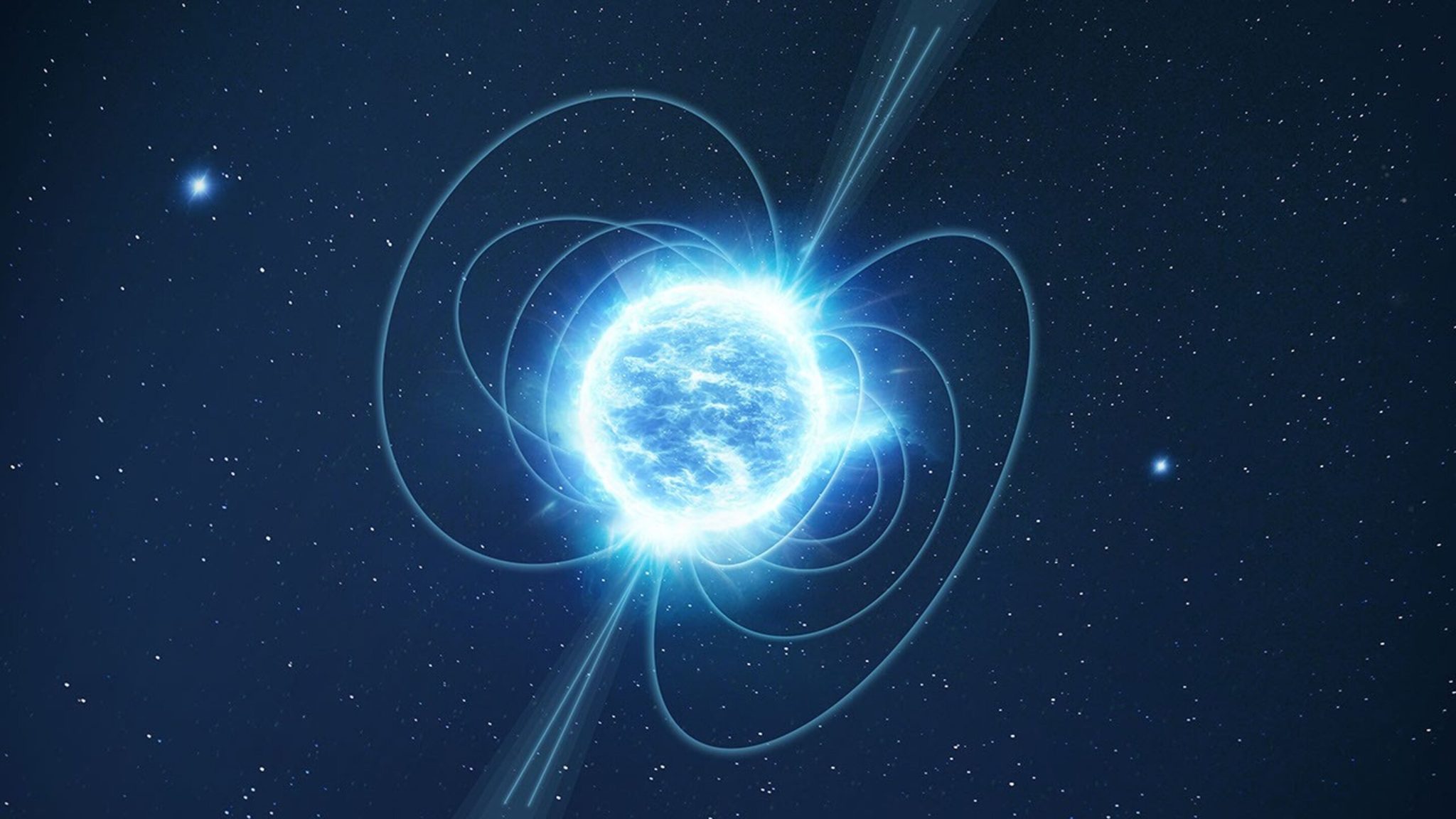
The second hypothesis points to magnetars. A magnetar is left behind after a massive star explodes as a supernova, so a burst triggered by a mechanism such as a starquake can occur almost immediately, even in a young galaxy.
Manisha Caleb considers it highly unlikely that this burst originated from the merger of two neutron stars. The results were published in the peer-reviewed journal Science. The case for magnetars is also supported by an event in 2020, when a similar radio burst was detected from magnetar SGR 1935+2154 in our own Galaxy.
The Imprint of the Cosmic Web
On its journey to Earth, the radio signal passes through the diffuse matter between galaxies and carries its imprint. Xavier Prochaska of the University of California, Santa Cruz, compares the burst to a flashlight illuminating the invisible cosmic web.

Traces of two structures were found in the signal from FRB 20240304B: a previously unknown galaxy cluster approximately 3.5 billion light-years away and the Virgo Cluster, located about 54 million light-years from Earth. The authors estimate that MeerKAT will make it possible to discover and precisely locate several similarly distant bursts each year. Their light began its journey toward us when the Universe was less than half its current age, and the galaxies from which it came will be studied using James Webb images.
