

Neptune possesses a ring system that was officially identified 37 years ago. However, the history concerning the existence of these rings extends significantly further and encompasses a mystery intricately linked to their characteristics
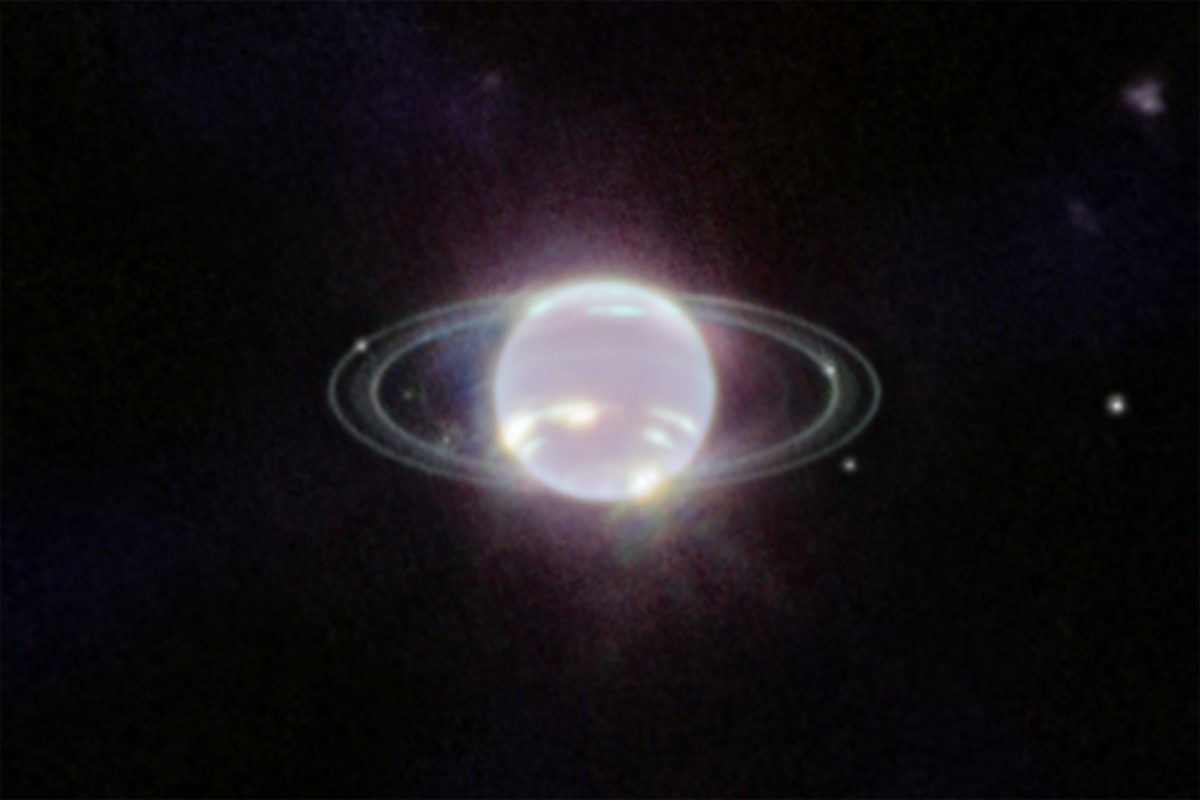
The discovery of Neptune’s rings
Neptune is recognized as the eighth planet from the Sun and is the most distant one in the Solar System. Its average distance from the Sun measures approximately 4.5 billion kilometers. Today we know that Neptune has a system of at least five major rings, but the first hints of their existence appeared almost immediately after the planet itself was discovered. William Lassell first reported their discovery in 1846, shortly after the planet itself was identified.
However, it soon became evident that this was simply a consequence of the limitations inherent in the telescope he employed. The rings were neglected for a period of one hundred years. Their potential existence was reconsidered in 1966, when astronomers observed a planetary occultation and observed that it transpired marginally earlier than anticipated.
The situation changed in 1977, when the rings of Uranus were discovered using the same method—observing stellar occultations. This forced astronomers to return to the old observations of Neptune and analyze them more carefully.
In 1984, astronomers resumed observations of the planet’s occultation of stars and made a noteworthy discovery: the eclipse was observed on one side of the planet, but not on the opposite side. This finding supported the hypothesis that Neptune is encircled by a system of open rings or arcs.
Scientists were unable to comprehend the mechanism behind this phenomenon; however, they were powerless to intervene, as the ground-based telescopes available at the time lacked the capability to observe the rings directly.
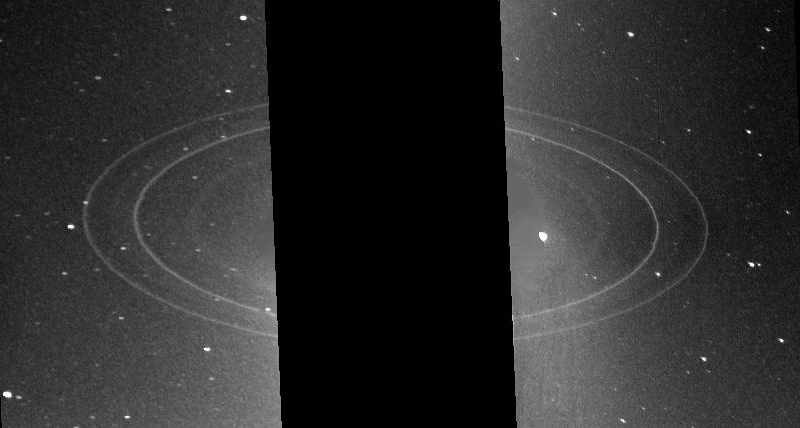
The situation was finally clarified by Voyager 2. On August 22, 1989, the spacecraft flew by Neptune and took the first direct photographs of its ring system, confirming its existence. The images showed that there were indeed several mostly closed rings around the planet, but in one of them, Adams, there were particularly bright and dense areas, which turned out to be the very ring arcs.
Structure of the rings
Scientists have long debated whether at least one of Neptune’s rings is actually open, as this would strongly contradict orbital mechanics. However, they ultimately concluded that the planet’s four moons, which orbit within the ring system, exert a significant influence on the structure of the rings.
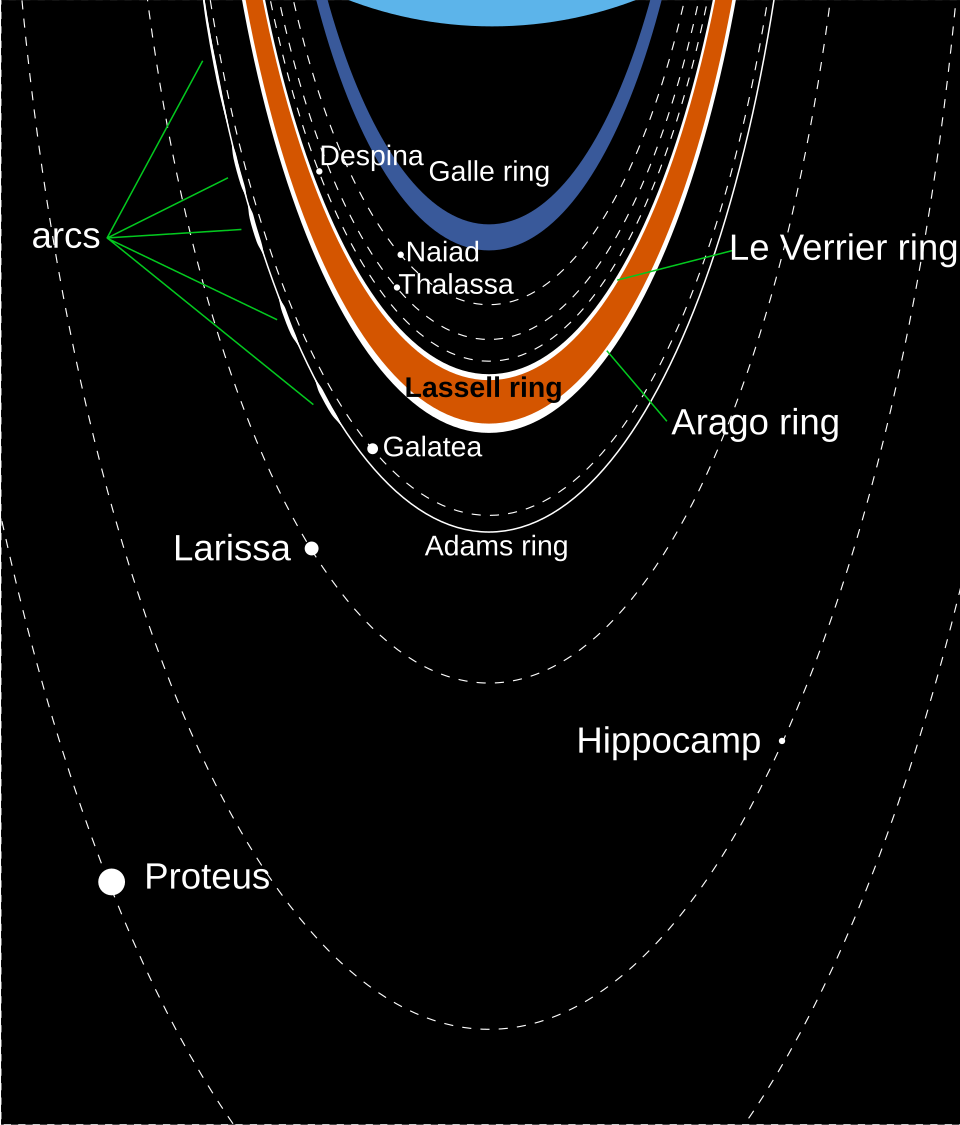
The Galle ring is situated nearest to Neptune’s surface. Its innermost boundary is positioned 41,900 km from the center of planet, with a width of approximately 2,000 km. Comprising primarily fine dust, it is exceedingly faint.
Subsequently, the narrow and luminous Le Verrier ring is introduced, measuring merely 110 km in width with an outer radius of 53,000 km. Within this ring, in closer proximity to its inner boundary, orbits the Despina moon. Despina exhibits an irregular shape, with an approximate diameter of 150 km. Additionally, two other moons, Naiad and Thalassa, are situated in the space between the Galle and Le Verrier rings.
Immediately beyond the Le Verrier ring lies the relatively sparse Lassell ring. Its width is approximately 4,000 km. At its outer edge begins the narrow and luminous Arago ring, which has a width of only 100 km.
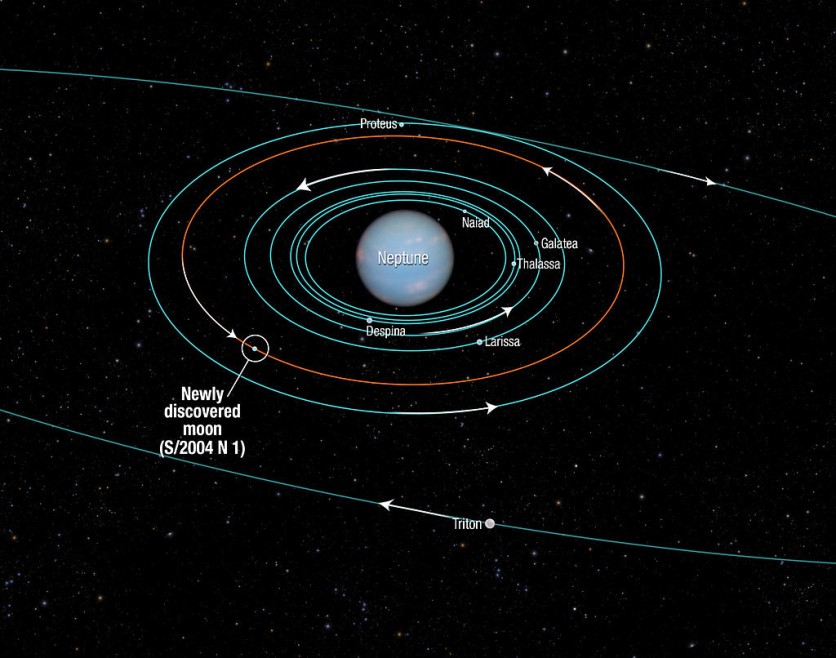
Subsequently, a gap is observed through which a secondary small satellite, Galatea, orbits. This is followed by the most notable object within the system — the Adams ring. The Adams ring is the subject of considerable debate among scientists, as it appears to comprise five distinct arcs. Initially, observations made it seem like they were separate, open rings, but Voyager 2 images showed that they were parts of a single ring. The material in these areas is distributed extremely unevenly, which makes the Adams ring unusual.
The mystery of the rings’ origin
One of the main mysteries of Neptune’s rings remains their origin. One of the main models suggests that the rings formed much later than the planet itself, from the debris of a moon or several small moons destroyed by powerful collisions.
However, in reality, this whole picture is with several separate rings, between which are located medium-sized moons. Different rings differ in structure and ratio of dust and larger particles, and ring arcs have an even more unusual composition and distribution of matter. In general, there are enough strange things in the Neptune system. In particular, some studies show that different rings were formed from different dust fractions and from different satellites.
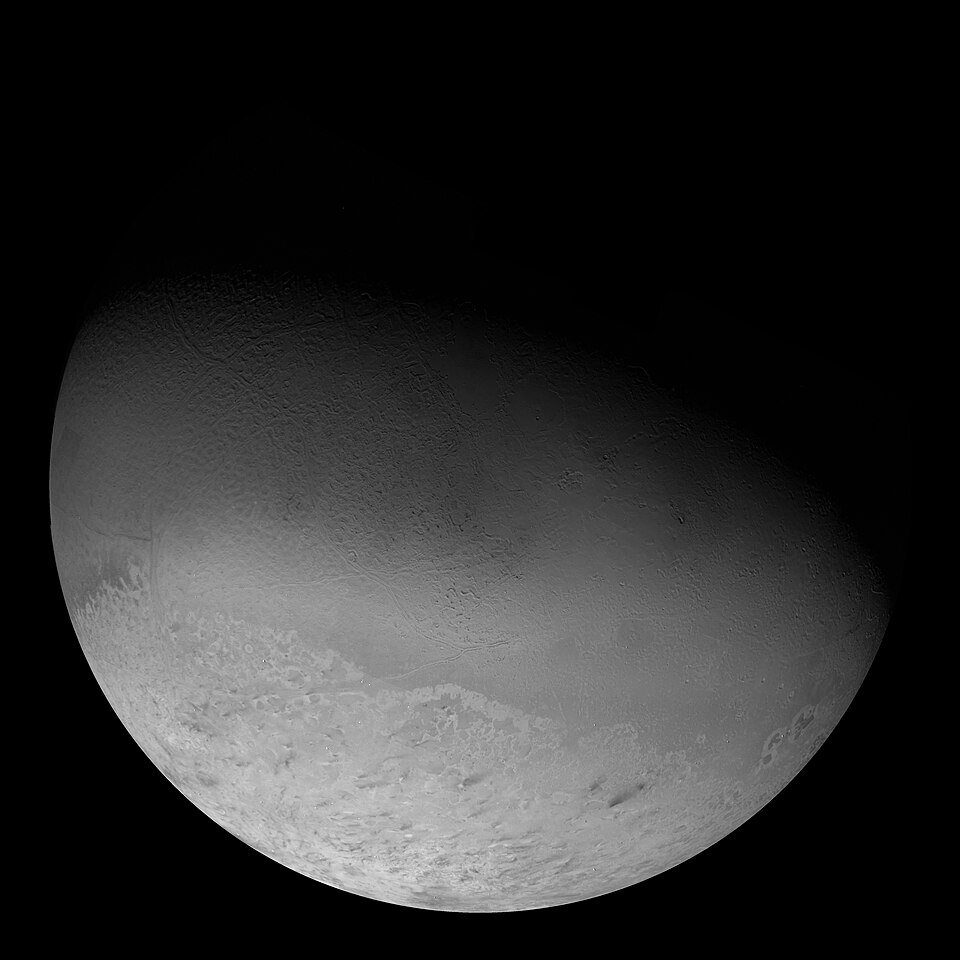
Among the satellites of Neptune there are no bodies comparable in size to the large satellites of other giant planets. The exception is the huge Triton, which, most likely, was once a Kuiper belt object captured by Neptune’s gravity. Its unusual retrograde orbit is one of the main arguments in favor of such a scenario.
And recent observations by the James Webb Space Telescope have added another very interesting detail to this story. In the spectra of the small moons Larissa and Galatea, as well as the rings, signs of magnesium phyllosilicates were found – clay minerals, which are the result of the intense interaction of silicate matter with liquid water. At the same time, no ordinary water ice was found on the satellites themselves.
This may mean that the modern rings and inner satellites of Neptune contain material from the bowels of much larger ancient bodies, in which water changes of minerals once occurred. One of the main hypotheses links their origin to the capture of Triton: its appearance could have destroyed the original satellite system, and the fragments later reassembled into the modern rings and small satellites.
Whether the capture of Triton was the main reason for the formation of the modern ring system has not yet been definitively established. Whether this is true or not – scientists will have to find out.
