

An international team of researchers from the University of Ottawa (Canada) and the Max Planck Institute for the Science of Light (Germany) has taken an important experimental step in the field of quantum physics. Scientists succeeded in using ordinary sunlight to generate pairs of entangled photons. The results of the study, published in the journal Optica, demonstrate the potential possibility of creating more energy-efficient quantum infrastructure without the mandatory use of powerful laser systems.
Challenging a Long-Standing Assumption
Entangled photons are pairs of light particles with correlated quantum states. Measuring the parameters of one of them immediately provides information about the state of the other, regardless of the distance between them. This property forms the basis of quantum encryption, quantum computing, and secure data transmission.
Quantum pairs are usually produced using a process known as spontaneous parametric down-conversion: a laser beam is passed through a special crystal. Physicists have traditionally preferred lasers because they emit coherent light with a stable phase and within a narrow range of wavelengths.
Unlike lasers, sunlight is completely incoherent: it consists of many different wavelengths and propagates in many directions. For a long time, it was considered unsuitable for creating quantum entanglement. However, previous theoretical calculations and tests with LEDs suggested that this might be possible if the quantum property does not depend on the wavelength or direction of the light.
An Open-Air Laboratory
To test the hypothesis in practice, the scientists created a special optical system. Sunlight was focused using a window-sized Fresnel lens and directed through a glass cone-shaped concentrator into a thin optical fiber, and then into a crystal.
The experiment lasted for three days outdoors. The resulting photon pairs achieved about 94% fidelity with an ideally entangled state. The scientists also recorded a violation of Bell’s inequality, conclusively confirming the quantum nature of the observed correlations, which cannot be explained by the laws of classical physics.
Although the quality of the entanglement was somewhat lower than that achieved with laser-based systems because of optical distortions and changing cloud cover, the researchers described the results as a successful “proof of principle.”
The Future of Satellite Quantum Communications
At present, the technology is still at an early stage and is not intended to completely replace lasers in high-precision laboratories. However, the direct use of sunlight offers significant advantages.
Traditional laser systems require substantial amounts of electricity, continuous cooling, and stabilization, while losing most of their energy as heat. Switching to solar energy would make it possible to bypass the stage of converting electricity into an optical beam.
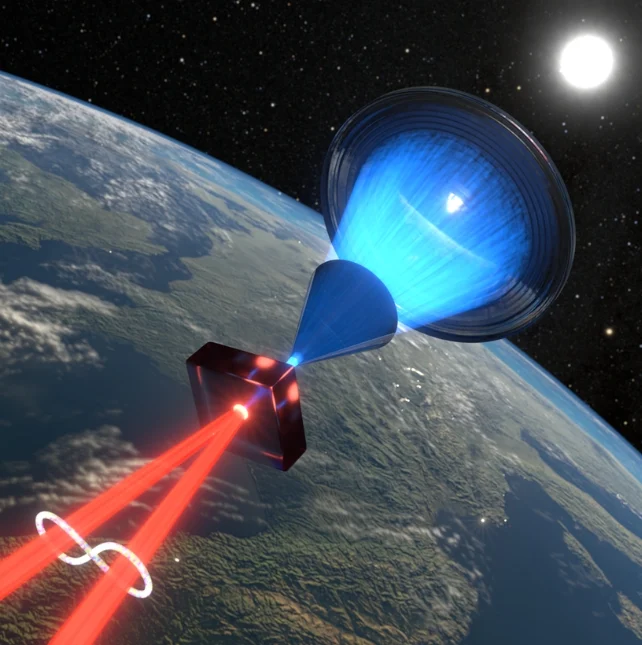
In the future, similar compact sources could operate in remote regions of Earth or aboard spacecraft. Once in orbit, quantum satellites could directly use solar radiation to generate and distribute secure quantum encryption keys across the planet.
Previously, we reported on the possibility of quantum communications over interstellar distances.
According to Science Alert
