

A special class of supernovae is characterized by anomalous brightness as the shock wave after the explosion interacts with a dense shell of gas surrounding the star. A new study using simulations has shown that such a cocoon can form during the exchange of matter between components of a binary star system shortly before the explosion.
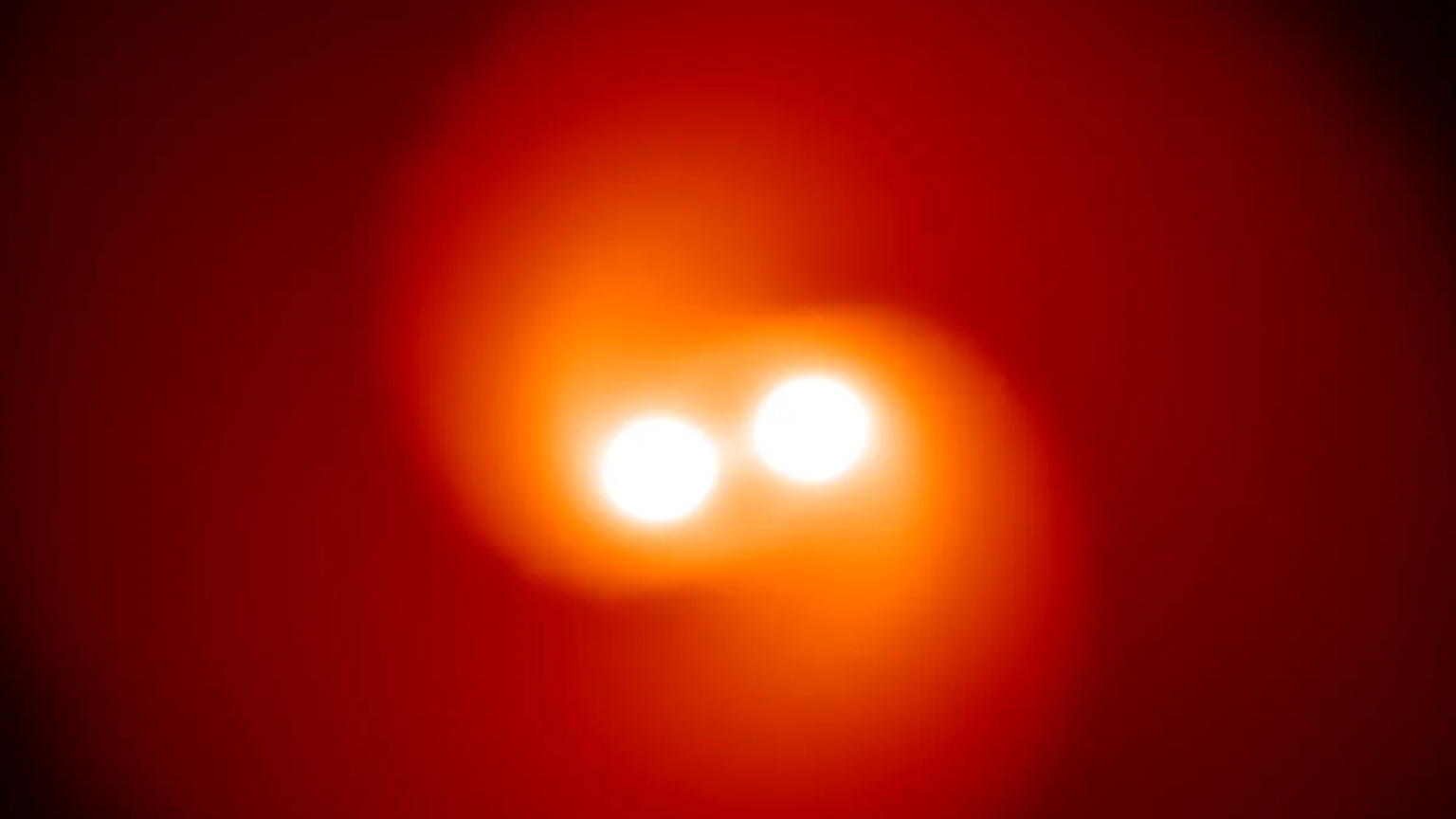
The Mystery of Bright Explosions
When a massive star runs out of fusion fuel, its core collapses under its own gravity. In many cases, the outer layers of the star are ejected in a supernova explosion, leaving behind a neutron star or black hole.
In the case of interacting supernovae, the blast wave additionally collides with matter that was previously ejected into the vicinity of the system. The kinetic energy of the collision is converted into radiation, and the flash becomes much brighter. The origin of this gas-dust shell remained unclear for decades.
Roche Lobe Overflow
Most massive stars exist in binary systems bound by gravity. In the late stages of evolution, one of the partners turns into a red giant and can expand hundreds or even thousands of times compared with its original size.
If such a star fills its Roche cavity, that is, the gravitational region where its gravity prevails over that of its partner, matter from the surface begins to flow through the inner Lagrangian point to the companion star. The partner is able to capture only a part of this flow. The rest of the matter leaves the system or accumulates around both stars, forming a dense circumstellar gas shell. It is such a cocoon, according to the results of the new simulation, that can become a source of anomalously bright radiation during a supernova explosion.
A Question of Timing
A group of researchers from the Academia Sinica Institute of Astronomy and Astrophysics (ASIAA) conducted hundreds of computer simulations of mass transfer in binary systems, Space.com reports. It turned out that the timing of the start of this process is critical for the emergence of an interacting supernova.
If the transfer of material occurs too early, millions of years before the final collapse, the cocoon has time to disperse into the surrounding space. For the shell to remain dense enough to collide with the shock wave, the exchange must begin only a few thousand years before the supernova explosion.
The Decisive Role of the Companion
According to the simulations, it is the presence of the second object in the system that determines both the course of stellar evolution and the nature of the final explosion. The work was published on June 30 in the peer-reviewed journal The Astrophysical Journal Letters.
By comparison, a single massive star can lose a significant part of its envelope through stellar wind, but this process stretches over millions of years and does not create a dense nearby cocoon. It is the gravitational interaction with a companion that compresses the ejected material into a compact structure, which then becomes the “target” for the supernova shock front. The modeling numerically demonstrated a direct link between the timing of mass transfer in a pair of stars and the formation of an interacting supernova.
