

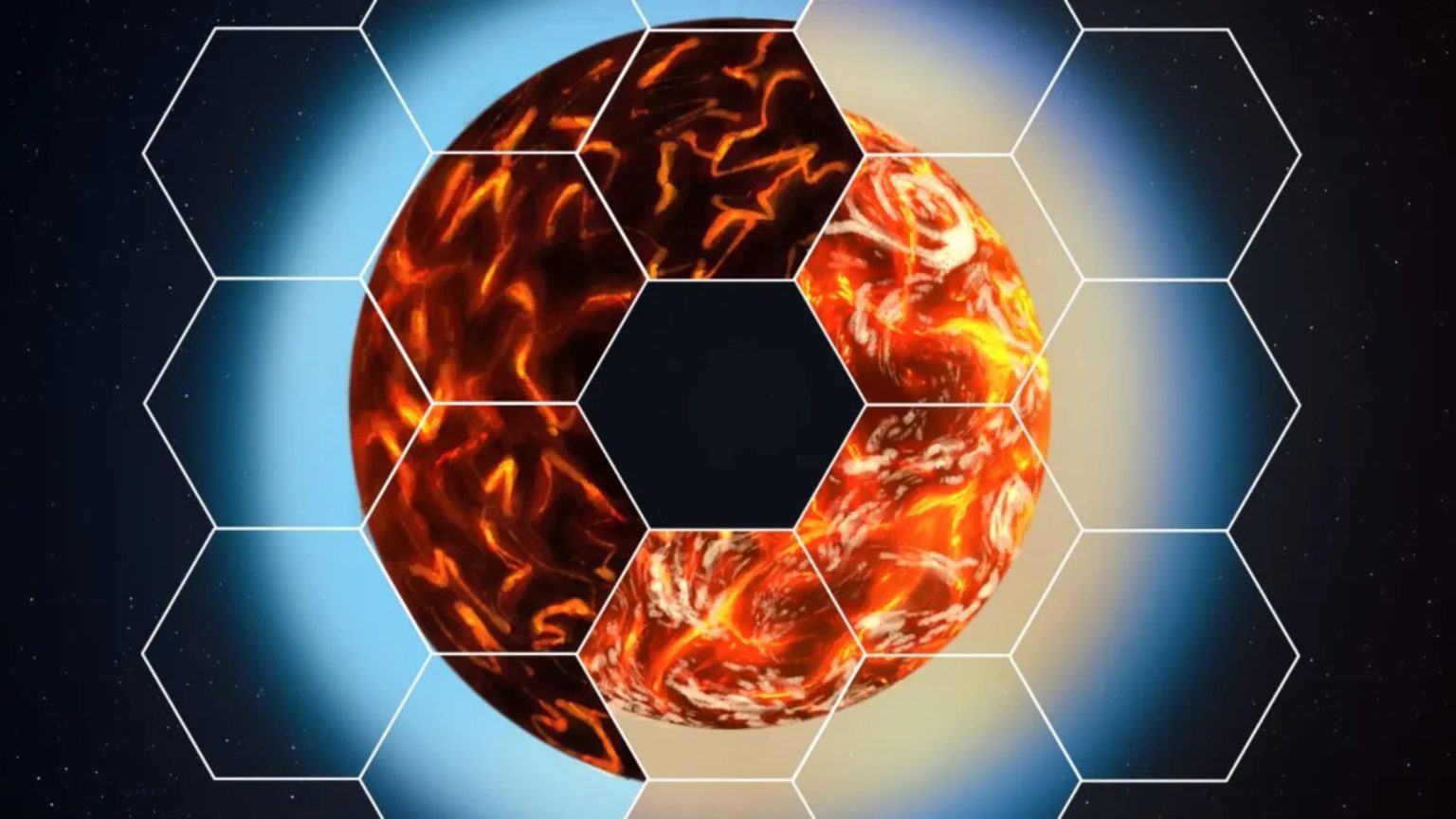
Clouds made of vaporized rock can act as a powerful thermal barrier. They heat the surfaces of exoplanets to temperatures at which solid ground turns into an ocean of magma. Scientists reached this conclusion while modeling the atmospheres of sub-Neptunes. These are among the most common types of planets in the galaxy, although none exist in the Solar System.
Clouds cover the planet like a blanket
Sub-Neptunes occupy an intermediate size range between Earth and Neptune. They are thought to consist of a rocky core surrounded by a deep atmosphere, but the exact chemical composition of these layers has remained unknown. Neither ground-based telescopes nor James Webb have yet provided a definitive answer.
A group led by Sagnik Mukherjee of Arizona State University modeled the behavior of mineral clouds in the deep atmospheric layers of such worlds. Under enormous pressures and temperatures near the boundary between the atmosphere and the solid, rocks partially evaporate, forming mineral clouds that may include aluminum oxide, iron, magnesium silicate, manganese sulfide, potassium chloride, sodium sulfide, and zinc sulfide into vapor. Clouds formed from these compounds act as an effective insulating layer, trapping the core’s heat inside the planet, space.com reports.
Superheated air and magma instead of a surface
The effect turned out to be much stronger than previously assumed. According to Mukherjee’s calculations, heating caused by the cloud layer raises the temperature at the boundary between the atmosphere and the solid surface by about 1,400–2,600 degrees Celsius. At the same time, the upper layers of the atmosphere cool noticeably, and almost no heat escapes outward.
Matthew Nixon of Arizona State University commented on the consequences of this heating. “For some of the planets we modeled, this additional heat is enough to melt the surface and create a magma ocean,” he said.
An unexpected outcome for a candidate water world
One such candidate is GJ 1214b, which orbits a red dwarf 48 light-years away. It was previously considered a water world, but James Webb data from 2025 detected metallic vapor and a carbon dioxide haze in its atmosphere. This has significantly weakened the hypothesis of a global ocean of liquid water. New work suggests that an ocean of molten magma may be hidden beneath the dense atmosphere.
The presence of a magma ocean changes the chemistry of the entire atmosphere. Oxygen, silicon hydride, and silicon monoxide seep upward from the magma. In the opposite direction, the molten layer absorbs ammonia, methane, and water vapor. Because of this exchange, the composition of the atmosphere detected by telescopes may differ substantially from the planet’s true chemical composition, complicating the interpretation of James Webb observations.
In addition, the excess heat prevents the atmosphere from contracting over billions of years, so the planet remains “inflated.” If the modeling results are confirmed, this would call into question the idea that sub-Neptunes could be potentially habitable.
Even when the temperature at the surface boundary is not high enough to form magma, it still remains too high for liquid water to exist. The study’s results were published on July 8 in Astrophysical Journal Letters.
