

Three NASA helicopters will fly to Mars without a separate landing platform. After slowing down with a parachute and rockets, the three vehicles will separate from the descent stage and land on the surface independently. The SkyFall mission will search for subsurface ice at depths ranging from half a meter to three meters, and its radar antenna has just undergone a series of tests at NASA’s Jet Propulsion Laboratory.
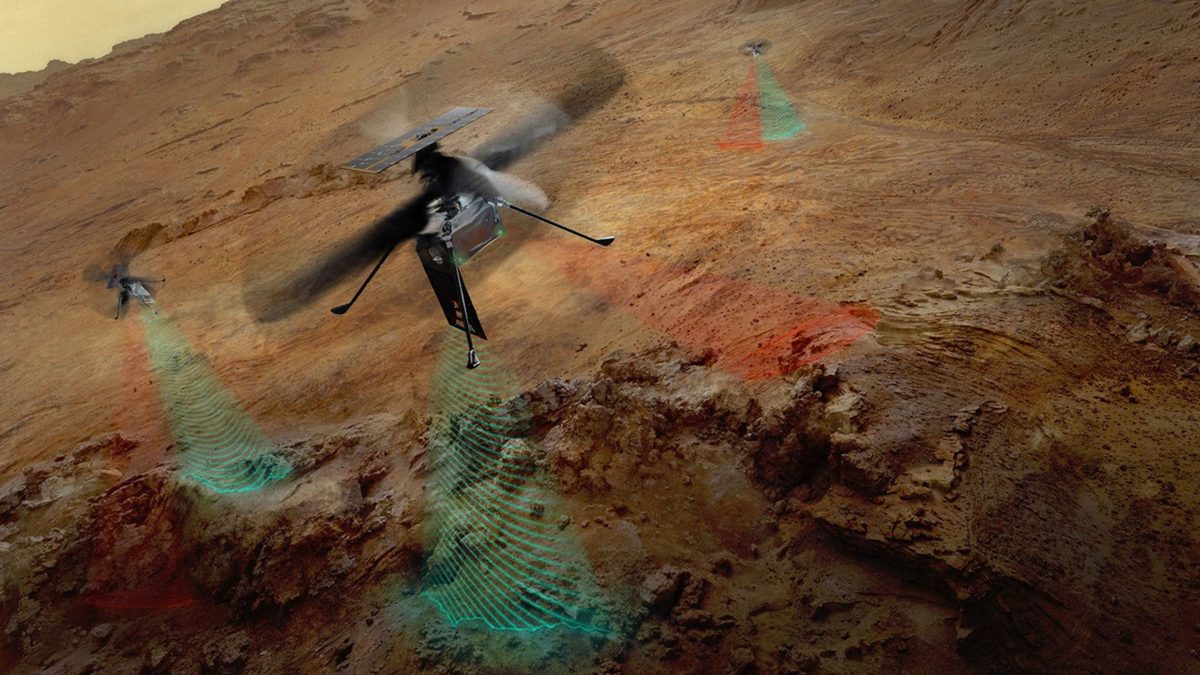
Three vehicles without a rover intermediary
The SkyFall mission consists of three helicopters, one larger and two smaller. Each carries four scientific instruments, including visible- and near-infrared cameras, radar, temperature sensors, and a radiation monitor. The vehicles will be able to transmit data directly to orbiters, unlike Ingenuity, which required the Perseverance rover as a relay.
This is much faster than using rovers and provides more detail than orbital imagery. The launch is scheduled for late 2028 aboard the Space Reactor-1 Freedom spacecraft, NASA reports. It will be the first interplanetary mission with a nuclear electric propulsion system. Arrival at Mars is expected in the fall of 2030. Before that, the spacecraft will make its first flyby of the planet in 2029, with the landing taking place after the second approach.
The SkyFall mission will use three helicopters to map subsurface ice and search for sites for future landings. Credit: NASA/JPL-Caltech
A flexible antenna instead of a rigid one
SkyFall’s radar operates across an ultra-wide frequency range from 500 to 2,500 megahertz. Longer wavelengths can penetrate to depths of several meters, while shorter ones provide a more detailed picture of the upper layers. Satellites in orbit can detect large deposits of ice tens of meters below the surface, but they cannot see what lies closer to the surface.
Future crews need precisely this accessible ice, which can be used to produce water, oxygen, and fuel for the journey home. According to principal scientist Adrian Tang of the Jet Propulsion Laboratory, the only way to remotely locate such deposits is to fly close to the surface.
A conventional antenna for this frequency range would be about 48 centimeters long and would require open space beneath the vehicle. However, the helicopter has a ground clearance of only 15 centimeters. The team chose a Vivaldi antenna, a flat design with curved elements that can be made from metallized fabric. Its key feature is its flexibility: during landing, it bends so that it does not strike the ground, and after takeoff, it returns to its original position for operation.
Engineer Christine Gebara explains that even after being reduced in size, the antenna is about one and a half times longer than the helicopter’s landing legs. Therefore, it bends during landing and returns to its original shape after takeoff. Because SkyFall will make dozens of flights, the antenna must withstand these cycles without losing its shape. It was made even smaller because dry Martian regolith blocks radio waves far less than soil on Earth.
Endurance testing
At the Jet Propulsion Laboratory, the prototype was bent and twisted to simulate different positions after landing. The antenna was placed in a thermal chamber with temperature fluctuations similar to those on Mars, and each time its ability to transmit and receive signals was tested. The structure was also turned upside down and subjected to loads far greater than Martian gravity.
The results showed that the antenna can withstand 200 landings, twice as many as required for a successful primary mission. Its signal performance did not deteriorate. Tang described the tests as an important milestone, although more work remains before the antenna receives full flight certification.
The team is now building an engineering model for vibration testing and tests in a simulated Martian environment, including at the Mars Yard.
