

The supernova of 1181 is one of the few in our Galaxy to have been directly observed by humans. Its remnant, known as Pa 30, has a unique structure that makes it resemble a firework. Scientists recently discovered that its filaments are chains of individual clumps of gas.
The Historical Supernova SN 1181 Recorded in Ancient Texts
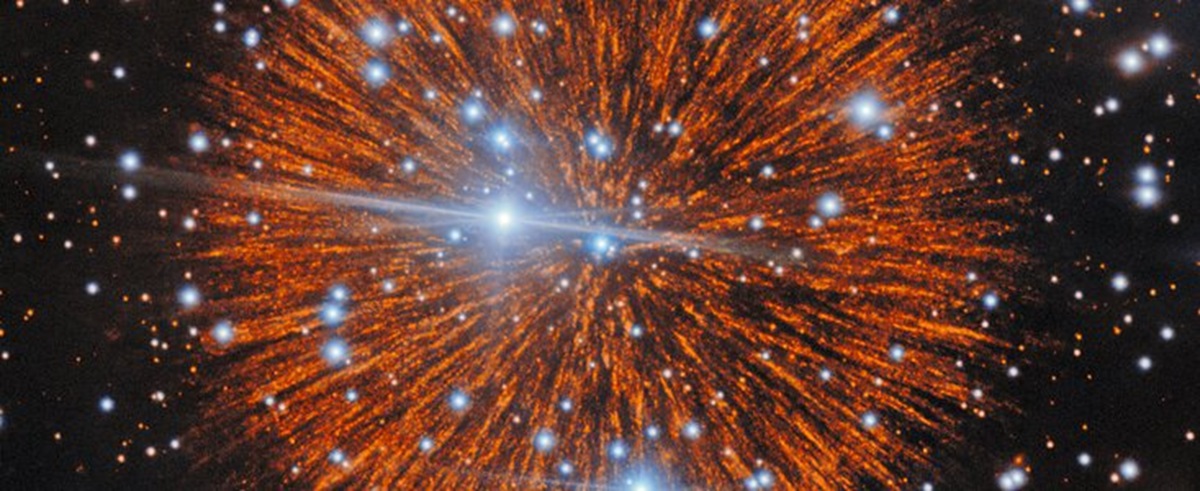
No, the image does not show a firework. This is Pa 30—the probable remnant of the historical supernova observed in 1181, now captured in unprecedented detail by the Gemini North telescope. The telescope is part of the International Gemini Observatory, which is funded in part by the U.S. National Science Foundation (NSF) and operated by NSF NOIRLab. Taken with the Gemini Multi-Object Spectrograph (GMOS), the image reveals that the remnant’s distinctive firework-like ejecta have a cascading, knotted structure, according to noirlab.edu.
The historical supernova, designated SN 1181, is one of only five supernovae in the Milky Way observed from Earth before the invention of the telescope. Eight separate texts indicate that Chinese, Japanese, and Arab astronomers first observed it between August 4 and 6, 1181. The supernova remained visible in the constellation Cassiopeia for 185 days. Based on what we know about how stars end their lives, this colossal explosion should have left something behind. Pa 30—a system consisting of a central blue star surrounded by ejected shells resembling a firework—is the leading candidate for the remnant of this supernova.
The Discovery of the Planetary Nebula Pa 30 and a Detailed Study of Its Structure
Pa 30 was discovered only in 2013, as part of a citizen science campaign to search for planetary nebulae in data from the Wide-field Infrared Survey Explorer (WISE) satellite. It was the 30th nebula identified by American amateur astronomer Dana Patchick. Follow-up observations with the KPNO 2.1-meter telescope and the 2.4-meter Hiltner telescope—both located at NSF’s Kitt Peak National Observatory, a program of NSF NOIRLab—revealed faint, diffuse emission from the nebula and striking radial filaments extending through it to form an almost perfect sphere. Based on its estimated age and brightness, scientists consider Pa 30 the probable remnant of SN 1181.
An analysis of the new Gemini North observations, led by Timothy Cunningham and Ilaria Caiazzo, revealed approximately ten times as many filamentary structures in Pa 30 as had previously been observed. It also shows that the radial filaments consist of continuous chains of tiny knots of gas, rather than the smooth streaks previously assumed. This knotted structure suggests that fluctuations in temperature or density may have occurred in the circumstellar environment, shaping the supernova ejecta as they expanded radially from the explosion site.
A Unique Type Iax Supernova Remnant
Pa 30 is unique among all known supernova remnants. Its surviving central star, IRAS 00500+6713, is extraordinarily hot, with a temperature of approximately 200,000 °C (~360,000 °F). It also produces extremely fast stellar winds, traveling at around 16,000 kilometers per second (~10,000 miles per second).
Stars that survive a supernova are expected to be “kicked” away during the powerful explosion. However, Pa 30’s central star appears to lie almost exactly at the center of the remnant. This intriguing configuration suggests that the explosion was relatively symmetrical and rules out a strong kick that could have displaced the star from the center. On this basis, researchers conclude that SN 1181 was an exceptionally rare Type Iax supernova. Unlike standard, high-energy Type Ia supernova explosions, which completely destroy their stars, Type Iax supernovae are lower-energy explosions that fall short of total destruction and leave a surviving stellar remnant. Pa 30 is the only known Type Iax remnant in the Milky Way.
The story of SN 1181 is one of people joining forces across time and space to understand the changing Universe. While new astronomical questions arise every day, SN 1181 invites us to reflect on which mysteries of the distant past remain unsolved.