

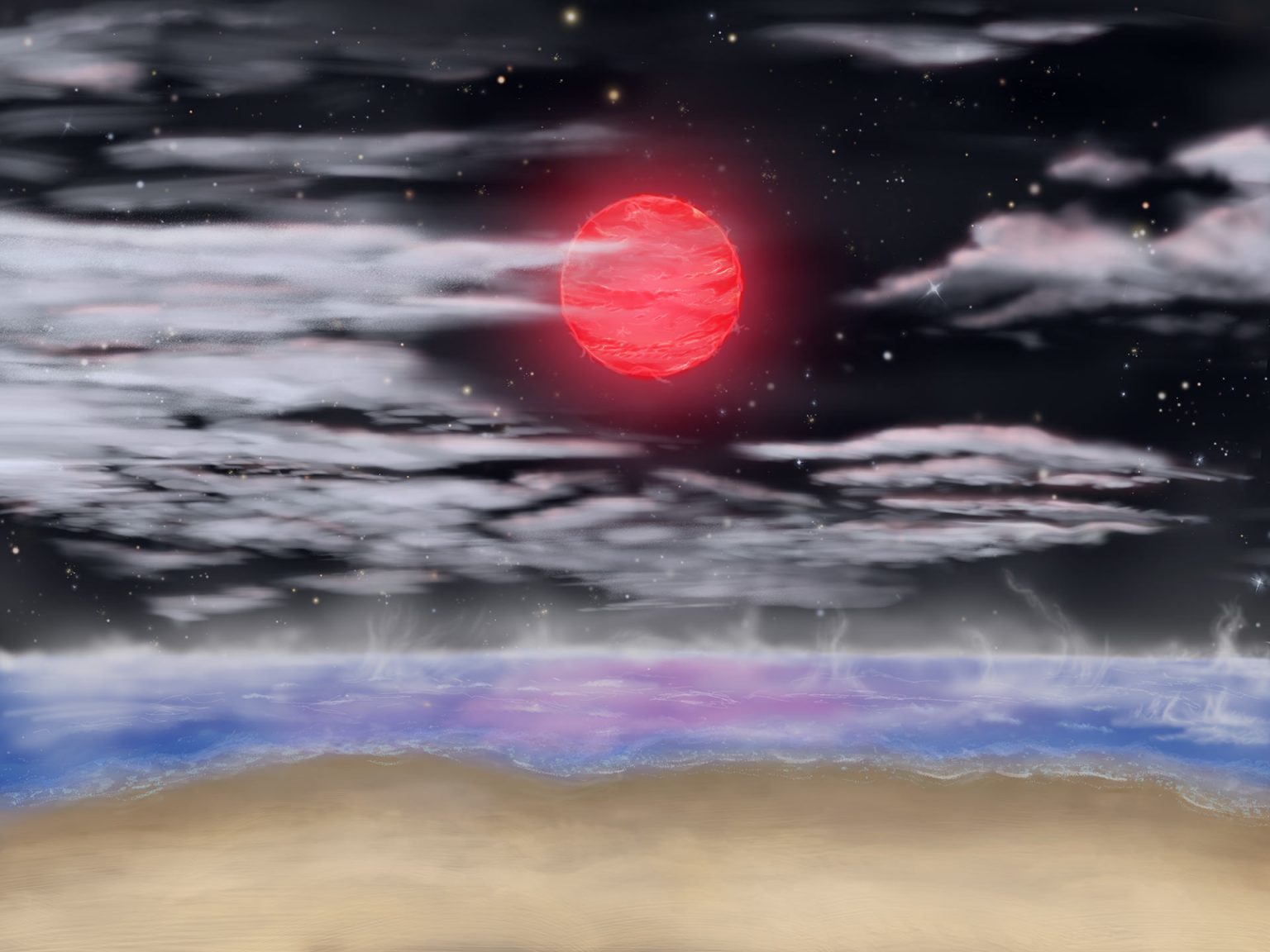
The planet Gliese 3378 orbits a red dwarf star. It is situated at a distance from its star where water on its surface is expected to exist in liquid form. This potential habitability renders it a subject of scientific interest.
A new super-Earth
A consortium of American astronomers has announced the discovery of a new super-Earth located merely 25 light-years from Earth. Its most significant characteristic is its position within the star’s so-called “habitable zone,” suggesting the potential existence of liquid water. This revelation was communicated through the website www.sci.news.
The planet orbits Gliese 3378. It is one of the numerous red dwarf stars in the Sun’s vicinity. This diminutive star, possessing a luminosity that is merely a few percent of the Sun’s, was identified as early as the 20th century and subsequently included in the Gliese Catalogue of Nearby Stars. These stars are most frequently examined to ascertain the presence of orbiting planets.
Regarding Gliese 3378b, the planet is approximately 2.3 times the mass of Earth and completes a single orbit around its star within 21.45 days. While this may appear modest, it is crucial to consider that the star itself is significantly dimmer than the Sun; consequently, this planet receives merely 90% of the stellar radiation that Earth receives.
The enigma surrounding the atmosphere of a planet
Gliese 3378b was identified via observational data collected using the Habitable-zone Planet Finder instrument on the Hobby-Eberly Telescope at the McDonald Observatory in Texas, as well as the NEID spectrometer on the WIYN Telescope at the Kitt Peak National Observatory in Arizona.
They enabled the identification of the fundamental characteristics of the planet; however, in 2026, the discovery of an Earth-like planet within the “habitable zone’ does not constitute a significant breakthrough in and of itself. A more pertinent question concerns planets possessing atmospheres. There remains ongoing debate regarding the capacity of red dwarfs to effectively strip away the atmospheres and hydrospheres of Earth-like planets.
This is why many individuals assert that, despite the existence of numerous such planets within the Galaxy, this does not augment the probability of discovering a planet conducive to life. However, Gliese 3378b resides on what is termed the “shelf.” The interplay of the star’s luminosity, the planet’s orbital distance, and its mass establishes conditions whereby a sufficiently dense atmosphere can endure the star’s flares.
All that remains is to determine whether this is indeed the case, and Gliese 3378b stands as one of the most suitable candidates for this investigation. However, the main uncertainty remains unchanged: it is not known whether GJ 3378 b has an atmosphere.