

Chinese astronomers working with the FAST radio telescope have reported on their study of the binary pulsar PSR J1856−0039. Among similar systems, it is the lightest and has the second-shortest orbital period. Scientists say that in 82 million years, the two components are expected to merge into one.
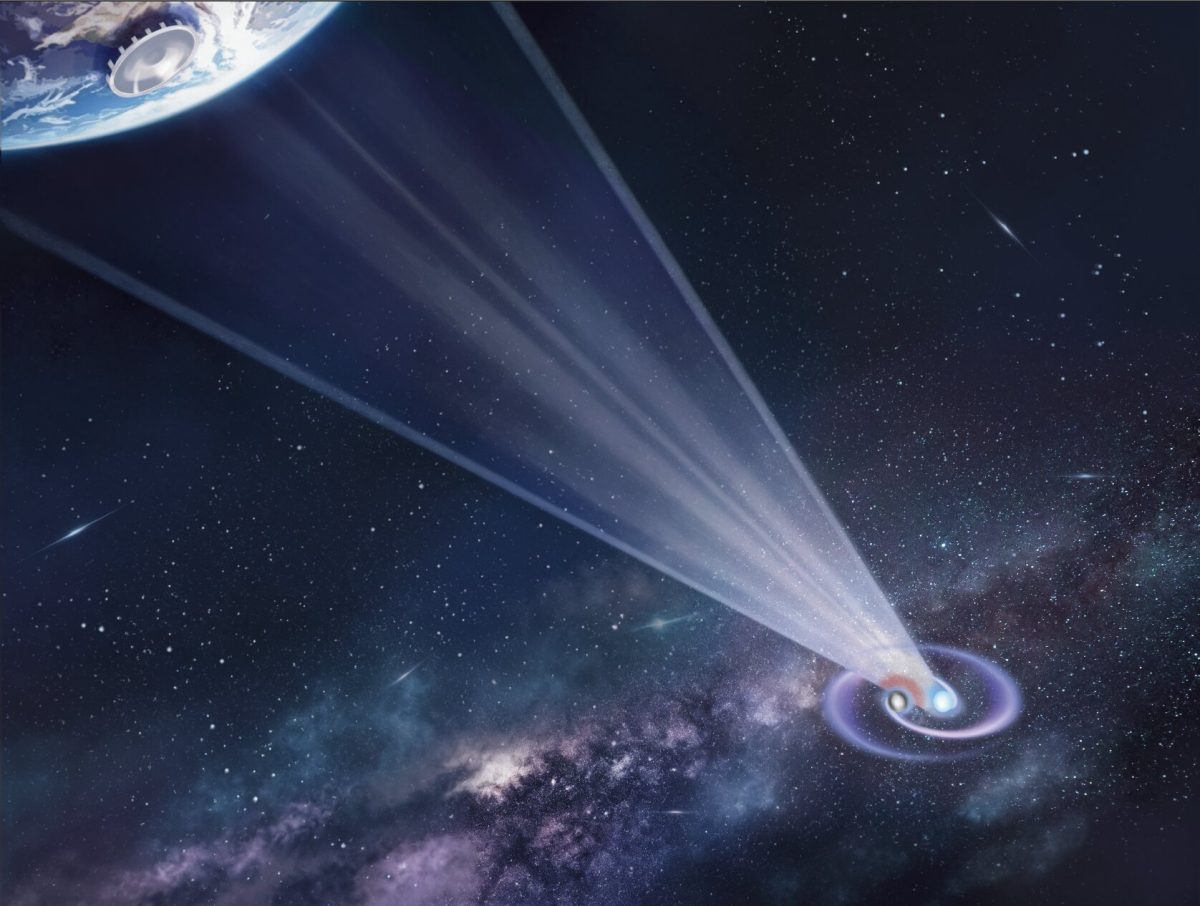
Binary Pulsar PSR J1856−0039
Astronomers from the Chinese Academy of Sciences report that they have studied the lightest known pair of neutron stars. They were able to precisely determine the masses of the components, as well as establish that they will eventually merge into a single object. According to phys.org, a paper presenting the results of this research was published in Physical Review Letters.
In general, neutron stars orbiting another object and emitting short-period radio signals due to interaction with its matter are not particularly rare in space. But binary pulsars, in which both objects in the pair are the final products of the evolution of massive stars, are far less common.
The pulsar PSR J1856−0039 itself was discovered by Chinese astronomers using the FAST radio telescope back in 2020, and they have been observing it ever since. It was already known that the combined mass of the two neutron stars is 2.49 times the mass of the Sun, making it the lightest among all similar systems. It is also known that this pair has an extremely short orbital period, making it an ideal candidate for testing the validity of certain theories.
What the New Research Showed
Thanks to its unique size, the FAST radio telescope has an extremely low signal-to-noise detection threshold. This is precisely what makes it one of the best instruments for studying distant neutron stars.
Using this instrument, scientists were able to determine the mass of each component of the PSR J1856−0039 system and its orbital period. The latter turned out to be 2.36 hours, making it the second-shortest known orbital period among pulsars. To understand how unusual this system is, imagine two stars similar to the Sun compressed to the size of Earth and forced to orbit each other in a period ten times shorter than the time it takes our planet to rotate once around its own axis.
The main conclusion from the observations confirmed the primary hypothesis. The two neutron stars of PSR J1856−0039 are indeed moving closer together and will merge into a single object in approximately 82 million years. What that object will be is an interesting question that physics cannot answer unambiguously.
In theory, it should still be a massive neutron star. However, if it practically stops rotating, centrifugal forces will no longer be able to counteract gravity, and the star could collapse into a black hole. In that case, it would be the smallest known object of its kind.