

One of the molecules that most readily reacts with other substances in space has been reliably detected near a star in a late stage of evolution. The object around which it was found is located in a neighboring galaxy, and the observations were carried out with the James Webb Space Telescope. The amount of methyl there turned out to be significantly higher than models predict. The authors explain the excess by the gradual destruction of dust particles, from which the molecule enters the gas.
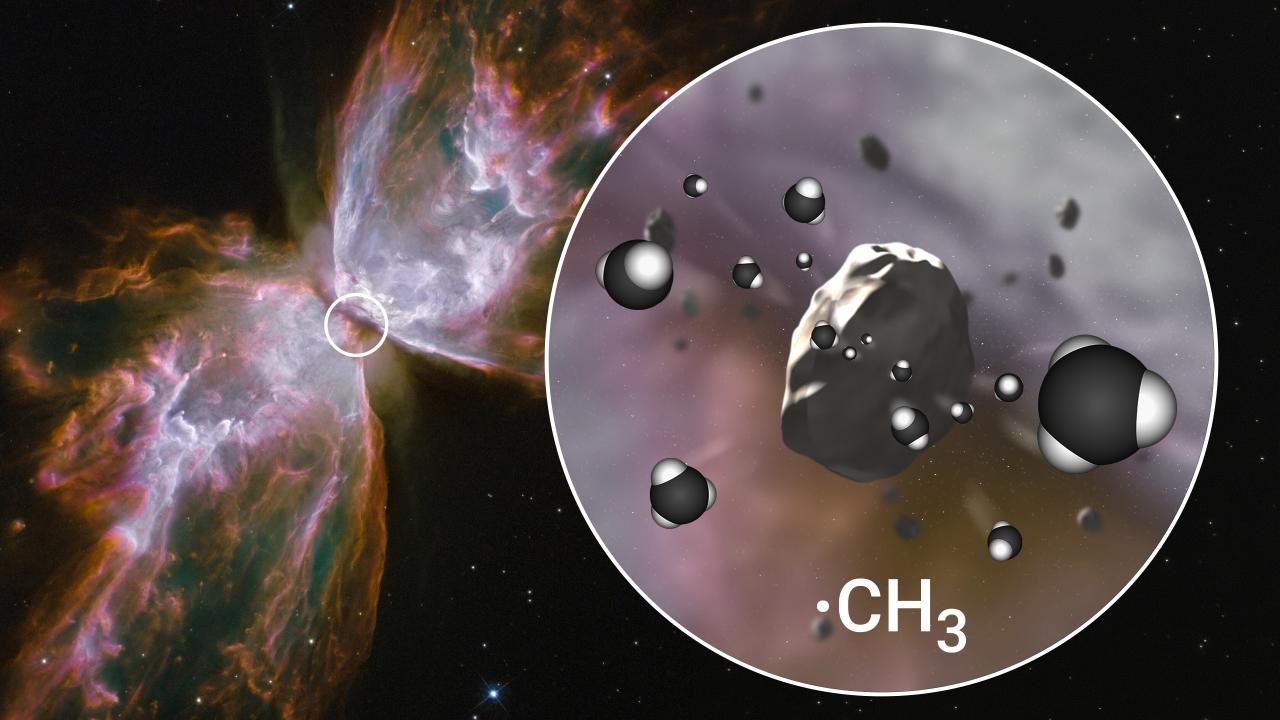
Unexpected Excess of Methyl
Methyl CH₃ is a monovalent radical of methane, that is, a methane molecule missing one hydrogen atom. One of its electrons remains unpaired, so the molecule readily combines with almost any nearby substance. Because of this, the radical exists only for a very short time.
The molecule was detected near the object SMP LMC 011 in the Large Magellanic Cloud. A team led by postdoctoral researcher Jialu Li also measured its abundance, which was noticeably higher than predicted. Conventional chemistry, in which ultraviolet radiation breaks down simpler molecules such as methane, should produce only a modest amount of CH₃.
The excess points to a mechanism previously unknown to scientists. As reported by the Institute of Astrophysics of the Canary Islands, the results were published in the peer-reviewed journal The Astrophysical Journal Letters.
Invisible to Radio Telescopes
Astronomers detect most molecules in space through radio signals. The symmetrical structure of CH₃ does not produce such a signal. The radical can be identified only through a particular vibration, and Earth’s atmosphere absorbs that wavelength. Therefore, it was searched for using the Mid-Infrared Instrument (MIRI) aboard James Webb.
In 2023, the charged form of this molecule, the methyl cation CH₃⁺, was found with the same telescope in a protoplanetary disk in the Orion Nebula. Now the neutral radical has been reliably detected for the first time in the environment of a carbon-rich star approaching the end of its evolution.
Dust as a Source of Methyl
Around such stars, carbon and hydrogen condense into a disordered, soot-like material. It is called hydrogenated amorphous carbon. The authors believe that this dust is gradually broken down by ultraviolet radiation from the central star, shock waves, or both factors together. As a result, methyl enters the surrounding gas.
This picture reverses the usual view of large carbon molecules, polycyclic aromatic hydrocarbons. They are generally thought to form in the gas and then settle onto dust grains. The new result also allows for movement in the opposite direction, so the team proposes a two-way connection between dust and gas chemistry.
From Benzene to Toluene
The object SMP LMC 011 contains an unusually large amount of benzene C₆H₆. It is the simplest aromatic molecule, in which six carbon atoms form a ring. These compounds were called aromatic because of the distinctive smell of the first substances of this class to be discovered; in chemistry, the term refers to the special stability of the ring.
Several such rings linked together form polycyclic aromatic hydrocarbons. All of them belong to organic compounds, meaning they are carbon-based, like the molecules of living organisms. Methyl can attach to benzene step by step. This forms toluene, then ethylbenzene, and progressively larger aromatic compounds.
Another detail supports this scheme. If methyl reacted with itself, ethane C₂H₆ would appear in the gas, but it was not found. The absence of ethane suggests that CH₃ is being consumed in the growth of aromatic molecules.
Co-author Arturo Manchado of the Institute of Astrophysics of the Canary Islands calls such stars some of the main sources of carbon dust and complex organic molecules in the Universe. According to him, current chemical models will now have to be supplemented with these reactions.
