

Maps of distant galaxies still bear the imprint of events from the first moments after the Big Bang. An international team of astronomers has proposed a more precise way to measure it. Their approach accounts for how the distances to objects vary across different parts of the sky, rather than simply counting how many objects are there. This method will help uncover the physics behind the rapid expansion of the early Universe.
A 25% Gain in Precision
The astronomers measured the primordial non-Gaussianity parameter. It indicates how much the earliest fluctuations in matter density deviated from a perfectly random distribution. The new method improved the precision of this measurement by 25% compared with standard approaches.
The result was the second most precise measurement obtained using galaxy catalogs and the best among photometric samples, in which distances to objects are not measured directly. The findings were published in the peer-reviewed journal Astronomy & Astrophysics.
The Mystery of Inflation
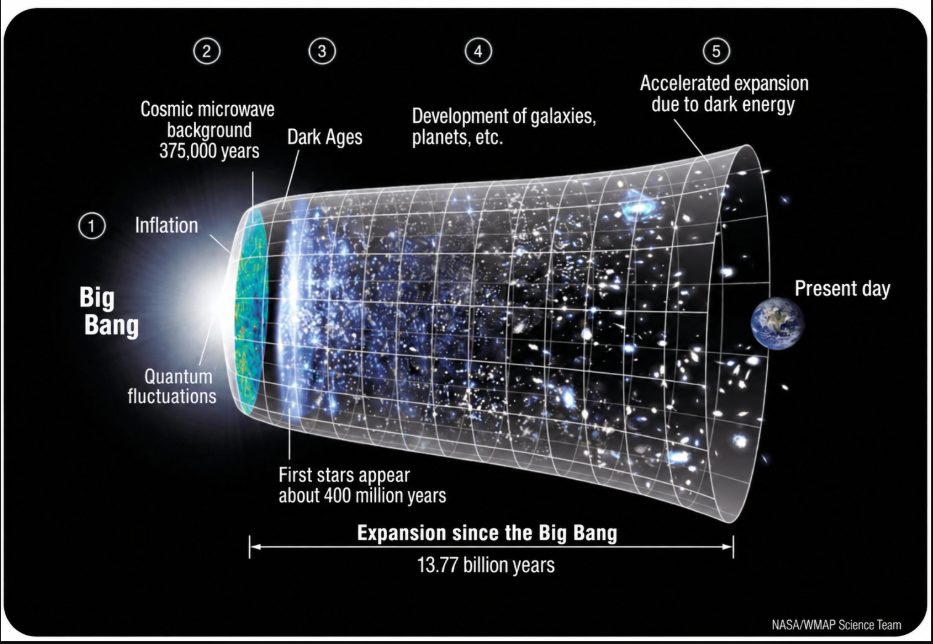
Most cosmologists agree that, in its first moments, the Universe underwent a phase of extremely rapid expansion. In a tiny fraction of a second, its size increased by 26 orders of magnitude. This model became known as cosmic inflation.
Inflation also explains the emergence of the first irregularities in the distribution of energy, from which galaxies eventually formed. However, the precise physical mechanism that drove it remains unknown.
The tightest constraint on the non-Gaussianity parameter still comes from measurements of the cosmic microwave background—the residual light of the early Universe—made by the Planck space telescope, rather than from galaxy maps. Planck’s uncertainty is about five units, while distinguishing between inflation models requires an uncertainty of around one.
Quasars from Gaia Data
For their analysis, the team used the Quaia catalog, compiled by Kate Storey-Fisher of Stanford University using data from the Gaia space telescope. During more than a decade of observations of the Milky Way with ESA’s spacecraft, astronomers also recorded over a million quasars—the exceptionally bright cores of distant galaxies.
Storey-Fisher notes that Gaia was not designed to study the large-scale structure of the Universe. However, no other quasar catalog covers such a large volume of space, allowing researchers to trace the distribution of matter precisely.
Distance as a New Variable
Astronomers usually compare the numbers of galaxies in different regions of the sky. The new technique adds fluctuations in redshift—the stretching of light from a receding object toward longer wavelengths. Redshift is used to estimate distance.
Carlos Hernández-Monteagudo of the Institute of Astrophysics of the Canary Islands explains that angular redshift fluctuations serve as a separate cosmological observable. This observable provided additional information from the same data.
Upcoming Sky Surveys
José Bermejo-Climent, the study’s lead author from Hungary’s Konkoly Observatory, believes that precision must improve further before definitive conclusions about inflation can be drawn. The team plans to apply the method to this decade’s major sky surveys.
These include the Dark Energy Spectroscopic Instrument (DESI), the Euclid and SPHEREx space telescopes, and the Legacy Survey of Space and Time (LSST) at the Vera C. Rubin Observatory. Whether researchers can distinguish the simplest inflation scenario from more complex alternatives now depends on the catalogs these surveys produce.