

Scientists at Leiden University have solved the mystery of the youthful appearance of planet-forming disks in the Orion Nebula. Their findings suggest that the nebula’s massive central star formed through a collision between two smaller stars, increasing its luminosity and accelerating the evaporation of material from these disks.
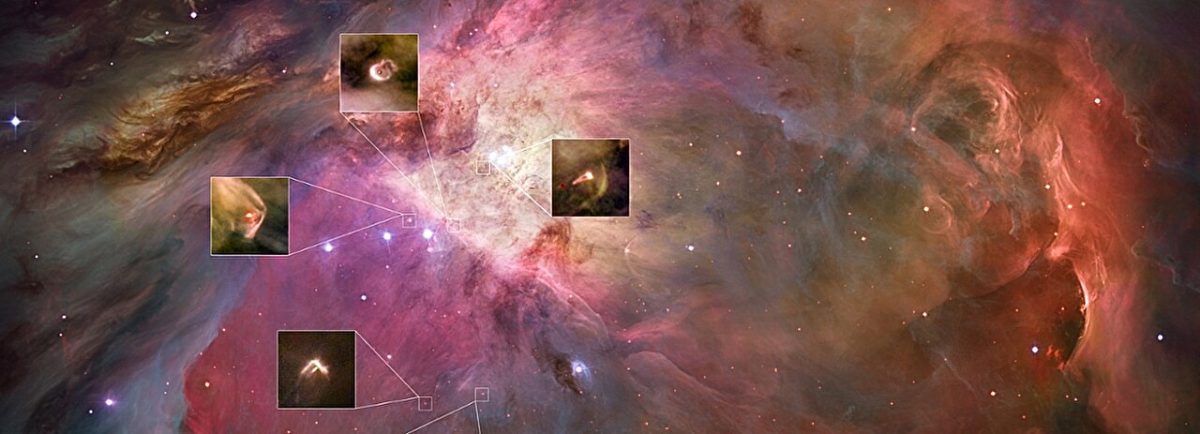
Tadpole-Shaped Disks
The Orion Nebula is a large star-forming region visible to the naked eye. Some young stars in the nebula are surrounded by disks of gas and dust where planets form. Radiation from the massive central star, Theta-1 Orionis C1, gradually strips material from these disks, giving them tadpole-like shapes, according to Phys.org.
The disks are losing mass so quickly that, given the stars’ ages of approximately one million years, they should have disappeared long ago. A large shell surrounding the central star presents another mystery. The star drives the surrounding gas outward, causing the shell to expand at approximately 13 km/s (8 miles per second).
Extrapolating backward from this expansion rate suggests that the shell formed only a few hundred thousand years ago. The stars are therefore much older than the apparent ages of both the gas shell and the dusty “tadpole” disks. This is the Orion Nebula’s age paradox.
The Merger of a Binary Star System
Leiden astronomer Maite Wilhelm and her colleagues propose a new scenario that could explain both mysteries. They suggest that Theta-1 Orionis C1, which is approximately 33.5 times more massive than the Sun, formed when a binary star system merged. A binary consists of two stars orbiting their common center of mass under their mutual gravity. The researchers suspect that a third star disrupted the system, knocking one of the stars out of its stable orbit and ultimately causing the pair to collide.
If these two stars did merge a few hundred thousand years ago, the resulting star’s luminosity—the amount of light it emits—should have increased dramatically at that point. The researchers used computer simulations to test whether this scenario could explain the observations.
The simulations showed that the scenario is plausible. Before the collision, the two stars emitted far less radiation, allowing the surrounding dusty disks to survive for most of their lifetimes. Only after the merger did the stellar radiation increase sharply, triggering rapid evaporation of the disks.
Cold Gas Provides an Additional Driving Force
However, the gas shell’s rapid expansion requires an additional explanation. Estimates suggest that the merger alone increases the driving force by a factor of 30, while explaining the observed expansion requires a hundredfold increase. The researchers suspect that cold gas from the evaporating dusty disks also plays a role. When this gas mixes with the hot gas inside the expanding bubble, it could provide the additional driving force needed.
The proposed scenario could also explain two other unusual features of Theta-1 Orionis C1: its observed tilted magnetic field and a slight excess of nitrogen in the star.
More Stellar Collisions in Our Cosmic Neighborhood Than Previously Thought
Co-author Simon Portegies Zwart is enthusiastic about the findings: “This is the first time we have witnessed the aftermath of a major stellar collision in our own cosmic neighborhood. It also shows that stellar collisions may be far more common than we previously thought, and that they can have far-reaching consequences.”
The scientists believe that subtle effects in triple-star systems can significantly influence star-forming environments—and perhaps even planets that are still forming.
