

Neutrinos remain the most elusive known particles. They have no electric charge, have an extremely small mass, and are capable of passing through solid rock without the slightest slowing. An international team of physicists has, for the first time, obtained an indication of a cumulative neutrino signal accumulated from the early Universe to the present day.

The accumulated signal of billions of collapses
Every few seconds in the visible part of the cosmos, a massive star exhausts its fuel and collapses, giving birth to a neutron star or a black hole. The explosion is accompanied by a stream of neutrinos that immediately spread out in all directions. Over billions of years, the radiation from countless supernovae has mixed into a continuous background known as the diffuse supernova neutrino background, or DSNB.
Detecting it would mean gaining a direct tool for measuring the history of star formation across the entire cosmos. However, the particles from distant explosions are extremely scattered, and their signals are so weak that no detector had previously been able to separate them from the general noise. Predicted theoretically back in the 1980s, this background had been searched for for decades, and all previous attempts had produced only an upper limit on the flux, not a statistically significant excess.
How the detector works
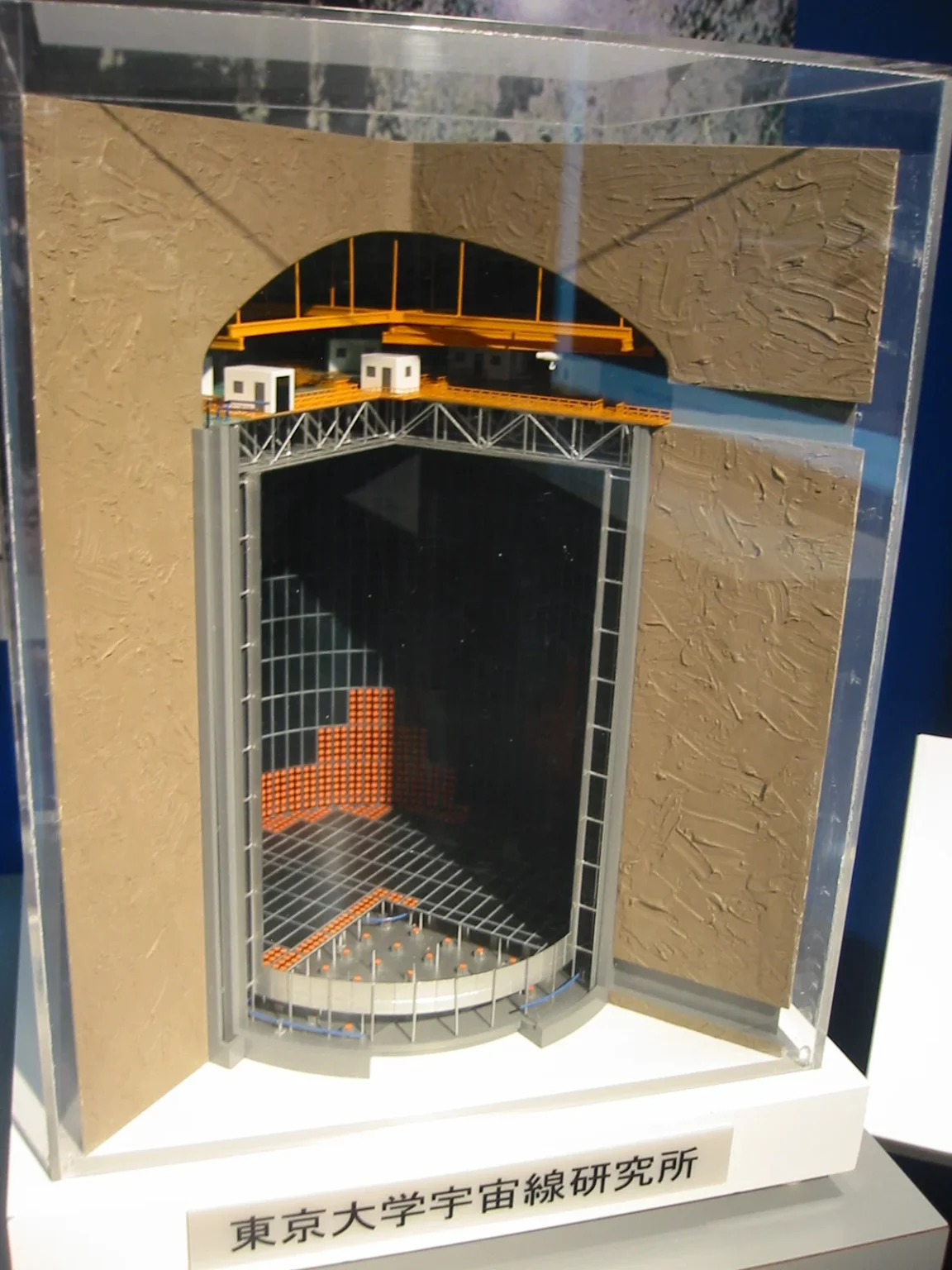
The Super-Kamiokande detector is located at a depth of 1,000 meters in Gifu Prefecture, where the thickness of the rock filters out cosmic rays. The detector is based on a tank containing 50,000 tons of ultrapure water, surrounded by about 13,000 light-sensitive photomultiplier tubes.
When a neutrino interacts with water, it can produce a charged particle. In the case of searching for a diffuse neutrino background, this is most often a positron, which is produced when an antineutrino interacts with a proton. If such a particle moves through water faster than light propagates in it, a weak blue Cherenkov radiation is produced. It forms a light cone, similar to how a supersonic plane creates a shock wave in the air. This does not violate any laws of physics, because we are talking about exceeding the speed of light in a medium, not in a vacuum. It is this Cherenkov light that the Super-Kamiokande photodetectors record.
The first phase lasted from 2008 to 2020 and accumulated 3,349 days of observations using pure water. In the second phase, which began in 2020, gadolinium salts were added to the tank. Gadolinium is a rare-earth element that increases the efficiency of identifying electron antineutrinos.
The researchers examined data accumulated over about 5,000 days and saw a barely noticeable but stable excess of events. The signal exceeded what was expected from the ordinary background. Its statistical significance reached 2.6 sigma, corresponding to 99.5% confidence that it was not random.
The threshold still needed for discovery
A formal discovery in particle physics usually requires statistical significance at the 5 sigma level. The result obtained has a significance of 2.6 sigma, which makes a random origin of the signal unlikely, but does not yet allow us to consider it a definitive confirmation. This is only the first statistically significant evidence for the existence of a diffuse neutrino background from supernovae. The best observation explains the DSNB flux with an intensity of about 3.6 cm⁻² s⁻¹, which is in good agreement with theoretical predictions.
The results were presented on June 25, 2026, at the Neutrino 2026 conference at the University of California, Irvine, Universe Today reports. Yosuke Ashida, an associate professor at Tohoku University, noted that the team plans to combine the current Super-Kamiokande data with observations from its successor, the much larger Hyper-Kamiokande. A joint analysis should increase the sensitivity enough to cross the required five-sigma threshold.
More than thirty years of waiting
“Obtaining the world’s first indication of the diffuse supernova neutrino background is a deeply meaningful achievement and a cherished goal from the very beginning of the Super-Kamiokande project,” said Hiroyuki Sekiya, spokesperson for the collaboration and an associate professor at the University of Tokyo.
The collaboration brings together about 250 researchers from 60 universities and scientific institutions. Its predecessor, the Kamiokande detector, recorded neutrinos from the supernova SN 1987A in the Large Magellanic Cloud, and that event still remains the only direct observation of neutrinos from a specific stellar collapse.
Now physicists stand on the threshold of moving from observations of individual explosions to a continuous background that carries the history of the formation of neutron stars, black holes, and the gradual chemical enrichment of the Universe. If the signal is confirmed, astrophysics will gain a new way to observe processes that no existing telescope can detect.
