

What is time, and does it truly exist beyond our perception? A physicist from the University of Birmingham has taken a significant step toward solving this fundamental scientific mystery. Professor Giovanni Barontini created a quantum miniature universe in the laboratory. The experiment demonstrated that no external clock is needed to measure or establish the passage of time. His research, published in the journal Physical Review Research, shows that time may be a by-product of the behavior of quantum systems rather than a fundamental component of the cosmos.

In modern quantum gravity, the hypothesis that time may not be a fundamental property of the universe, but rather emerges only as a consequence of deeper physical processes, is actively being explored. For example, the Wheeler–DeWitt equation describes the quantum state of the universe without an explicit time variable. This gives the impression that there is no built-in “clock” at a fundamental level that determines the sequence of events.
The everyday movement from the past to the future that we call time must arise from complex relationships among particles within a system. The principal challenge was determining how this hypothesis could be tested experimentally.
A Laboratory Recipe for the Cosmos
To put the theory into practice, Professor Barontini constructed a simplified quantum model of the Universe. He used a cloud of 24,000 atoms cooled to within only a few billionths of a degree above absolute zero.
The atoms were isolated within a closed system and separated by a thin optical barrier formed by two laser beams operating at different frequencies. This created two regions: an observable “bright” sector and a hidden “dark” sector.
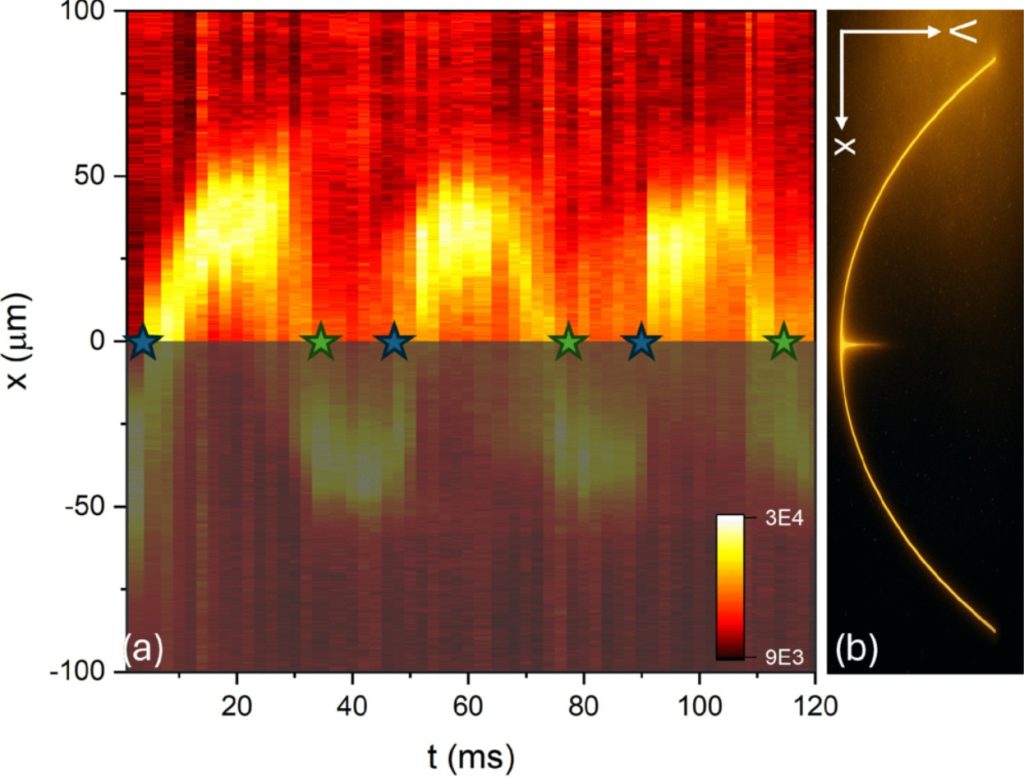
Within this microcosm, the “bright” region alternately expanded and contracted. This resembled a cyclic model of our Universe, extending from the Big Bang to the Big Crunch. Because the system was completely isolated, the scientists could record the sequence of events solely through the internal processes of the miniature universe, without relying on any external instruments.
The Birth of “Entropic Time”
The experiment showed that a form of “time” emerged within the quantum system through changes in the level of disorder, or entropy, as atoms migrated between the bright and dark regions. As long as the particles moved and redistributed themselves, the system evolved—in other words, it moved forward in time. Once this movement subsided and the distribution of particles became constant, time within the miniature universe literally stopped.
Barontini called this phenomenon “entropic time.” It has several distinctive properties:
- it always moves in one direction, creating a clear “arrow of time”;
- it logically orders events even during the contraction and expansion of the quantum cloud;
- it can accelerate or slow down depending on the rate at which entropy changes.
A Bridge to Quantum Gravity
The researchers also managed to rewrite the fundamental equation of quantum mechanics, the Schrödinger equation, in terms of so-called entropic time. This shows that the evolution of a quantum system can be described even without the use of an external clock, relying only on internal changes in its state.
The results demonstrate one possible way to order events in systems where the usual concept of time is absent. Now, instead of dry mathematical models, scientists have received a real laboratory tool, although this does not yet solve the problem of time in quantum gravity. The experiment creates a new laboratory platform for testing the corresponding theoretical models. In the future, such quantum systems may help to study certain aspects of the physics of black holes, the early Universe, and other phenomena where the classical description of space-time ceases to work.
Previously, we attempted to determine whether time flowed differently immediately after the Big Bang.
According to sciencedaily.com
