

The Perseverance rover has transmitted an impressive panoramic image of an area known as Broom Point. Captured in late spring 2025 on the 1,505th Martian day of the mission, the image shows the outer rim of Jezero Crater, which rises 150 meters high. The panorama reveals light-colored layers of ancient bedrock approximately 75 meters thick. Scientists estimate that this formation is more than 3.9 billion years old, making it one of the oldest regions of the Red Planet ever studied by humanity.
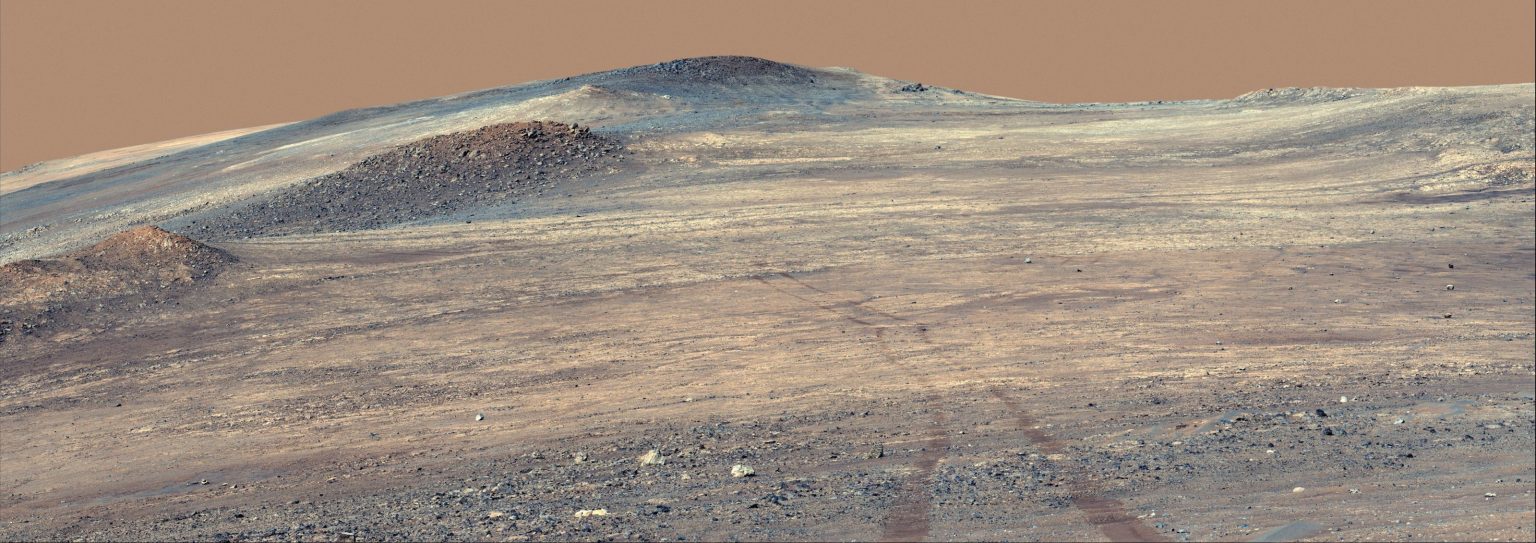
Studies of Broom Point revealed a remarkable geological anomaly: the layers of ancient rock are almost standing upright, tilted at an angle of more than 80 degrees. Scientists believe that this thick formation was initially created by a series of powerful asteroid impacts. Later, even larger cosmic collisions that formed the enormous Isidis basin and Jezero Crater itself effectively overturned the geological layers of Mars, preserving evidence of ancient catastrophes for billions of years.
A Scientific Map of the Martian Descent
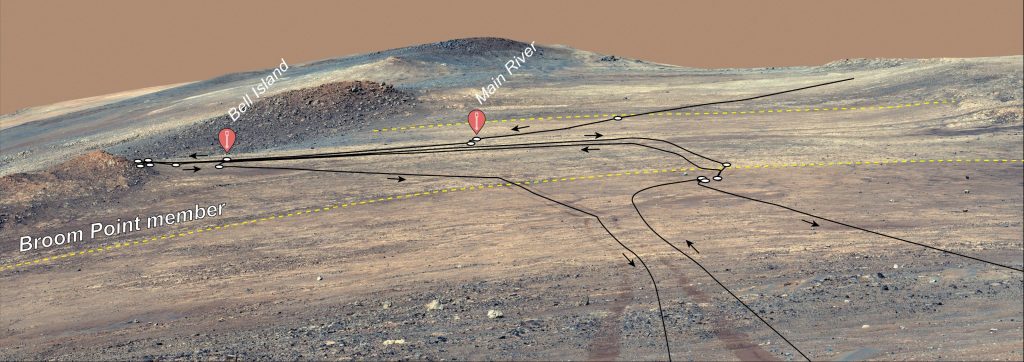
Images taken by the Mastcam-Z camera also clearly show a trail of rover wheel tracks. They illustrate a difficult maneuver, as Perseverance had to descend a very steep and hazardous slope of the crater. To facilitate analysis, specialists prepared a detailed graphic diagram based on the panorama:
- Boundaries of the ancient formation: The upper and lower limits of the Broom Point deposits are marked with yellow dashed lines.
- Travel path: The rover’s routes are shown in black.
- Research stops: Locations where the rover remained for extended periods to study the surrounding environment are marked with white circles.
- Time capsules: Red icons indicate the sample collection sites at Bell Island on April 22, 2025, and Main River on March 10, 2025. These samples are eventually planned to be returned to Earth.
Who Is Behind the Mission?
The Perseverance rover is operated by NASA’s Jet Propulsion Laboratory, which is managed by the California Institute of Technology, or Caltech. The high-precision Mastcam-Z camera system is the result of extensive international scientific cooperation. It is operated by Arizona State University in collaboration with Malin Space Science Systems, which was responsible for designing the cameras. The instrument’s calibration targets were developed and tested by specialists from the Niels Bohr Institute at the University of Copenhagen.
Perseverance previously discovered evidence of an ancient lake on Mars.
According to NASA
