

The laureates of the six Nobel Prizes are being announced this week. The first award announced was in Physiology or Medicine. It was awarded for optogenetics, a method of controlling nerve cells using light. The method originated from a protein in a single-celled alga that enables it to move toward a light source. Neuroscientists can now investigate exactly which cells in the living brain shape memories, emotions, and behavior.
An Alga That Moves Toward the Light
It all began with a question Peter Hegemann asked himself. He wanted to understand how the single-celled alga Chlamydomonas swims toward a light source. In the early 2000s, Peter Hegemann of the Max Planck Institute of Biochemistry in Martinsried and Georg Nagel of the Max Planck Institute of Biophysics in Frankfurt identified a protein called channelrhodopsin on the surface of its cell.
When exposed to blue light, a channel opens within this protein. Charged ions enter the cell through it, generating an electrical impulse. Another finding followed: any cell into which channelrhodopsin was introduced became sensitive to light.
This same alga has traveled to space several times. As early as 1985, a space shuttle mission investigated how Chlamydomonas orients itself relative to light in microgravity. In 2018, mutant strains of the alga were grown aboard the ISS for about a month as part of the Space Algae-1 experiment to test the stability of its genome and its suitability for life-support systems, according to NASA.
A Light Switch for Neurons
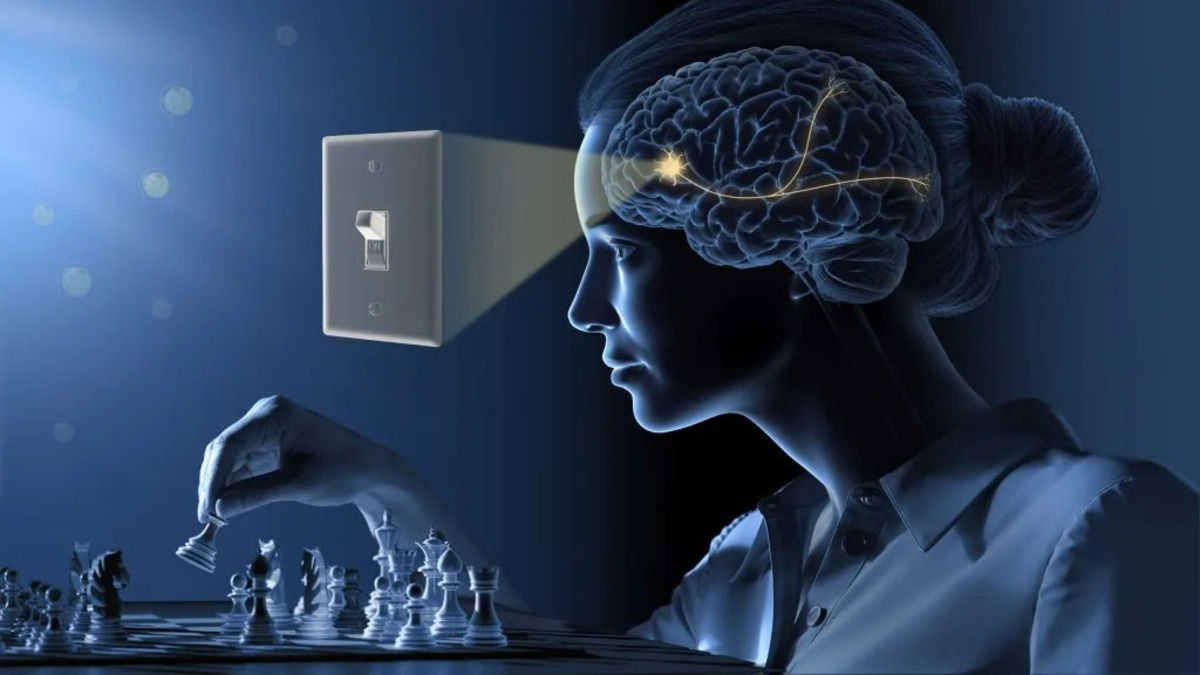
Karl Deisseroth of Stanford University and the Howard Hughes Medical Institute introduced the channelrhodopsin gene into rat nerve cells. When blue light was directed at them, the cells generated a nerve signal. Karl Deisseroth published this finding in 2005, and two years later applied the light switch in the brains of mice.
In the twentieth century, neuroscientists identified which brain regions were associated with particular functions, but the methods available at the time did not allow them to establish cause and effect. The resulting picture of the brain resembled a sketch of a map with many blank areas.
Previously, researchers primarily used electrodes to stimulate the brain. An electrical current activates all nearby neurons indiscriminately, making it impossible to determine which group of cells is responsible for a particular response. The channelrhodopsin gene can be introduced into just one type of neuron, allowing light to activate only those cells with millisecond precision.
From the Laboratory to the Clinic
According to the press release on NobelPrize.org, optogenetics has already helped identify neural circuits that control memories, emotions, and behaviors associated with neurological and psychiatric disorders. Per Svenningsson, chair of the Nobel Committee for Physiology or Medicine, said the method makes it possible to map the brain in ways that were once only a dream.
NASA’s report Rodent Research in Space recommends considering optogenetics for studying and controlling cognition and behavior in rodents during future spaceflights. No space experiments using this method have been conducted so far.
In clinical medicine, optogenetics is being tested as a way to restore vision. The first patient whose vision was partially restored using this method was described in the journal Nature Medicine in 2021. Following treatment and with the aid of special goggles, a man with retinitis pigmentosa was able to locate and count objects on a table.
The 2026 Nobel Week Schedule
The Nobel Assembly at Karolinska Institutet awarded the prize “for the discovery of light-gated ion channels and optogenetics.” The prize amounts to 12 million Swedish kronor. Karl Deisseroth, Peter Hegemann, and Georg Nagel will share the sum equally.
The Physics laureates will be announced on Tuesday, October 6, no earlier than 12:45 p.m. Kyiv time. The Chemistry laureates will be announced at the same time on Wednesday, October 7. Read about the discoveries honored in these fields in our upcoming articles.
Thursday, October 8, will be devoted to Literature, while the Peace Prize laureate will be announced in Oslo on Friday. The week will conclude on October 12 with the Prize in Economic Sciences in Memory of Alfred Nobel.
