

Ghost particles may point to black holes inside mysterious galaxies discovered in the early Universe with James Webb. Their existence helps untangle two astrophysical puzzles at once.
A Neutrino Source Inside a Dusty Cocoon
Cosmic neutrinos are almost massless and have no charge, so they can freely escape even the densest environments. Every second, hundreds of trillions of these particles pass through the human body. At the same time, the origin of most of the high-energy cosmic neutrinos recorded on Earth still remains unknown.
Usually, the events that produce such neutrinos also create high-energy photons. If all neutrino sources also emitted gamma rays, the Universe’s gamma-ray background would be far brighter than it actually is. It is therefore logical to assume that there are environments from which photons cannot escape, while neutrinos leave without obstruction.
Mysterious Little Red Dots
Such an environment may be provided by galaxies known as little red dots. They were discovered with James Webb in the early Universe, about 600 million years after the Big Bang, and almost never occurs before the Universe reached an age of 2 billion years.
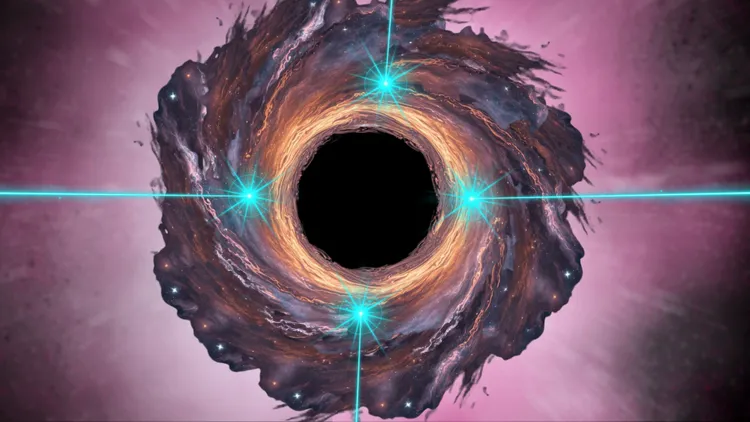
These objects show very weak emission in the X-ray and radio ranges, which is unusual for active galactic nuclei. Researchers suggest that a black hole is hidden at the center of each dot, surrounded by a thick layer of gas and dust. This cocoon absorbs photons but allows neutrinos to escape.
The authors of the study, led by Riku Kuze of Kyoto University, estimated the contribution of red dots to the overall neutrino background. According to their calculations, if particle acceleration occurs inside these galaxies, they could produce a significant share of the high-energy neutrinos detected on Earth.
An Invisible Engine at the Dawn of the Universe
The general mechanism of neutrino formation is known. Protons collide with photons or gas in a dense environment, generating a stream of ghost particles.
At the same time, gamma-ray photons become trapped in the dense shell and do not reach the observer. According to Riku Kuze, it is still difficult to directly observe individual objects. But their sheer number makes little red dots a convincing candidate for the main supplier of cosmic neutrinos, space.com reports.
The team’s next step is to compare the ratio of neutrino types produced in such systems with what detectors observe. If the proportions match, it will support the hypothesis, the results of which were published in the peer-reviewed journal Physical Review D.
