

Magnesium oxide is a material with a high melting point that forms at the boundary between the core and mantle. Scientists recently studied it and concluded that it deforms differently depending on the orientation of its crystals, influencing how it shapes planets.
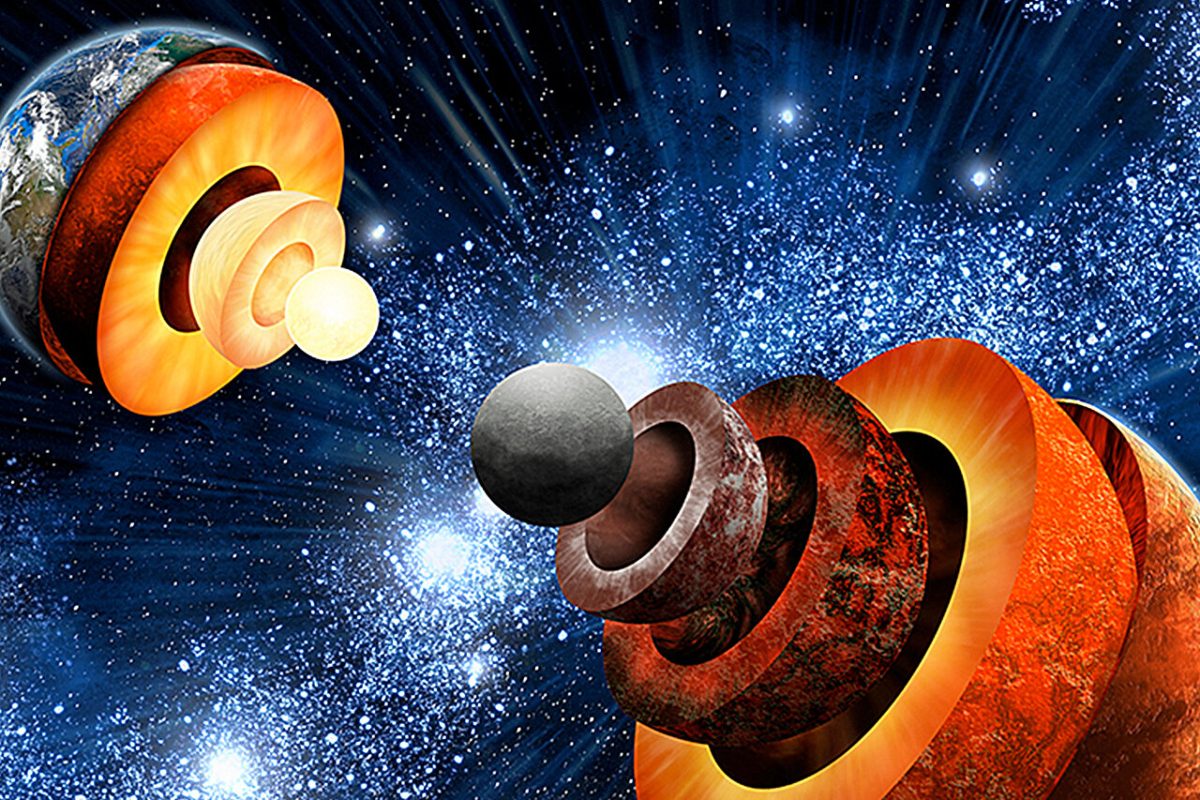
Magnesium Oxide on Earth and in Space
Scientists from Johns Hopkins University and Lawrence Livermore National Laboratory recently investigated the behavior of magnesium oxide under high pressure. According to Phys.org, the findings were published in Physical Review X and are important for understanding how planets form throughout the Universe.
Magnesium oxide is a material with an extremely high melting point that forms at the boundary between Earth’s outer core and mantle under exceptionally high temperatures and pressures. It is not confined to our planet. On more massive super-Earths, it may form a superconducting crystal structure, while in gas giants it may be present directly within the core.
This mineral is involved in heat and mass transfer within celestial bodies and, consequently, in their magnetic fields. Understanding its behavior is therefore essential for modeling these processes. But there is an important complication: in laboratory experiments, magnesium oxide does not behave quite as expected.
The scientists set out to solve this puzzle in their new study. They tested a bold hypothesis: what if the transformation of magnesium oxide depends on the direction in which it is compressed at high temperatures? To investigate, they studied samples using lasers and presses in the laboratory.
Research Findings
A cube is symmetrical, and magnesium oxide has a cubic crystal lattice. Until now, no one had considered that there might be a particular direction in which these crystals compress differently from others. However, the paper’s authors reasoned that three distinct cases could be identified.
The first is when force is applied along the direction of the bonds in the crystal lattice; the second is when it is applied along the diagonals of the faces; and the third is when it acts parallel to the faces of the cubes themselves. The researchers combined simultaneous optical measurements of shock-wave velocity and temperature with X-ray diffraction, which reveals the arrangement of atoms.
Unexpectedly, they found that the crystal lattice deforms as predicted by established theory along the cube’s diagonal. In other directions, a more complex process occurred. A thin, short-lived disordered zone appeared ahead of the shock front, followed by a region of irregular crystal growth.
These features explain the discrepancies between theory and earlier experimental results. Scientists can now model the interiors of a wide variety of planets much more accurately and use those models to explain their characteristics.
