

A hypothesis that had remained without direct verification for almost two decades has finally been confirmed. The highest-energy particles escaping from the vicinity of the remnant of a massive star really do move along the magnetic-field lines of the Galaxy. This was discovered thanks to the properties of X-ray radiation.
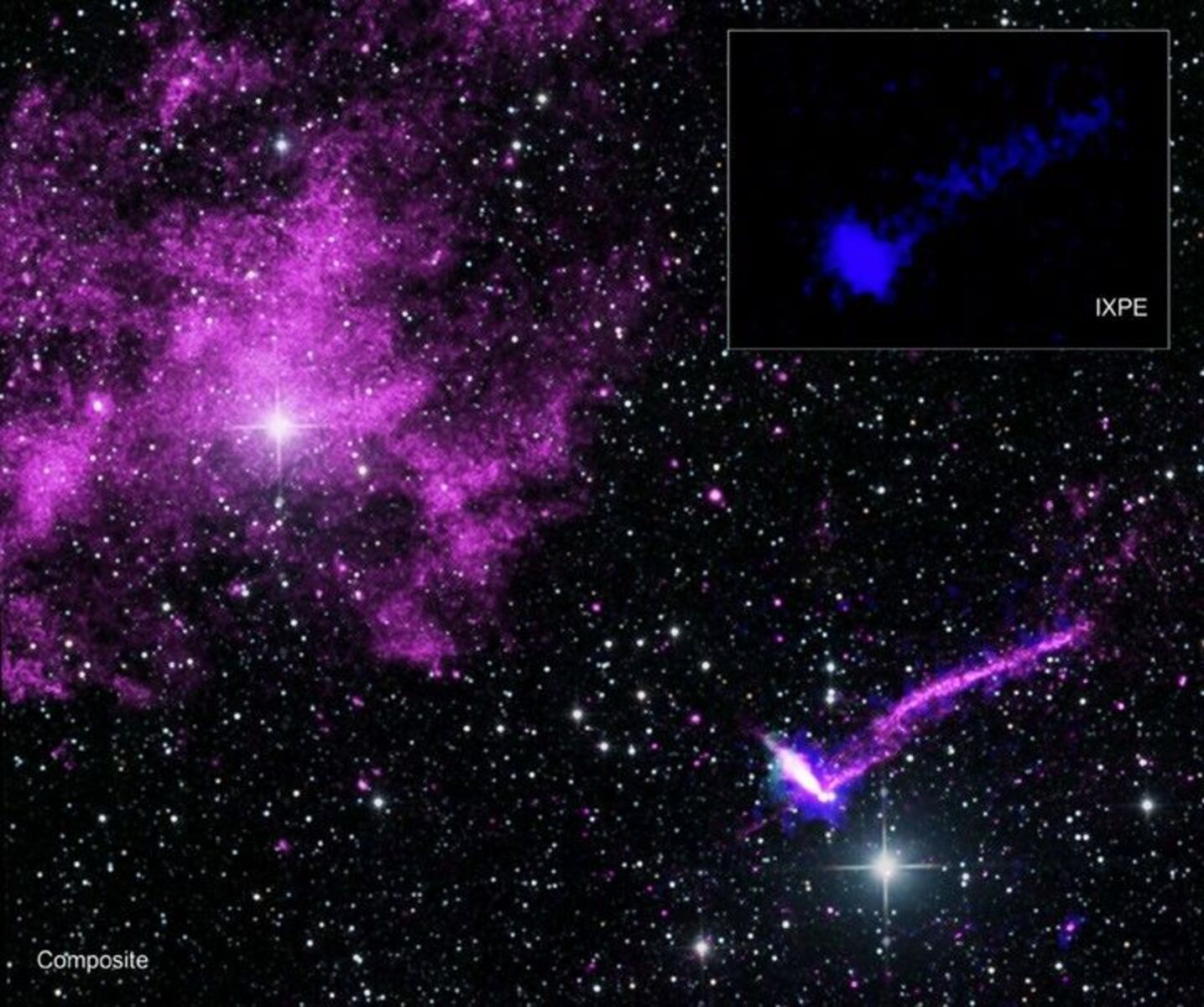
The pulsar in the Lighthouse Nebula
The pulsar PSR J1101-6101 rotates 16 times per second and races through the interstellar medium. It is the dense remnant of the core of a former massive star, compressed to the size of a large city.
Two narrow structures visible in X-rays extend from it, and they differ in length. Astronomers call the longer one a filament, while the shorter one has been called a trail.
Shock wave ahead
Its rapid motion through interstellar gas creates a shock front ahead of the pulsar, similar to the wave in front of a boat’s bow. Most charged particles remain trapped behind this boundary and form a turbulent trail.
Since 2008, there had been a hypothesis that the most energetic of these particles nevertheless break through the shock front. After that, they should flow along the Galaxy’s field lines, stretching into a long, thin thread. For a long time, it was not possible to test this model through observations.
Polarization measurements
The problem was solved using the orbital X-ray polarimeter Imaging X-ray Polarimetry Explorer, or IXPE. The instrument records the direction of oscillation of the electric vector in light, and from this scientists determine the orientation of the magnetic field in the source itself.
In June 2025, almost 18 days of observations were devoted to the nebula, according to NASA. The object is rather faint, so a team led by Jack Dinsmore of Stanford University developed analysis methods that use every recorded photon without simplifications.
Before IXPE was launched in late 2021, X-ray polarimetry had hardly been used in astronomy for more than four decades, since the previous reliable measurements of this type had been made by the OSO-8 spacecraft in the 1970s. In four years of operation, the observatory has already measured polarization for dozens of cosmic objects, from black holes to supernova remnants.
More than 99 percent confidence
Processing the observations showed that the magnetic field is stretched along the particle flow, and the reliability of the conclusion exceeds 99 percent. The long-standing hypothesis has received direct confirmation, and the paper with the results was published in the peer-reviewed journal The Astrophysical Journal.
The degree of polarization itself came as a surprise, as it turned out to be very high. Roger Romani of Stanford University notes that most models of filaments predict strong turbulence. The measured values point to a much calmer environment.
Two pictures in different wavelength ranges
X-ray observations have shown that the magnetic field in the region producing the X-rays is oriented almost parallel to the long trail of the pulsar. Radio observations, however, indicate a nearly perpendicular direction of the field.
Niccolò Bucciantini of the National Institute for Astrophysics in Italy believes this discrepancy is evidence of a complex internal structure of such systems. Most likely, the high-energy electrons that emit X-rays and the less energetic particles responsible for the radio emission occupy different regions of the nebula. This is the first direct evidence that the acceleration of particles occurs in more than one place and, presumably, by different physical mechanisms.
