

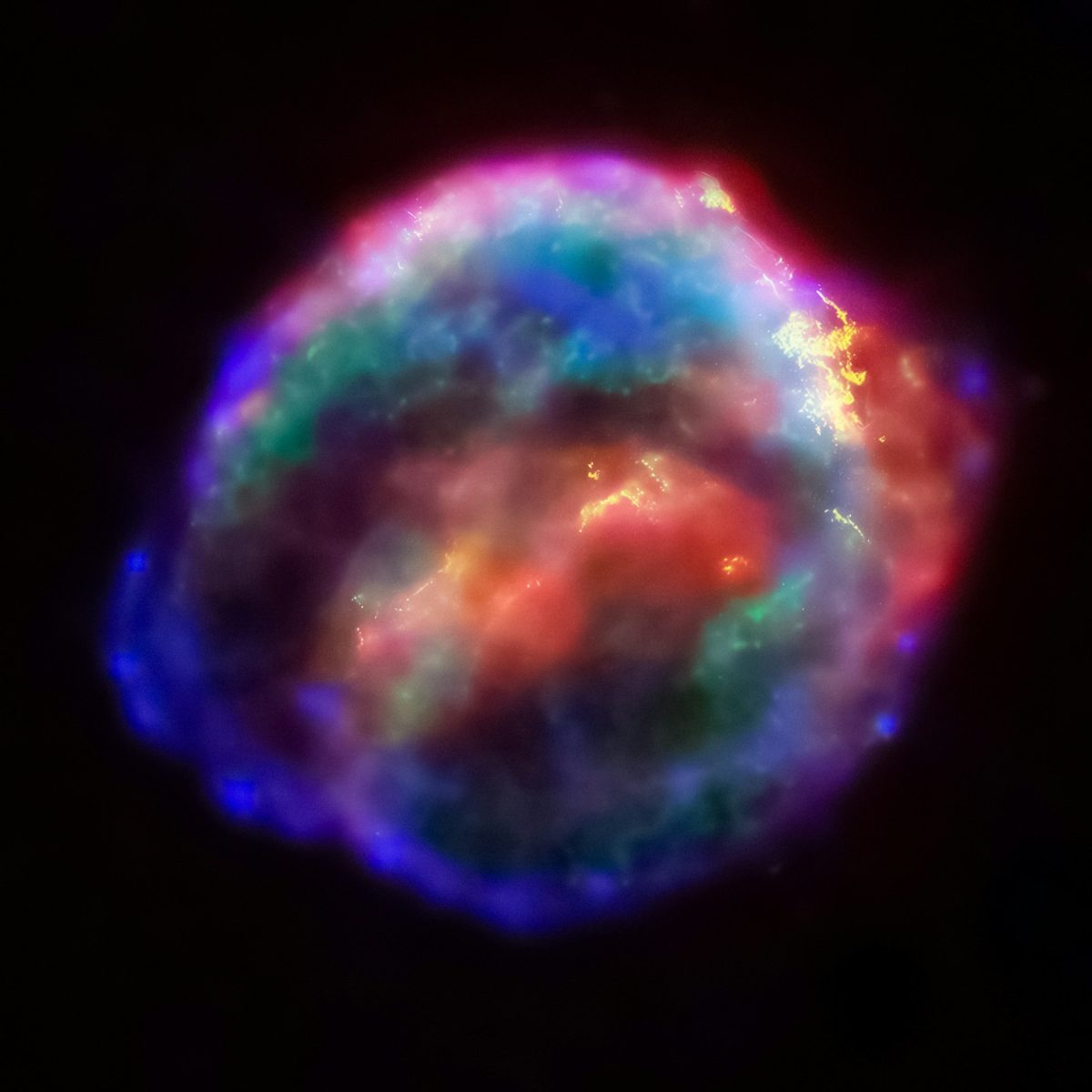
The James Webb Space Telescope (JWST) has made another important discovery in the study of the evolution of the first stars. The observatory detected a likely supernova explosion in the early Universe just days after the event itself. Designated AT 2026abck, the object lies in an actively star-forming galaxy at a redshift of z ≈ 5.017. This means we are seeing light emitted when the Universe was only about 1.2 billion years old.
A report on the discovery by a team of astronomers led by Ming-Yang Zhuang of the University of Illinois Urbana-Champaign was published on the arXiv preprint server.
What Makes This Discovery Unique?
Supernova explosions in the young Universe give scientists a direct way to understand how massive early stars lived and died in metal-poor environments. However, observing them is extremely difficult: as space expands, the emitted light is stretched and shifted into the infrared range.
Thanks to its highly sensitive infrared instruments, JWST has already detected more than 200 potential supernovae at redshifts of up to z ≈ 6. Beyond z ≈ 4, however, most have been observed only sporadically, and only a handful have been caught within the first few days after exploding. Moreover, at redshifts above z ≈ 5, only one supernova has so far been spectroscopically confirmed—and only because its light was magnified nearly 30-fold by gravitational lensing from a galaxy cluster.
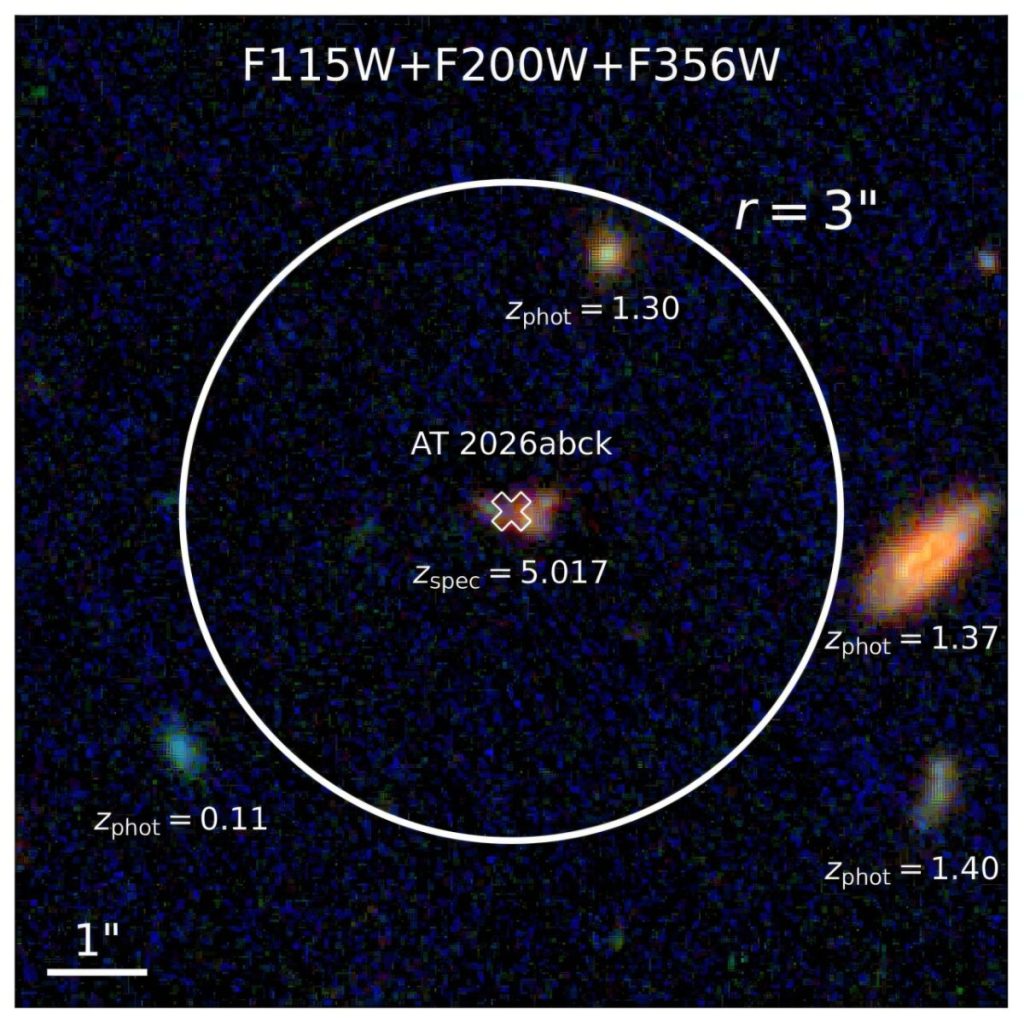
AT 2026abck was found in a region of the sky without any gravitational magnification. The object was spotted through the NEXUS program, in which JWST revisits the same area every two months. On May 28, 2026, the source was absent from the images, but observations 71 days later revealed an object with a magnitude of approximately 27.4.
Brighter Than Expected
Modeling showed that the object has a temperature of around 17,000 K, a radius nearly 46 times the distance between Earth and the Sun, and a luminosity of approximately 3 × 10⁴³ erg/s. Astronomers estimate that the explosion occurred just 4–10 days before detection, measured in the system’s own rest frame.
The burst lies between two components of its host galaxy, approximately 3,600–4,200 light-years from the galaxy’s center. This rules out a star being torn apart by a black hole or a flare from an active galactic nucleus, both of which typically occur at the very center. The strong ultraviolet emission and high temperature are also inconsistent with Type Ia supernovae.
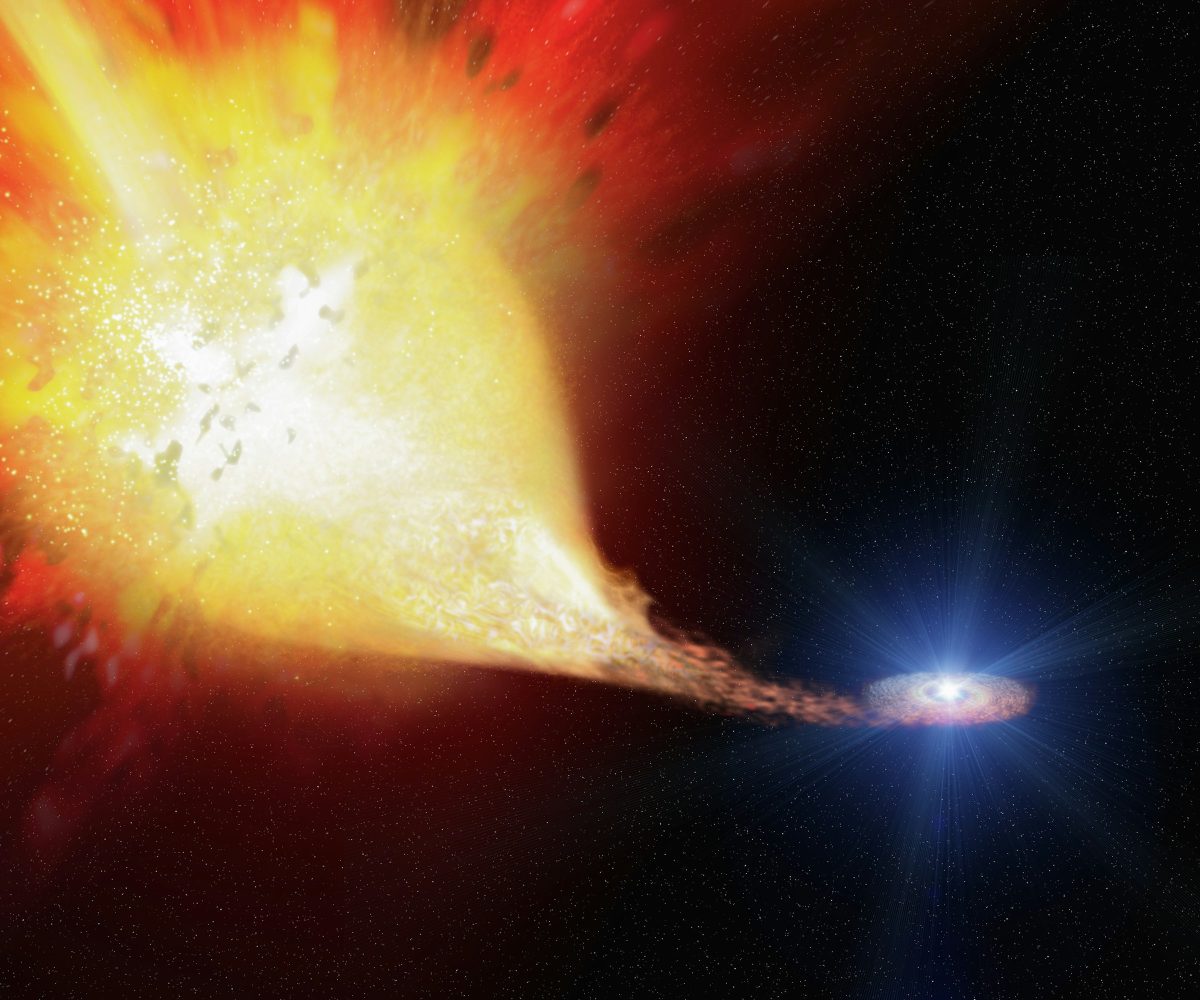
Events like this most often belong to Type II—explosions caused by the collapse of massive stellar cores. Yet among dozens of well-studied nearby Type II supernovae, none had a temperature above 15,000 K after six days or a comparable luminosity as early as day four. AT 2026abck proved significantly hotter and brighter than conventional examples at similar stages.
Two Hypotheses for Astronomers
Scientists suggest that the high brightness could be explained by a Type II supernova surrounded by dense, compact circumstellar material. In this scenario, additional energy is released through shock cooling or the shock wave’s interaction with this material.
The stellar mass of the object’s host galaxy is approximately 6 billion solar masses, while its metallicity is 0.3 times that of the Sun. Its star formation rate ranges from 14 to 21 solar masses per year, which is typical of that era.
Detailed spectroscopy with the NIRSpec instrument is needed to definitively classify the object. The researchers also consider the possibility of a superluminous supernova caught during its rise in brightness. Further JWST observations will allow these hypotheses to be tested quickly: an ordinary Type II supernova will fade rapidly in the ultraviolet, while a superluminous supernova will continue to brighten.
We previously explained how supernova explosions destroy planets and wipe out life.
Based on material from phys.org.
