

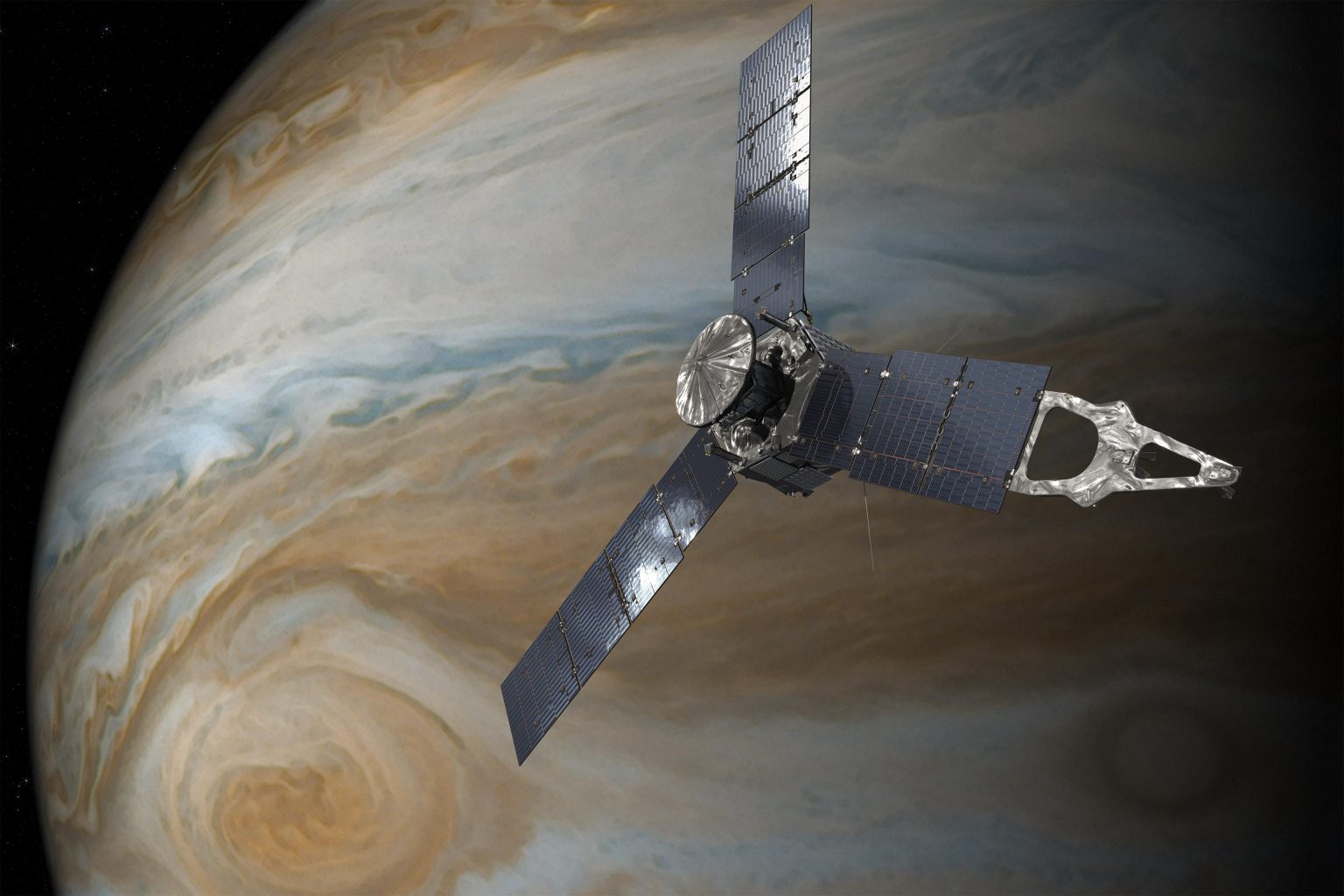
The flat disk of charged gas surrounding Jupiter is more complex than previously thought. During active periods, it develops ripples that rotate with the planet. These are generated by numerous regions where magnetic field lines break and reconnect. Researchers reached this conclusion using measurements from NASA’s Juno spacecraft.
Four Crossings in Ten Minutes
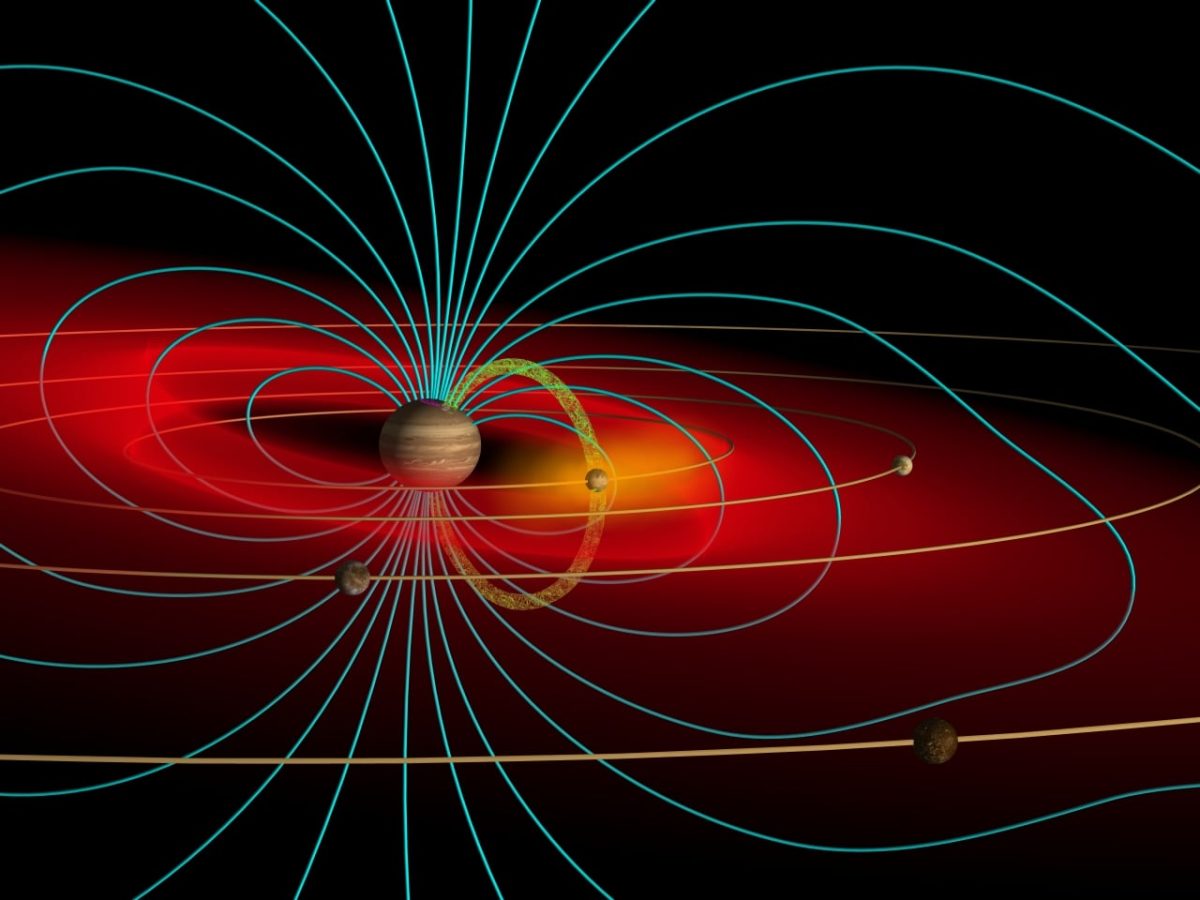
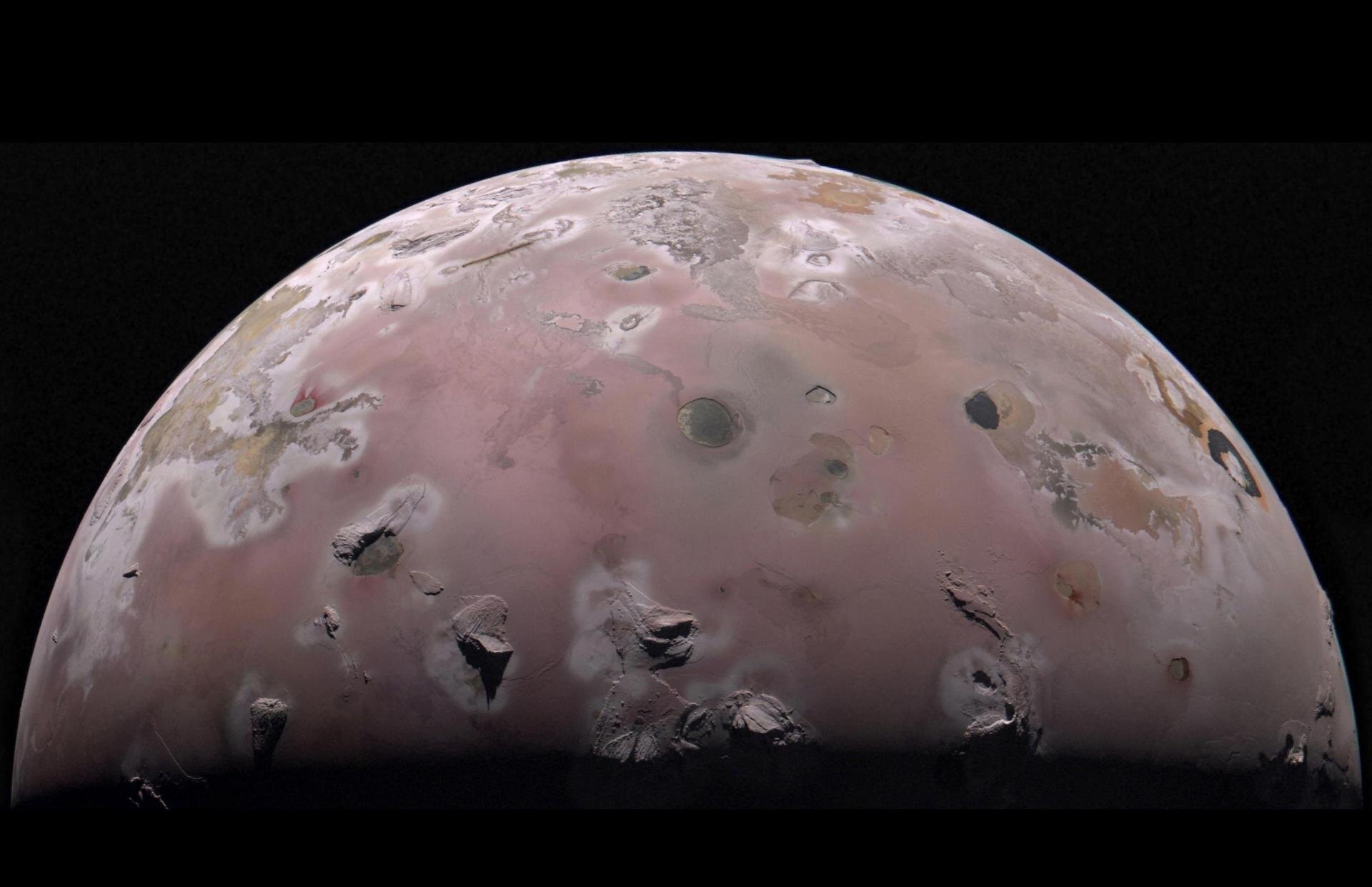
The magnetodisk is a thin layer of plasma near the planet’s magnetic equator. Its material comes from Io’s volcanoes, and the gas giant’s rapid rotation stretches it into a plane. A thin sheet of electric current runs through the middle of the disk. Above and below this current sheet, the magnetic field points in opposite directions.
Because the magnetic axis is tilted, the disk wobbles up and down with each rotation, which takes nearly ten hours. An orbiting spacecraft typically crosses the current sheet twice during that time. Smaller oscillations had been observed before, but their cause was unclear.
On one occasion, Juno passed through the sheet four times in ten minutes. Almost every crossing was accompanied by signs of magnetic reconnection. This is the process in which opposing field lines converge, break, and reconnect in a different configuration. The released energy accelerates electrons and ions, and bursts of these particles were also detected.
A Rippling Current Sheet
The current sheet was not simply wobbling: it was bending into waves, with ripples lasting from a few minutes to more than an hour. The authors of the paper, published in the peer-reviewed journal Science China Earth Sciences, link this behavior to small reconnection sites spread across approximately 100 degrees of longitude—more than a quarter of a circle. These sites continually break field lines and disturb the sheet’s equilibrium.
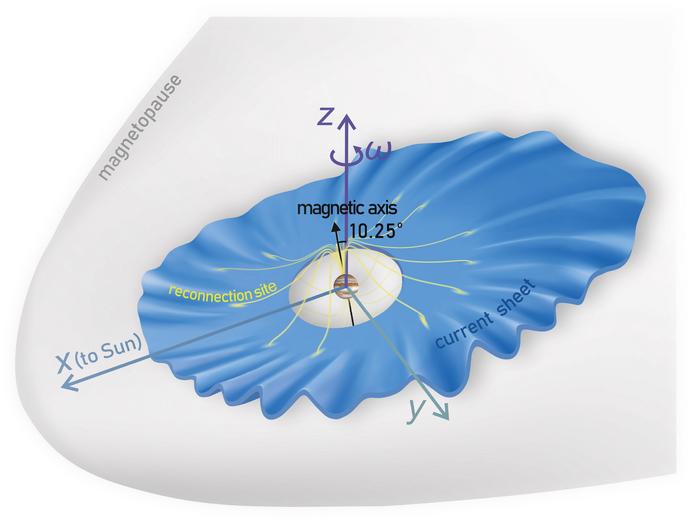
Jupiter’s magnetosphere rotates rapidly, so the rippling surface moves with the planet. A Science China Press release compares this to a crumpled tablecloth on a turntable.
How It Differs from Earth’s Magnetosphere
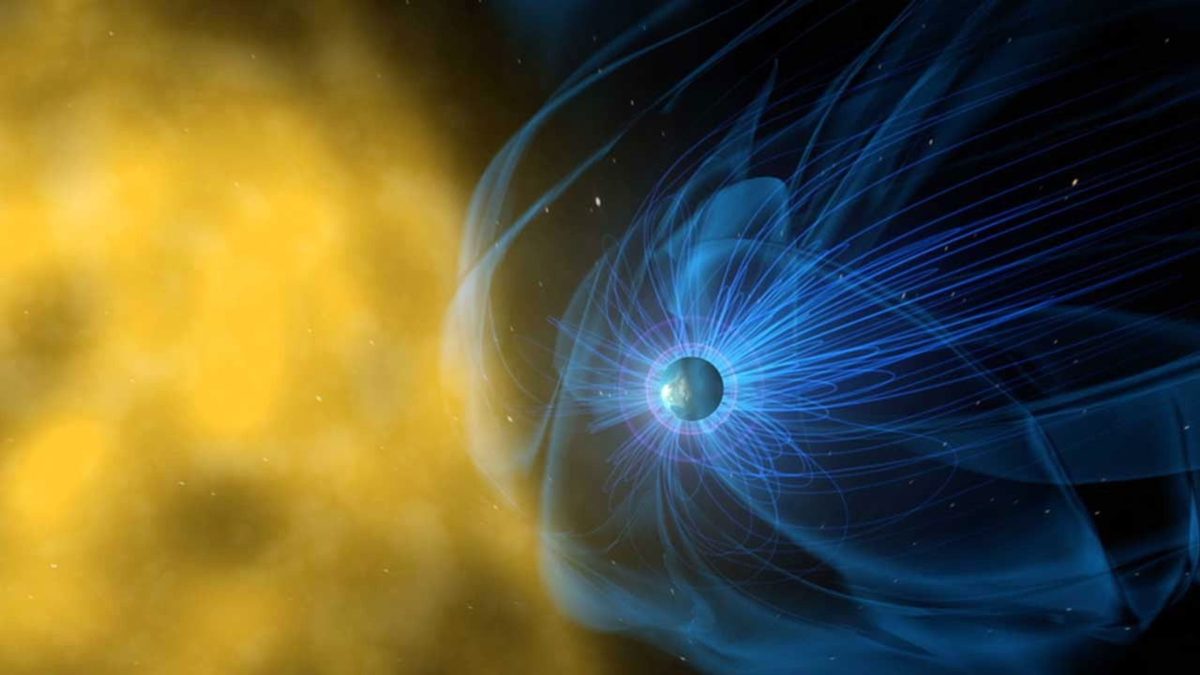
Similar oscillations are known to occur in Earth’s magnetotail, the nightside portion of the magnetosphere stretched out by the solar wind. There, a bend forms at a reconnection site and propagates away from it like a wave along a taut rope.
Near Jupiter, however, signs of reconnection appeared at almost every crossing, according to Universe Today. The sheet moved without a consistent period, so its behavior cannot be explained by an ordinary wave propagating from a particular point.
The Researchers’ Earlier Work
In 2018, the study’s first author, Ruilong Guo of Shandong University, used Cassini data to describe reconnection on Saturn’s dayside driven by the planet’s rotation. In 2024, researchers from the same group found evidence of similar processes in Jupiter’s magnetodisk in archival measurements from Galileo and Voyager.
Scientists from the University of Liège and the University of Hong Kong also contributed to the new study. All the Juno data used are available in NASA’s public archive.
Implications for Particles and Auroras
The rippling sheet may influence how particles from Io’s volcanoes are accelerated and distributed throughout the magnetodisk. From there, they enter the inner magnetosphere, with its intense radiation, or are directed toward the auroras.
Juno has been operating near Jupiter since 2016. Its extended mission is scheduled to run until September 2028.
Now it is the theorists’ turn. Their models will need to describe the magnetodisk as a layer that continually breaks and bends into waves rather than as a flat sheet.
