

The James Webb telescope is once again showing astronomers interesting things. This time, it helped study the gas giant HATS-6 b, located in a distant star system. It turned out to be unexpectedly cold.
A Giant Around a Small Star
As phys.org reports, using the James Webb Space Telescope, a team of astronomers led by the University of Maryland detected water, methane, and ammonia in the atmosphere of HATS-6 b — a giant planet located 500 light-years from Earth. The observations also showed that HATS-6 b may be significantly colder than standard calculations predict, suggesting that the planet’s interaction with its star may be much more complex than previously thought.
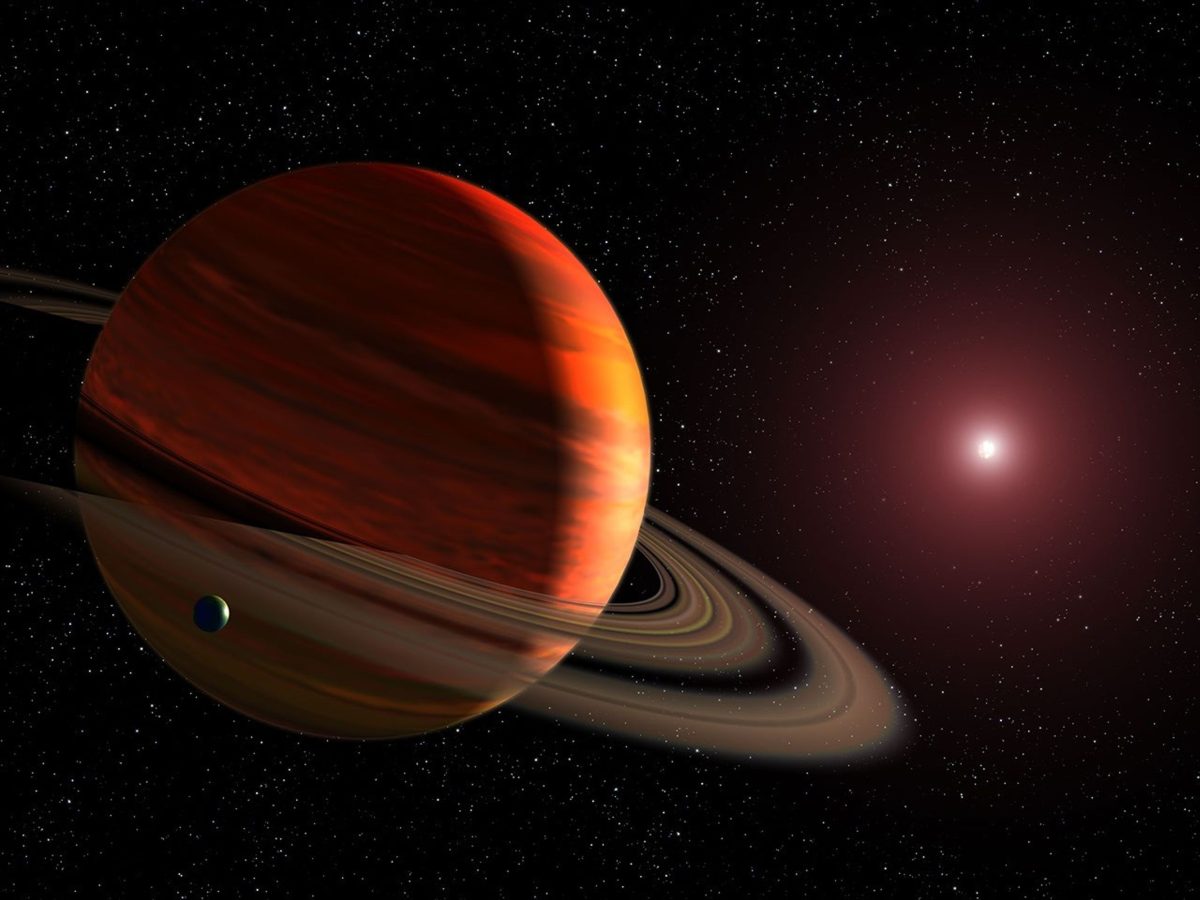
HATS-6 b is approximately the size of Jupiter and orbits an M-type dwarf star — a small, cool, reddish star — every three days. Planets form from the disk of gas and dust left over after a star forms, and smaller stars have smaller disks. However, the giant size of HATS-6 b does not quite fit this rule, considering how small its sun is.
“These smaller stars do not have enough material or time to form planets the size of Jupiter or Saturn,” explained lead author Giannina Guzman Caloca, a graduate student in astronomy at the University of Maryland (UMD). “So the fact that HATS-6 b can exist is really interesting because, based on what we know, this should not be possible.”
Astronomers know of only about 40 such planets. HATS-6 b is one of seven planets being studied as part of a James Webb program called Giant Exoplanets around M-dwarf Stars (GEMS). The program aims to compare these exceptional objects with better-studied giant planets orbiting stars similar to our Sun.
Studying these worlds is of great importance for planet-formation theory. By measuring the composition of their atmospheres, scientists hope to answer the question: did they form in the same way as hot Jupiters around Sun-like stars, or is something different happening here?
The Special Chemistry of Giants Around M-Type Stars
Using a method known as transmission spectroscopy, which involves observing how starlight passes through a planet’s atmosphere, the team detected four molecules in the atmosphere of HATS-6 b: water, methane, ammonia, and carbon dioxide. This discovery marked only the second time that ammonia has been detected on a distant planetary body using this method.
Because nitrogen-containing molecules such as ammonia should be more common on cooler giant planets than on scorching Jupiter-like planets, this discovery supports the theory that planets orbiting M-type dwarf stars may form a chemically distinct group.
The Exoplanet’s High Albedo
The unexpected temperature of HATS-6 b raises another important question. The commonly cited temperature of HATS-6 b — 425 degrees Celsius — is not an exact measurement, but a calculation based on the assumption that the planet absorbs all the light emitted by its star and distributes that heat evenly. However, the scientists’ preliminary analyses indicated a temperature closer to 120 degrees Celsius — a value that is physically unlikely for a planet orbiting its star every three days.
“If the planet really is this cold, it means that something is probably reflecting a significant portion of the starlight back into space, preventing it from heating anything,” explained Guzman Caloca. “The most likely explanation is clouds and haze surrounding the planet in the same way they surround Venus.”
The team’s results are important not only for HATS-6 b. Because a planet’s temperature is taken into account in every calculation of the composition of its atmosphere, such a large discrepancy raises questions about the reliability of the data astronomers obtain about the atmospheres of planets orbiting small, active stars.
Further Observations
Many mysteries remain for Guzman Caloca and her team. Observations at longer wavelengths may reveal other unexplained signals and test whether clouds are indeed responsible for the planet’s unexpectedly low temperature.
Astronomers have discovered more than 6,000 planets beyond our Solar System, and many of them are completely unlike those located closest to Earth. Studying their atmospheres — what they are made of, how they formed, which are similar to Jupiter, and which are unlike anything else — may help scientists determine whether other solar systems formed through mechanisms similar to those of our own.
