

Scientists used data from the Lunar Reconnaissance Orbiter to estimate the number of young faults on the Moon’s surface. These allowed them to determine that our satellite’s radius has decreased by approximately 45 meters over the past few hundred million years.
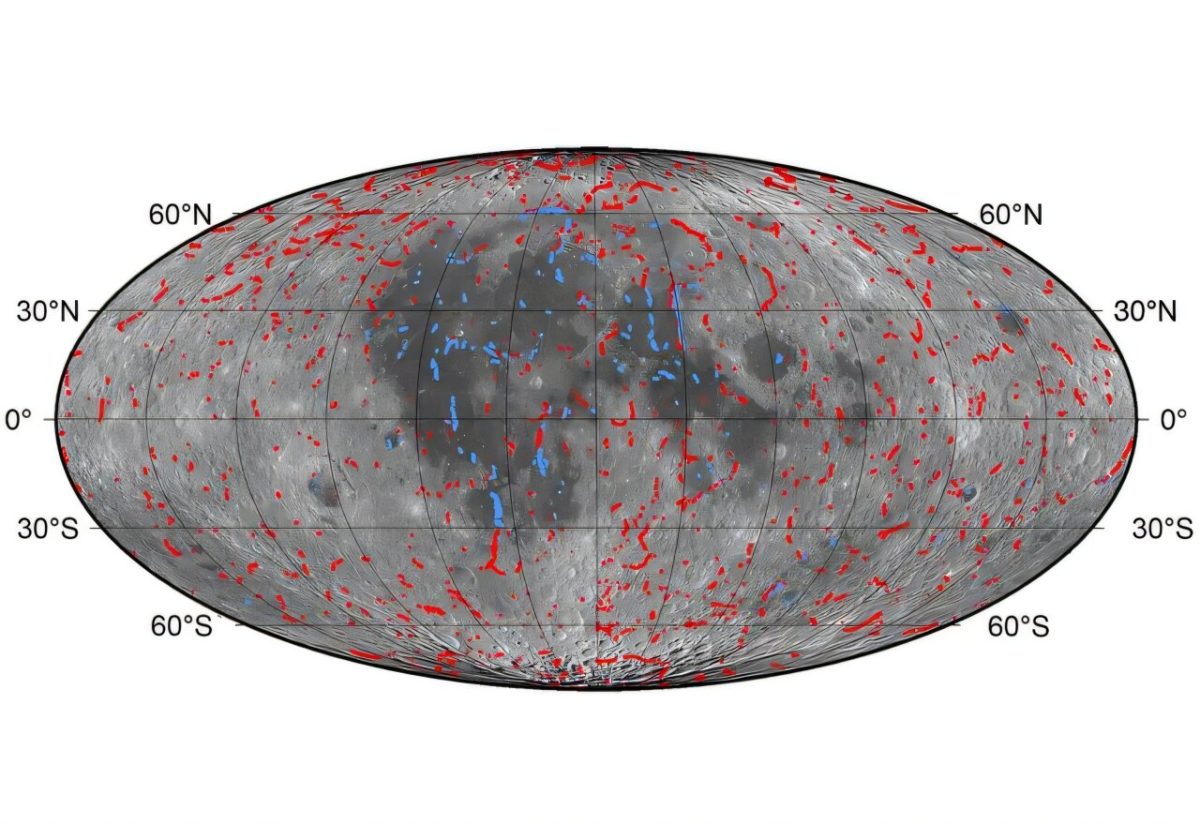
Faults on the Moon
The Moon is gradually shrinking. Scientists have known this for a long time. Recently, however, an international team of researchers published a study in The Planetary Science Journal estimating how much our satellite’s radius has changed in the relatively recent past, according to phys.org.
The Moon’s contraction over billions of years is a normal phenomenon. It is characteristic of all solid bodies in the Solar System, including Mercury. Heat and gases slowly escape from the interior and dissipate into space. Cavities close under the influence of gravity. This process happens incredibly slowly, but whether it amounts to millimeters, meters, or kilometers per million years has remained unclear.
This is where the Lunar Reconnaissance Orbiter helped researchers. It has been operating in lunar orbit for 17 years and has taken thousands of photographs, which were used to compile a global map. That map allowed researchers to look into the past.
Faults and the Moon’s Contraction
Like the Moon, Earth undergoes continuous, slow contraction, but there is a significant difference between the two bodies. Our planet remains seismically active. Its contraction occurs alongside much more powerful processes involving magma flow, which result in the crust being divided into separate blocks—tectonic plates.
On Earth, most tectonic activity occurs near faults as the plates move. The Moon’s crust, however, is continuous. As it contracts, it can only deform slightly and crack. Scientists therefore based their estimate of how much the Moon is shrinking on a count of relatively young faults.
Interestingly, these faults are unevenly distributed across the lunar surface. They are more numerous where the crust is thinner. Their total count indicates that over the past 400–800 million years—a period comparable to the existence of multicellular life on Earth—our satellite’s diameter has decreased by approximately 45 meters.
Scientists cannot say whether this process occurred steadily. If the rate remained constant, however, it would amount to 6–11 centimeters per million years, or 0.1 micrometers per year. For comparison, tectonic plates on Earth move at an average rate of 1.5 centimeters per year—approximately the same rate at which human fingernails grow.
