

NASA specialists examined the condition of the heat shield that protected the Orion spacecraft during its return to Earth at the end of the Artemis II mission. They concluded that it performed effectively during atmospheric flight and could therefore be used on subsequent lunar missions without changes to its design.
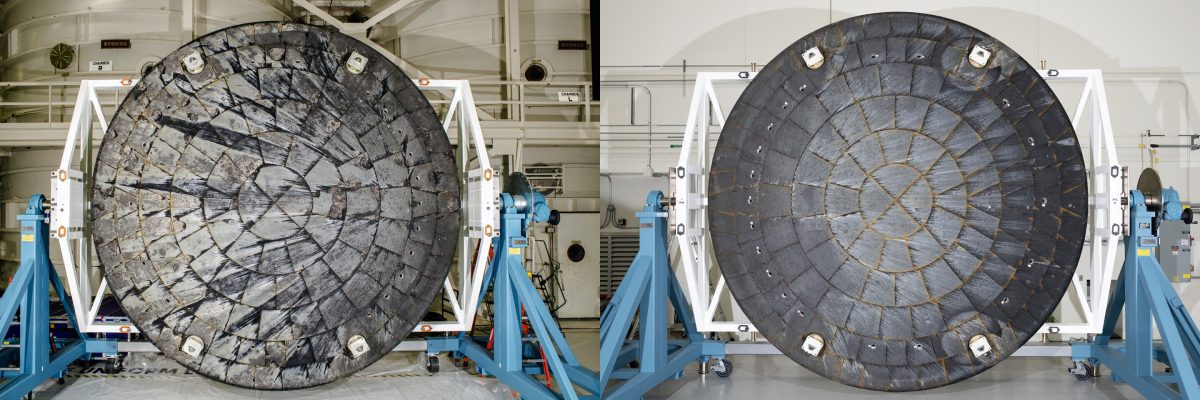
Changing Artemis II’s Reentry Trajectory
NASA’s Artemis II mission, which sent four astronauts around the Moon and successfully returned them to Earth, laid the groundwork for crewed flights to the lunar surface. Further analysis of engineering data from Orion’s heat shield confirmed initial findings showing that the shield performed as expected, according to phys.org.
Specifically, NASA assessed whether the thermal protection system effectively safeguarded the crew and Orion’s systems during reentry into Earth’s atmosphere. This test flight marked the first time astronauts had flown aboard Orion.
Orion reached a maximum speed of 39 times the speed of sound and encountered peak external temperatures exceeding 4,000°F (2,200°C). Meanwhile, the four astronauts inside remained relatively cool, with the cabin temperature at approximately 24°C during their return to Earth from the Moon.
Following NASA’s analysis of the Artemis I heat shield findings, supported by extensive material testing in arc-jet facilities at NASA’s Ames Research Center in California’s Silicon Valley, the agency modified Orion’s reentry trajectory for Artemis II. This shortened the maximum distance the spacecraft traveled between entering Earth’s atmosphere and splashing down in the Pacific Ocean. Premission analysis indicated that limiting this distance would reduce the time the heat shield spent in the temperature range associated with the phenomenon observed on the Artemis I heat shield.
The spacecraft entered the atmosphere precisely, coming within just 192 feet (59 meters) of its planned entry point, and splashed down 0.59 miles (0.95 kilometers) from its intended landing location off the coast of San Diego. Initial inspections of the thermal protection system, including photographs and video taken by divers after splashdown and subsequent inspections aboard the recovery ship, showed that it performed as expected, with significantly less cracking and char loss than on Artemis I.
A Shorter Descent Range Reduced Heat Shield Material Loss
After the spacecraft returned to NASA’s Kennedy Space Center in Florida following its lunar mission, thermal protection specialists began further examination of the heat shield, which consisted of 186 uniquely shaped blocks of an ablative material called Avcoat. The shield was then transported to NASA’s Marshall Space Flight Center in Huntsville, Alabama. There, sample extraction and internal X-ray scanning began in August to obtain additional engineering information about the system and the material’s behavior.
The postflight assessment showed that Orion’s aerodynamic and aerothermal performance, including its heat shield and backshell thermal protection system, matched engineering predictions based on preflight analyses and ground testing. The shorter allowable reentry range reduced cracking and char loss on the Artemis II heat shield tenfold compared with Artemis I, demonstrating the effectiveness of the trajectory change. Engineers found only nine areas of char loss of varying sizes on the Artemis II shield, compared with 103 during Artemis II.
The analysis also showed that Orion’s heat shield design remained unchanged between Artemis I and Artemis II, as demonstrated by the performance of system features such as the seams between the shield’s Avcoat blocks and the Avcoat surrounding the heat shield backing’s separation bolts.
No Signs of Overheating
A postflight inspection of Orion’s backshell—the protective covering on the sloping sides of the crew module, consisting of 1,300 ceramic tiles—showed the expected performance across the module’s surface. Visual inspections showed that backshell components designed to seal and protect openings, including windows, vents, thrusters, and the side hatch, also performed as expected, with no signs of overheating.
The team also conducted a postflight laser scan of the heat shield’s surface and is comparing these data with earlier measurements to determine material erosion, which will then be compared with analytical predictions. Engineers continue to extract heat shield samples at NASA’s Marshall Space Flight Center, alongside further material testing, evaluation, and thermal analysis to support long-term heat shield development, manufacturing efforts, and data collection.
Moving Toward Artemis II
Orion’s performance and the team’s analysis during Artemis II demonstrate the system’s reliability, its ability to support a crew, and key findings that will help improve Artemis III and subsequent missions. Following the extensive examination of the Artemis II heat shield, improvements were made to the Artemis III heat shield design to achieve uniformity and consistent permeability in the Avcoat blocks.
Technicians attached the heat shield to the Artemis III Orion crew module at NASA’s Kennedy Space Center in early July, and Orion’s crew and service modules were joined in late July. Since then, the spacecraft has been powered on for the first time, allowing engineers to verify that all connections between the two modules work as planned.
NASA continues to move toward Artemis III as teams prepare Orion for next year’s mission in low Earth orbit. NASA will launch the SLS (Space Launch System) rocket and Orion spacecraft with NASA astronauts Randy Bresnik, Frank Rubio, and Andre Douglas, along with ESA (European Space Agency) astronaut Luca Parmitano. They will dock with test versions of human landing systems from Blue Origin and SpaceX and demonstrate key systems and operations needed for future lunar landings, beginning with Artemis IV in 2028.
