

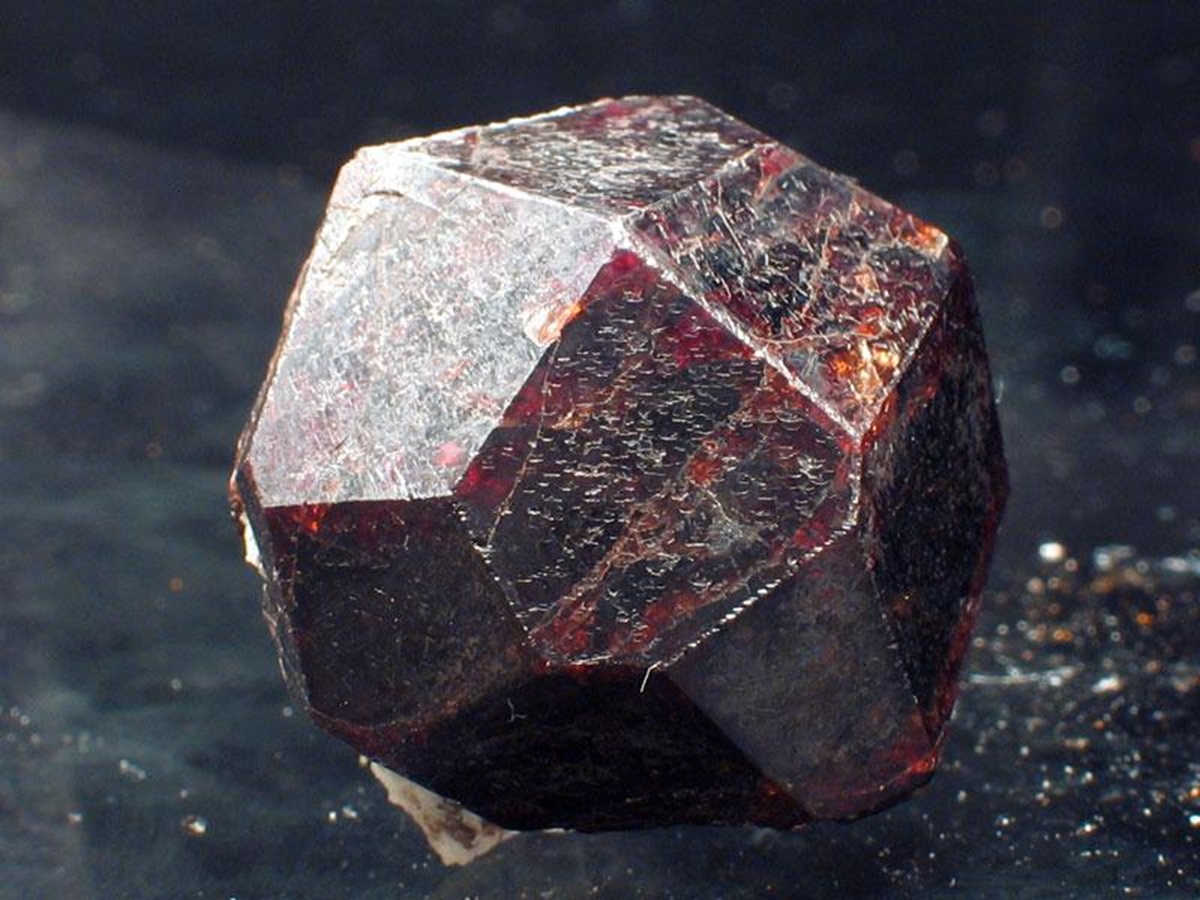
On Earth, garnet is best known as the bright red birthstone for January—widely used in jewelry since the Bronze Age and highly valued by the ancient Egyptians. A team of scientists has now identified a new type of rock containing garnet within a fragment of a meteorite originating from Mars.
Minerals preserve history
Although garnet is relatively common on Earth, its existence on Mars had previously only been hypothesized, with rare microscopic inclusions found in Martian meteorites formed during their ejection from the planet. This is the first time the mineral has been identified in a rock that may have formed directly within the Martian crust.
Mars has been the target of numerous exploration missions since the 1960s, using orbiters, landers, and rovers. While the search for signs of past life has driven much of this effort, it is the planet’s inorganic components—its rocks and minerals—that preserve a record of its 4.5-billion-year history.
Minerals and rocks form through complex interactions between the geosphere, atmosphere, hydrosphere, and even biological activity. Detailed analysis of newly discovered rocks and minerals can help scientists understand how the planet’s geological processes, climate, and potential habitability have evolved over time.
Andradite garnet formed in metamorphic environments
Garnets are a group of minerals that share the same crystal structure but have a wide range of chemical compositions. Some of the most common varieties in this group include almandine and pyrope (deep red January birthstones), as well as andradite and grossular.
The rock identified by researchers contains the garnet variety andradite. It can occur in different colors, but is most commonly yellow or green. It has also been used as a gemstone, sometimes referred to as “demantoid.” On Earth, andradite garnets are typically found in metamorphic rocks known as skarns, which form through intense heating and fluid–rock interaction.
Metamorphic environments on Earth are widespread and diverse due to active plate tectonics, which subjects rocks to extreme pressure and temperature during mountain-building and subduction processes. Mars, by contrast, lacks plate tectonics, and therefore the extent and nature of Martian metamorphism remain largely speculative and limited.
The garnet-bearing fragment of rock that was discovered may indicate a previously unknown metamorphic process on Mars, challenging our current understanding of the range of geological conditions on the Red Planet. It could also have formed in a new type of igneous rock, crystallizing from lava or magma that has never been observed on Mars before. However, despite these exciting possibilities, many uncertainties regarding the origin and formation of the garnet still remain.
Ancient meteorite impact
The meteorite containing andradite garnet, known as NWA 8171, was found in the Sahara Desert in northwestern Africa (NWA) in 2013.
Several pieces of this meteorite are now housed in the collection of the Royal Ontario Museum, including the fragment analyzed by scientists. NWA 8171 is one of 18 Martian meteorites that all originate from the same impact event. The most famous of these is NWA 7034, informally known as “Black Beauty.”
All 18 paired fragments have been confirmed as Martian based on matching trapped noble gases with the Martian atmosphere, as well as their mineral chemistry and overall oxygen isotopic compositions. Oxygen isotopic signatures act like unique planetary fingerprints and are widely used to determine the origin of planetary materials.
NWA 8171 also belongs to a class of meteorites known as Martian polymict regolith breccias. In essence, these meteorites are composed of a mixture of different rock fragments that were broken apart and reassembled on or near the surface of Mars as a result of ancient impact events.
Evidence for Martian origin
Although it has been confirmed that NWA 8171 originates from Mars, determining whether the garnet-bearing fragment also formed on Mars is more challenging. However, the evidence for a Martian origin is fairly strong and includes:
- The chemical composition of pyroxene grains associated with the garnet closely matches typical Martian values. While not as definitive as oxygen isotopes, pyroxene chemistry is often used as a planetary provenance indicator.
- The textures and mineralogy of the garnet-bearing fragment are consistent with other materials observed in NWA 8171.
- The fragment is embedded within a Martian meteorite. While this may seem obvious, it is nevertheless a significant point that should not be underestimated.
Possible exotic meteorites
However, as mentioned above, NWA 8171 is composed of a mixture of rock components, likely assembled on or near the surface of ancient Mars as a result of meteorite impacts. Some of these components could technically include preserved fragments of exotic “non-Martian” meteorites originating elsewhere.
Because of these complexities and the novelty of this garnet-rich rock type, it will likely be necessary to measure oxygen isotopes directly within the fragment to confirm its origin. This type of analysis is destructive, so it has been avoided while other investigations are ongoing.
Regardless of its origin, the discovery of garnet in this meteorite sample will provide new insights into geological processes on Mars and/or into meteorite impacts and material transport within the inner Solar System.
According to phys.org
