

From time to time, astronomers detect strange, almost ghostly radio signals from deep space. They flare up and vanish almost instantly, leaving no time for investigation. These phenomena, known as fast radio bursts (FRBs), are among the most mysterious events in the Universe. They are brief flashes of radio waves, usually lasting tiny fractions of a second, and their unpredictable appearance in the sky has made identifying their origins difficult for nearly two decades.
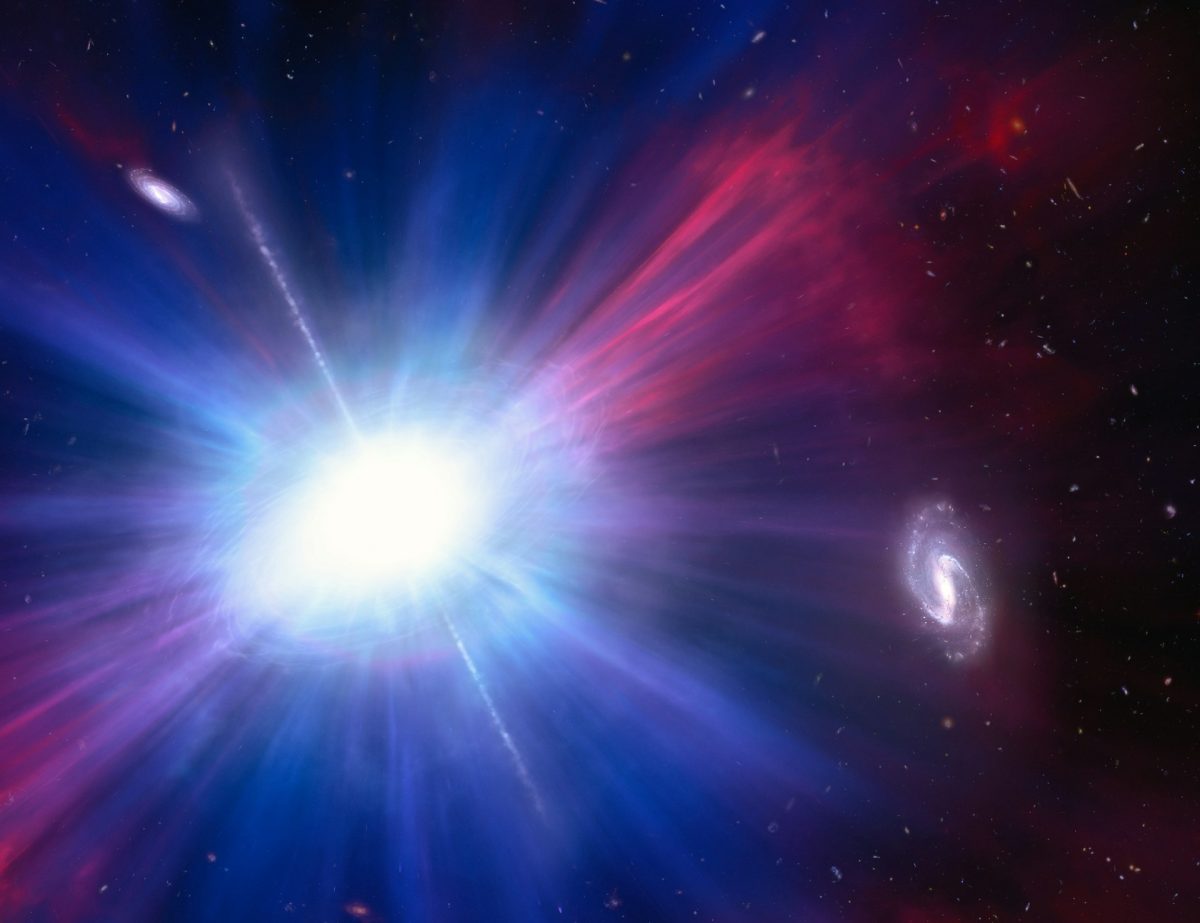
Scientists have now obtained an important piece of evidence. Astronomers reported detecting the most distant radio burst, designated FRB 20240304B. This pulse of ancient energy lasted just 1/1,000 of a second and traveled a distance corresponding to 80% of the Universe’s entire history.
Who Is the Prime Suspect?
The main difficulty in studying FRBs is that there are around 100 theoretical models for their origins. They release enormous amounts of energy at radio wavelengths—comparable to the emission of 500 million Suns within thousandths of a second. On a cosmic scale, however, these are relatively moderate events, nowhere near as powerful as supernova explosions or gamma-ray bursts.
One of the leading candidates for their source is a magnetar. This is a special type of neutron star with an extraordinarily powerful magnetic field, packing the mass of an entire Sun into a sphere the size of Kyiv. Another popular scenario involves a catastrophic collision between two neutron stars, producing a black hole or an extremely massive neutron star.
To uncover the truth about FRB 20240304B, an international team of astronomers drew on powerful observatories around the world and published a study in Science.
Searching for Bursts in the Darkness
The signal was first detected in March 2024 using South Africa’s MeerKAT radio telescope, which consists of 64 antennas. The event occurred during the era known as “cosmic noon”—a period just 3 billion years after the Big Bang, when star formation in the Universe reached its peak.
When astronomers pointed highly sensitive ground-based telescopes at the relevant patch of sky to identify the source’s host galaxy, they saw only darkness. Even the deepest optical images yielded no results.
The situation changed when they brought in the James Webb Space Telescope (JWST), with its exceptional infrared sensitivity. Instead of the massive, well-developed galaxy with a dense stellar population they expected, scientists found a tiny dwarf galaxy actively forming stars.
Why a Magnetar?
The newly identified dwarf galaxy turned out to be 1,000 times less massive than theoretical models had predicted. Moreover, it was exceptionally young: around 90% of its stellar mass had formed within the preceding 30 million years.
This finding became a decisive argument in favor of a magnetar. Neutron stars can orbit one another for billions of years before colliding, which would be impossible in such a young galaxy. Magnetars, by contrast, can form and release their stored magnetic energy within just a few million years, particularly in metal-poor galaxies, which tend to produce massive stars.
A Cosmic Flashlight
Beyond revealing their sources, radio bursts serve as a kind of astronomical probe. Light travels at its maximum speed only in a vacuum. As the signal passed through the cold, ionized gas of intergalactic space, its low-frequency waves slowed more than its high-frequency waves, delaying their arrival. Turbulent gas in the host galaxy further smeared the signal over several milliseconds.
Through this distortion, the FRB 20240304B pulse probed the cosmic structures along its path. It “illuminated” a previously unknown group of galaxies approximately 3.5 billion light-years away and carried the ionic imprint of the Virgo Cluster—the nearest structure of its kind to Earth, located about 54 million light-years away.
Astronomers currently know of only around 100 radio bursts with securely confirmed host galaxies, and most are much closer. Confirmation that such bursts existed so early in cosmic history opens the door to new targeted observing programs at even greater distances.
We previously reported on how the distribution of matter in the Universe was measured using radio signals from deep space.
Based on material from Science Alert.
