

The theory that the Moon formed as a result of a collision between the young Earth and a Mars-sized protoplanet called Theia has dominated the scientific community for more than two decades. However, new computer simulations, the results of which were published on September 1 in The Astrophysical Journal Letters, radically change our understanding of the timing of this cosmic catastrophe. Scientists found that our natural satellite may have formed not over centuries or thousands of years, but in just a matter of hours.
Temperature as the Decisive Factor
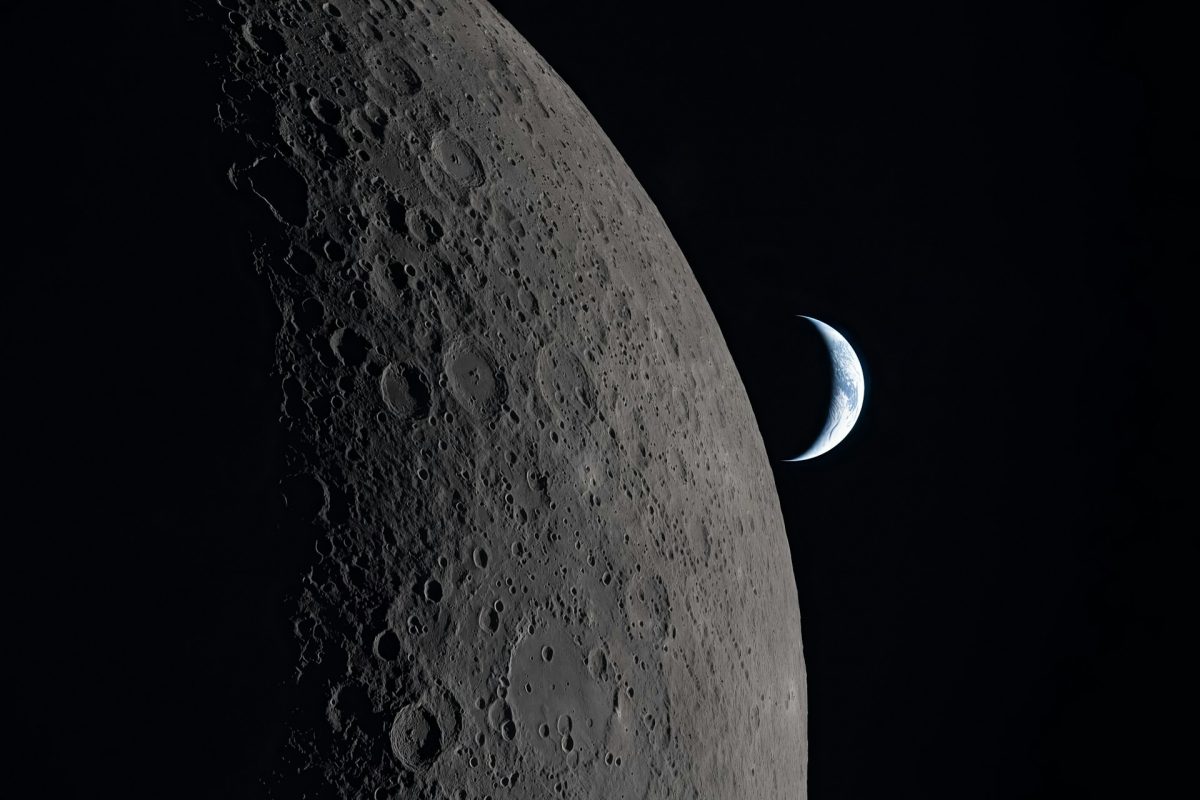
A research team led by Adina Denton of the Southwest Research Institute (SWRI, USA) improved the classical models developed in the early 2000s by planetary scientist Robin Canup. The main innovation of the new study was taking into account the internal temperature and plasticity of the materials of young celestial bodies.
“Warmer objects are weaker than colder ones,” Denton explains. “Given that the collision occurred at the dawn of the Solar System’s formation, Theia’s temperature was crucial to how it deformed and absorbed the impact.”
The simulations showed two fundamentally different scenarios depending on Theia’s age and temperature:
- Cold, slow scenario. If the collision had occurred later — 100–150 million years after the formation of the planets — Theia would have been colder and stronger. In that case, the impact would have created a stable ring of debris from which the Moon would have gradually accumulated over a long period.
- Hot, rapid scenario. If the catastrophe occurred less than 60 million years after the birth of the Solar System, the hot and soft Theia would have been completely destroyed during the impact. The simulations showed that under such conditions, the debris disk formed a fully developed Moon in just 5 hours.
The Isotopic Paradox and Exoplanets
In both calculated scenarios, most of the material of the new Moon should have come from the mantle of the destroyed Theia, with only a small fraction coming from Earth’s mantle. This creates a new puzzle for geochemists, because lunar soil samples show a remarkable isotopic similarity to terrestrial rocks, which current digital simulations still cannot fully explain.
In addition, the discovery has significant implications for exoplanet science. If moons of rocky planets form almost instantaneously, it will be extremely difficult for astronomers to detect dusty disks around exoplanets during their formation, because such structures would exist for too short a time. At the same time, the search for disks around gas giants remains promising, since they form not from collisions but from leftover material during the formation of the planets themselves.
Previously, we reported on how a capsule from the Moon concealed a 4.5-billion-year-old “treasure”.
According to Space