

Bright flashes of energy cut through the colorful cosmos, reminiscent of a scene from a science-fiction movie about an intergalactic battle. In reality, however, what we see is a majestic scene of creation. In a new image from the JWST space telescope, astronomers have captured a unique phenomenon: all stages of star formation occurring simultaneously. This image was selected as the Picture of the Month for June.
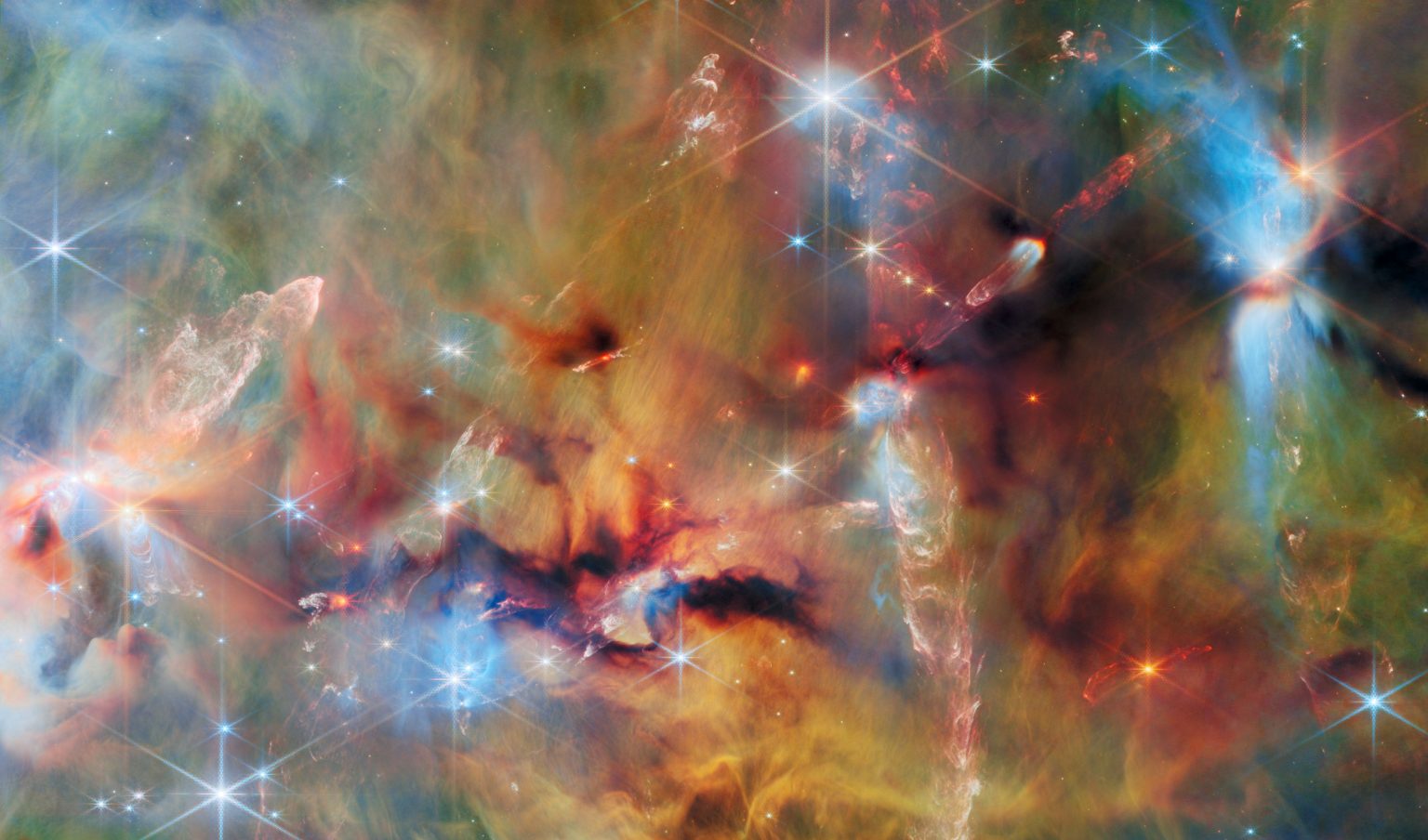
The focus of the study was the OMC-2 region — a dense star-forming zone located within the Orion Molecular Cloud. The new image immerses viewers in the dynamic world of a cosmic “nursery,” where gas, dust, and young stars are in constant motion.
OMC-2 lies slightly south of the famous Orion Nebula, in the area of the “Sword of Orion” asterism, and is a vast accumulation of cold gas and dust. This is where protostars are born — future stars that are still gathering mass.
The Palette of Cosmic Creation
The image impresses with its multilayered clouds of gas and dust, glowing in shades of blue, green, and yellow. Dense, cold dust masses appear in dark brown and black tones — they completely block the light, creating dark gaps across the field of view. Inside these dense cocoons, new stars may be forming right now, still hidden from human eyes.
At the same time, fully formed stars of various sizes are scattered throughout the scene — from tiny orange specks to large white-blue giants shining brightly through the cosmic haze.
Stellar Sculptors
The most spectacular part of the image is the network of faint glowing jets and wave-like lines cutting through the cloud. These structures form when powerful streams of matter from protostars collide at tremendous speed with the surrounding material, carving out bright ridges and shock fronts. Visually, this resembles an elegant cosmic sculpture, showing how young stars literally reshape the space around them.
Each such jet, ridge, or shadow helps scientists trace the movement of matter and study the mechanisms of star formation in greater detail. The complex textures reveal a remarkable interplay of forces: gravity compresses the material, new stars ignite, and their energetic outflows transform the cloud from which they emerged.
The Power of Infrared Vision
This detailed portrait was made possible only thanks to JWST’s infrared instruments. They can see through thick layers of dust that are completely opaque to ordinary optical telescopes, revealing stellar embryos and structures that had previously remained invisible to scientists.
It should be noted that OMC-2 is one of four parts of the broader Orion Molecular Cloud, which extends beyond the nebula of the same name. Nearby are OMC-1, located directly behind the nebula; OMC-3, to the north; and OMC-4, to the south.
Earlier, we reported on how an astronomer spent 70 hours capturing a stunning image of the Orion Nebula.
According to Live Science