

Having your name immortalized in celestial objects is a rare privilege, even for experienced professors. Yet Julian Shapiro achieved this while still in high school. By analyzing publicly available archives of astronomical observations, the young researcher discovered three unusual dwarf galaxies near the large spiral galaxy M101. Today, they are officially known as Shapiro I, Shapiro II, and Shapiro III.
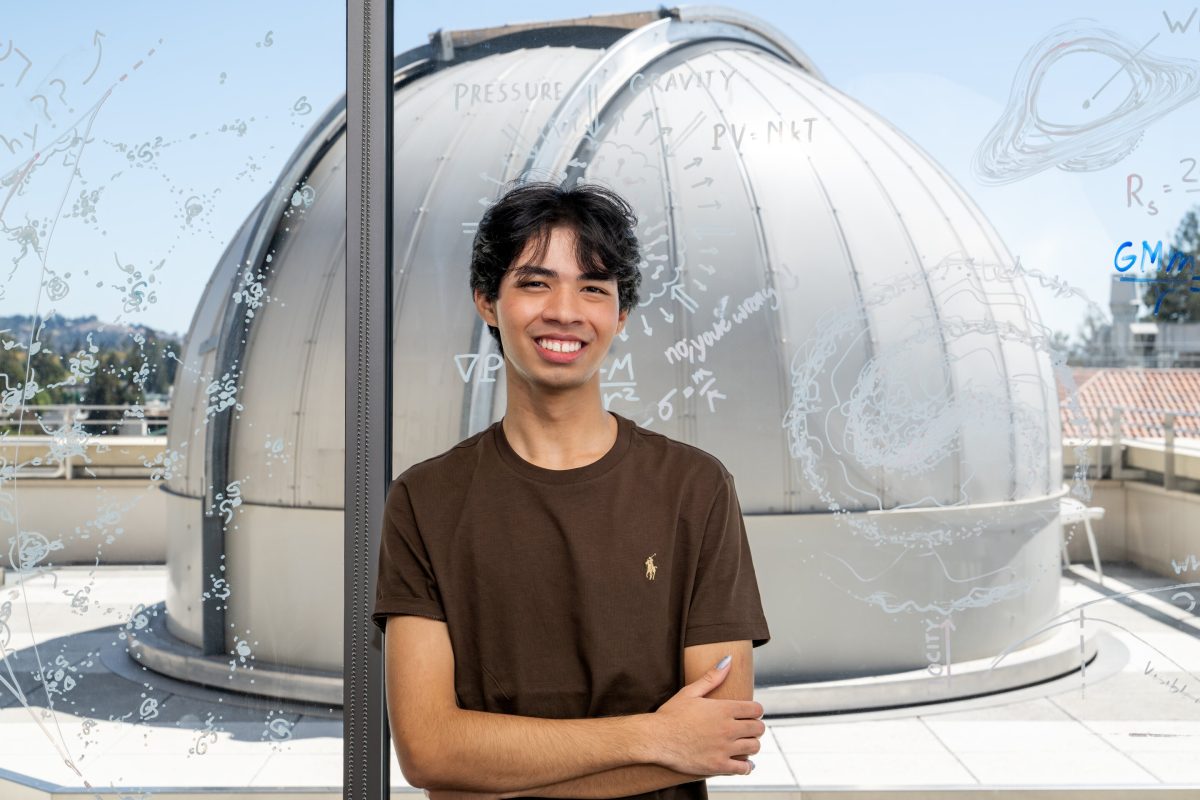
Julian is now studying astrophysics at the University of California, Berkeley, and working in the research group of renowned scientist Alex Filippenko. His high school research earned him a prestigious Davidson Fellowship and a publication in the respected scientific journal The Astrophysical Journal. It also became a striking example of how access to open data enables talented young people to make genuine breakthroughs.
The Mystery of Dwarf Galaxies
Dwarf galaxies are the most common building blocks of the Universe: they can contain anywhere from just a few thousand to several billion stars. They mostly form during cosmic collisions, when interstellar material is pushed into intergalactic space and gradually gathers together.
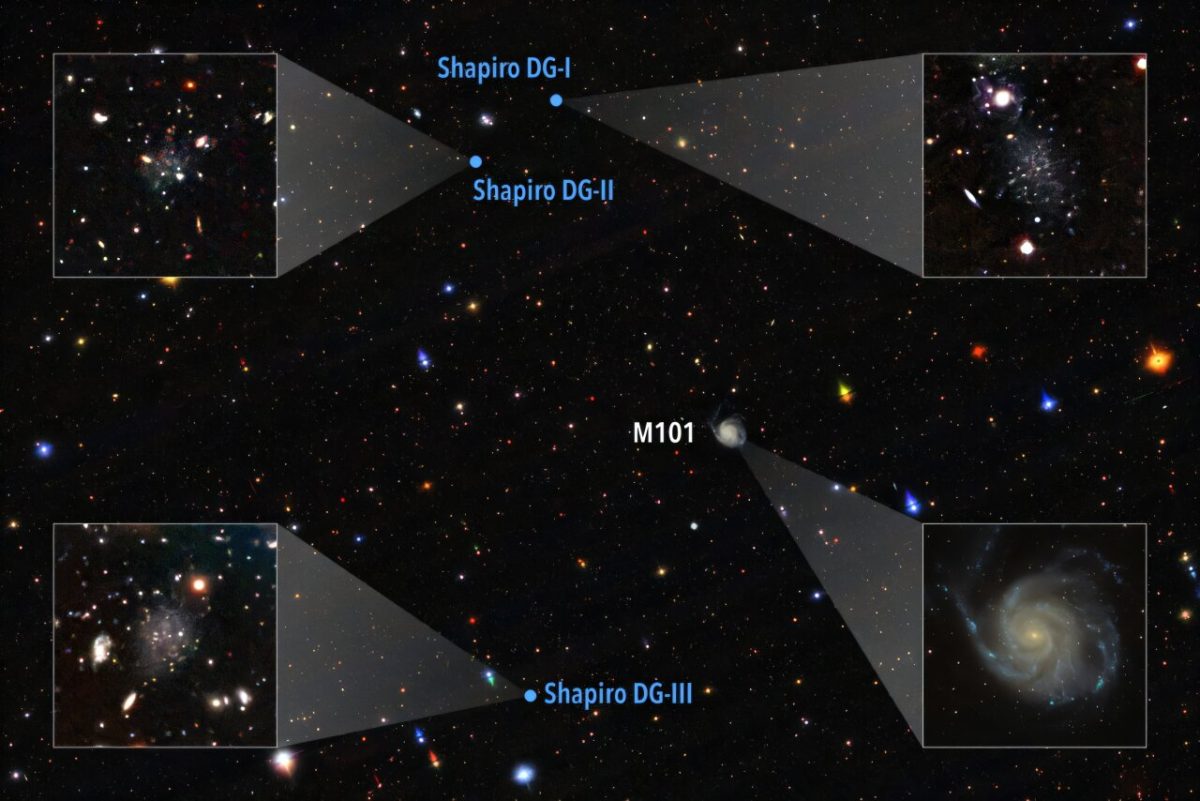
According to conventional expectations, an isolated dwarf galaxy far from giant neighbors should be actively forming new stars, since nothing is stripping away its interstellar gas. Yet the objects discovered by Shapiro defy this rule entirely. Despite occupying relatively empty regions of space, they have almost stopped forming stars—a phenomenon astronomers call “quenching.”
A Cosmic Boomerang
To solve this mystery, Julian conducted a series of computer simulations. The results showed that these systems must have been affected by a powerful external source.
The most likely explanation is that the three galaxies are so-called “backsplash galaxies.” In the past, they passed too close to the gravitational center of the enormous galaxy Messier 101, known as the Pinwheel Galaxy. During this encounter, immense ram pressure and gravitational forces literally stripped the dwarf systems of their entire gas reservoirs needed to form stars, before ejecting them back into intergalactic space.
Meanwhile, one of the systems, Shapiro II, is currently located fairly close to the spiral galaxy NGC 5585, which may indicate additional gravitational interactions.
A Look at the Future of Cosmology
The existence of such objects is predicted by the standard cosmological model with cold dark matter, but finding them in our “cosmic neighborhood” has so far proved extremely difficult. Shapiro’s careful distance calculations make it possible to develop new algorithms for finding similar galactic outcasts in the future.
The young scientist is now preparing for further observations with high-resolution space telescopes to precisely measure the orbital parameters of the systems he discovered. New observatories, including the Vera C. Rubin Observatory, are expected to help identify hundreds of similar objects soon and definitively confirm the theory formulated by the young astronomer.
We previously reported on how a teenager discovered 1.5 million previously unknown celestial objects in the Universe.
Based on material from Universe Today.
