

Astronomers have used the James Webb Space Telescope to study gas clouds orbiting the supermassive black hole at the center of our Galaxy. According to the new observations, enrichment with metals—any elements heavier than hydrogen and helium, including carbon, oxygen, iron, and gold—likely occurred through the explosions of many generations of stars.
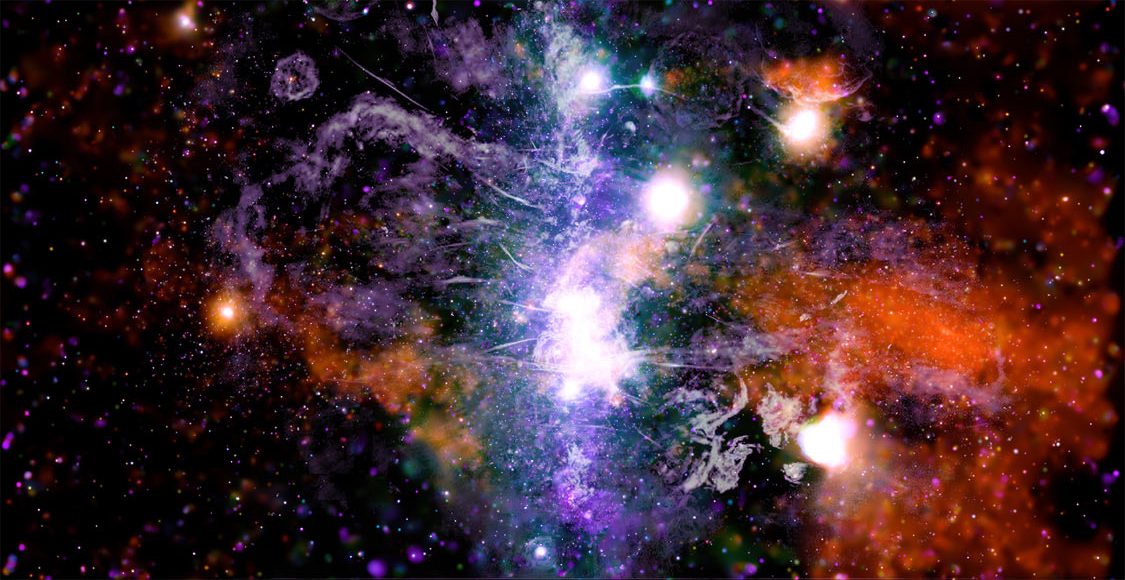
The Environment Around the Supermassive Black Hole Sagittarius A*
We know that a black hole, Sagittarius A*, lies at the center of our Galaxy and draws in matter. However, it consumes much less material than other supermassive black holes and does so more slowly, as reported by www.sci.news.
To understand why, scientists need to examine the properties of the material available for it to consume, including the gas, dust, and stars orbiting it.
As part of the study, Nicole Ford, a graduate student at McGill University, and her colleagues analyzed data obtained with the James Webb Space Telescope, a joint project of NASA, ESA, and CSA.
The telescope measures infrared radiation across a broad range of wavelengths with unprecedented spectral and spatial resolution.
This allowed the authors to distinguish the thermal signatures of numerous gas clouds orbiting near Sagittarius A*. It also enabled them to determine the metal composition of each cloud precisely.
Possible Energetic Outbursts in the Past
In a companion study published in The Astrophysical Journal, McGill University astronomer Mayura Balakrishnan and colleagues searched the gas for traces of past energetic outbursts from the black hole.
They found that local conditions influence the gas’s emission so strongly that the black hole’s effects are difficult to isolate. This does not rule out past outbursts, but it means that the gas cannot serve as reliable evidence of the black hole’s history.
“To understand how the black hole draws in matter, we need to compare these observations with simulations of how the gas evolves over longer timescales,” Ford said.
