

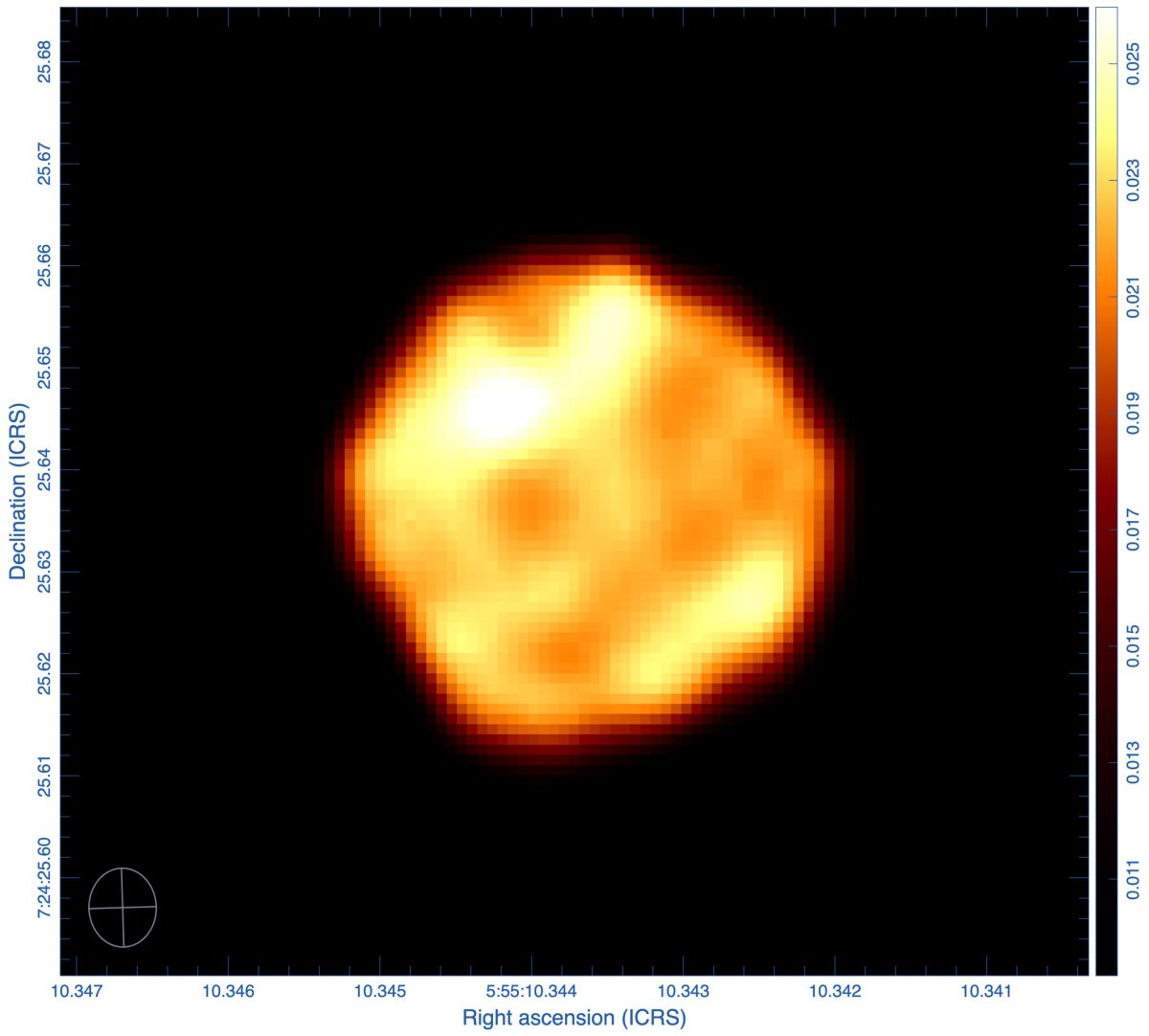
For the first time since its dramatic dimming in 2020, a group of astronomers has observed Betelgeuse’s inner atmosphere using the Atacama Large Millimeter/submillimeter Array (ALMA). They found that its surface is deformed and covered with spots. This may be connected to a companion star.
The “Great Dimming”
A team led by Bill Dent of the University of Manchester found that the inner atmosphere of this giant star is becoming increasingly uneven and asymmetric, which may possibly be related to a much smaller companion star.
For astronomers, Betelgeuse is one of the best-known objects in the night sky. Today, its light is being intensively studied across the entire electromagnetic spectrum, but over the past few years the star has been changing rapidly. “Betelgeuse is one of the nearest red supergiants — stars that will inevitably explode as supernovae, but in the meantime pollute interstellar space with powerful stellar winds,” Dent explains.
One particularly dramatic change occurred in 2020, when the star suddenly became about 2.5 times dimmer — an event that has since become known as the “Great Dimming.” This left many questions about the changes now rapidly taking place on Betelgeuse’s surface and in its inner atmosphere.
Astronomers have found that as all red supergiants age, these layers become increasingly nonuniform, forming bright spots and regions that sharply contrast with the rest of the stellar surface. Dent’s team suggested that these changes might be connected with the “Great Dimming,” but clearer observations were needed to confirm the hypothesis.
Studying the Star with ALMA
The researchers observed Betelgeuse using ALMA — an array of 66 radio telescopes in Chile’s Atacama Desert that produces images with extremely high resolution. The last time ALMA was specifically pointed at Betelgeuse was in 2015, before the “Great Dimming.”
Importantly, ALMA can detect wavelengths in the range of 0.6–1.4 mm originating from a layer located directly above Betelgeuse’s visible surface, thereby tracing the innermost part of its extended atmosphere. To maximize image resolution, Dent’s team used the longest possible baseline of the array, making measurements with pairs of antennas positioned as far apart as possible.
In addition, thanks to favorable weather conditions and state-of-the-art data-processing methods, “we were able to obtain images of ionized and molecular gas with a resolution of up to 7 milliarcseconds — equivalent to resolving objects 13 meters across on the surface of the Moon,” Dent says.
Spotted and Asymmetric
As previous studies had predicted, the observations showed that since 2015 Betelgeuse’s inner atmosphere has become more spotted and asymmetric, with temperatures in some hot spots about 800 degrees higher than in the surrounding regions.
ALMA also detected peaks and depressions on the star’s surface, indicating the presence of enormous convective cells. Stars like the Sun are covered with such cells, which form when heated gas rises, expands into the atmosphere, then cools and sinks back below the surface. In this case, however, the irregular pattern of hot spots points to a smaller number of much larger convective cells in Betelgeuse’s atmosphere.
“The brightest hot spot was also seen in the 2015 data, suggesting that the convective cells are actually quite persistent,” Dent says. “This also confirmed that the hot spots are predominantly aligned along a particular direction.”
The Companion Star May Align the Spots on the Stellar Surface
Interestingly, this alignment appears to be connected with the orbit of a much smaller nearby companion star, for which astronomers found convincing evidence in July 2026. “If the orbit of this companion is aligned with Betelgeuse’s equatorial plane, this could mean that the brightest and most persistent hot spots are located near the polar regions, where convection may be more active and stable,” Dent predicts.
With follow-up observations, astronomers hope to confirm this orbital connection. By gaining a deeper understanding of the irregularity and asymmetry seen in Betelgeuse’s atmosphere, researchers may ultimately obtain the clearest picture yet of how red supergiants shed their outer layers at the end of their lives.
