

Two planets will dominate the sky in July: Venus will be prominent in the evening, situated low above the western horizon, while Saturn will be visible with a golden glow prior to dawn. Mars is progressively ascending higher in the morning sky. Additionally, early July will feature a rare event associated with this planet. Enthusiasts of challenging observational tasks may observe Mercury shortly before sunrise during the final days of the month, as the planet gradually approaches its greatest western elongation.

The season of Jupiter has concluded. As observed from Earth, the planet is gradually approaching the Sun, and on July 29, an alignment will occur — Jupiter will pass nearly directly behind the Sun. It is anticipated to be visible in the morning sky in late August.
The most active meteor shower in July is the Southern Delta Aquariids. This shower has a very broad radiant; it will be observable from July 12 through August 23, with its peak occurring on July 31, when the Zenithal Hourly Rate (ZHR) is expected to approach 25. It is important to note that the radiant of this shower does not ascend significantly in our latitudes, thereby substantially diminishing the number of visible meteors. Furthermore, this year’s peak coincides with a nearly full Moon, which will further reduce the meteor count to approximately 1–2 per hour even in rural areas.
Although it may appear paradoxical, during July — one of the warmest months of the year — Earth attains its aphelion, which is the point in its orbit farthest from the Sun. The Earth’s orbit is slightly elongated and is an ellipse rather than a perfect circle, with the Sun positioned at one of its foci. Consequently, the total amount of solar energy received by our planet varies minimally throughout the year. Nevertheless, it is important to recognize that the seasons result from the tilt of Earth’s axis: due to this axial tilt, the Sun’s rays strike the Earth’s surface at a more oblique angle during the summer, thereby effectively heating the surface during the extended daylight hours.
July presents an excellent opportunity to observe the most luminous segment of the Milky Way. The optimal viewing conditions will occur around the mid-month period, coinciding with the new moon. To fully appreciate this celestial display, it is advisable to depart from urban areas and seek locations distant from significant light pollution. As the sky darkens and the faint band of the Milky Way becomes visible, direct your gaze toward the southern sky — specifically toward the constellations Sagittarius and Ophiuchus, which contain a multitude of deep-sky objects. Some of these objects may be visible to the naked eye, while others will necessitate the use of binoculars or a telescope.

General astronomical circumstances
July 4 — conjunction of Mars (+1.4m) and Uranus (+5.8m) in the morning sky; the two planets will be separated by only 6′, which is 5 times smaller than the diameter of the Moon.
July 6 — Earth reaches aphelion, the farthest point in its orbit. The planet will be 152,087,774 km from the Sun.
July 8 —before dawn, the Moon (48%) will be in close proximity to Saturn (+0.8m). The conjunction is scheduled to occur on July 7 at 8:31 p.m. UTC, at which point the separation between the two celestial bodies will be 5.1°.
On July 11 — conjunction of the Moon (16%) and Mars (+1.3m) in the predawn sky. Please be advised that the celestial bodies will be positioned quite low above the eastern horizon.
July 14 — new moon, precise timing at 12:43 p.m. Kyiv time (09:43 a.m. UTC).
July 17 — conjunction of the Moon (14%) and Venus (-4.2m). At 5:47 p.m. (2:47 p.m. UTC), the two celestial bodies will be separated by a distance of only 1°47′.
July 29 — full moon, precise timing at 5:36 p.m. Kyiv time (2:36 p.m. UTC).
A detailed overview of the most interesting circumstances
July 4: When Mars is approximately “touches” Uranus
Should you have never had the opportunity to observe Uranus, this presents an optimal occasion. Mars is readily visible to the naked eye, whereas a telescope or binoculars are required for a clear view of Uranus. The conjunction is scheduled to occur on July 4 at 09:10 a.m. (06:10 a.m. UTC), at which point the angular separation between the two planets will diminish to 6.3 arcminutes. Nevertheless, the configuration will not differ significantly within a few hours before or after this specified time. Consequently, the optimal period for observation is prior to dawn on the same day. An unobstructed eastern horizon is imperative for a successful observation.
The optimal viewing time is approximately 3:30 a.m., contingent upon your geographical location; therefore, it is advisable to consult a virtual planetarium. The reddish hue of Mars will be situated nearly precisely between two prominent star clusters in Taurus — the Pleiades and the Hyades. When observed through a telescope or binoculars, the celestial body nearest to Mars will almost certainly be Uranus. Both planets can be captured within a single field of view. From an observational perspective, Uranus will differ from the stars in that it exhibits fewer ‘sparkles’ and manifests as a small disk observable with moderate-power optical instruments.

July 6: The point farthest from the Sun
Throughout the year, the distance between Earth and the Sun varies due to the planet’s elliptical orbit. Annually, the Earth attains its maximum distance from the Sun at a slightly different time. Specifically, in 2026, this will occur on July 6 at approximately 8:00 p.m. (5:00 p.m. UTC), when the distance will be 152,087,774 km. The Earth will be closest to the Sun on January 3, 2027; the distance will decrease to approximately 147,098,291 km. Despite this difference — which is negligible by cosmic standards — Earth receives approximately 7% less solar energy at aphelion than at perihelion.
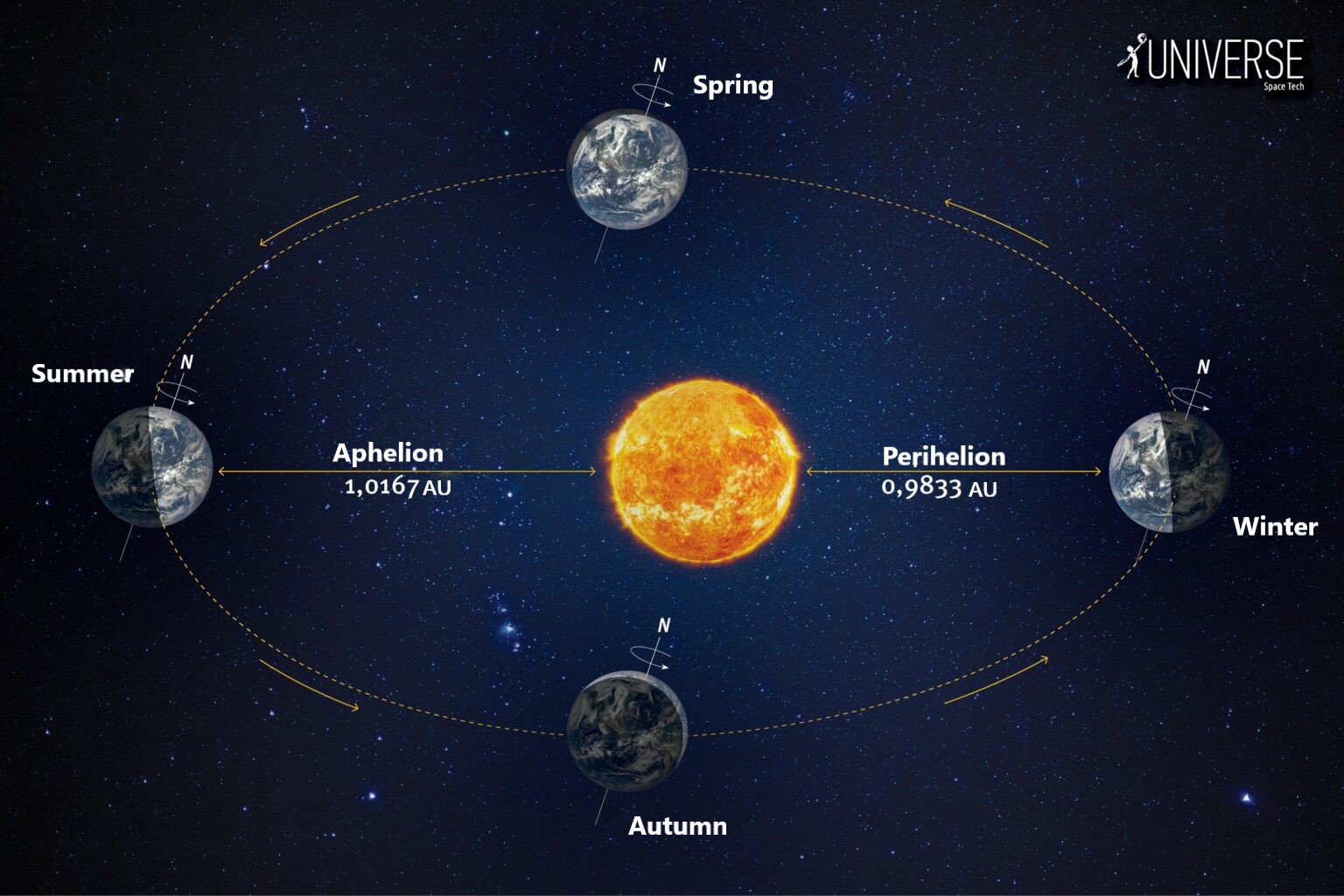
According to Kepler’s laws, the Earth traverses the aphelion at a marginally reduced velocity compared to its velocity at perihelion. Consequently, this results in the summer duration in the Northern Hemisphere being slightly longer than that of winter.
Is there a method to observe this event? Certainly, yes. One approach involves capturing a photograph of the Sun on the day it attains aphelion, and then, six months subsequently — on the day it reaches perihelion — and subsequently comparing the angular diameters of the Sun on these two occasions.

Photo: Michael Tech
July 14: Nights dedicated to deep-space objects
During multiple nights preceding and following the new moon, the sky remains devoid of excessive light pollution. This interval represents the optimal period for observing faint deep-sky objects such as nebulae, star clusters, and galaxies. However, this opportunity is contingent upon being situated under a dark, rural sky.
This month, we advise concentrating on celestial objects within the Milky Way. For novices, it is recommended to direct your telescope or binoculars towards any segment of the faint, milky-white band and gradually scan along it. You are highly likely to discover an array of star clusters. Please relax and observe where this exploration leads.
More experienced observers are encouraged to undertake a concise excursion through the notable highlights of the Milky Way’s most remarkable region. Just above the southern horizon, observers will be able to discern objects such as the Eagle Nebula (M16), the Lagoon Nebula (M8), the Trifid Nebula (M20), the Small Sagittarius Star Cloud (M24), along with numerous other star clusters.

July 17: An excellent opportunity to observe Venus in the daytime sky
The conjunction of the Moon and Venus on July 17 presents a rare opportunity to observe the brightest planet in the Solar System with the unaided eye during daylight hours. At 5:47 p.m., the Moon and Venus will be separated by merely 1°47′ — approximately three lunar diameters. This period can be regarded as the most favorable for these exceptional daytime observations.
An undeniable benefit of conducting daytime observations of Venus is the lack of excessive brightness, which, when contrasted against a dark sky, hampers the ability to discern the planet’s phase. The phases of Venus change similarly to those of the Moon, contingent upon the relative positions of the planet, the Sun, and Earth. Notably, on July 17, the phase will be at 62%.
For successful observations, select a location effectively shielded from direct sunlight by a building or dense tree canopy. It is highly probable that the Moon will be easily observable at the 14% phase. Venus will be positioned slightly higher than the crescent Moon. An equally suitable alternative involves conventional evening observations: Venus and the emerging Moon in the western sky are remarkably picturesque, notwithstanding the slight increase in the distance between them.

