

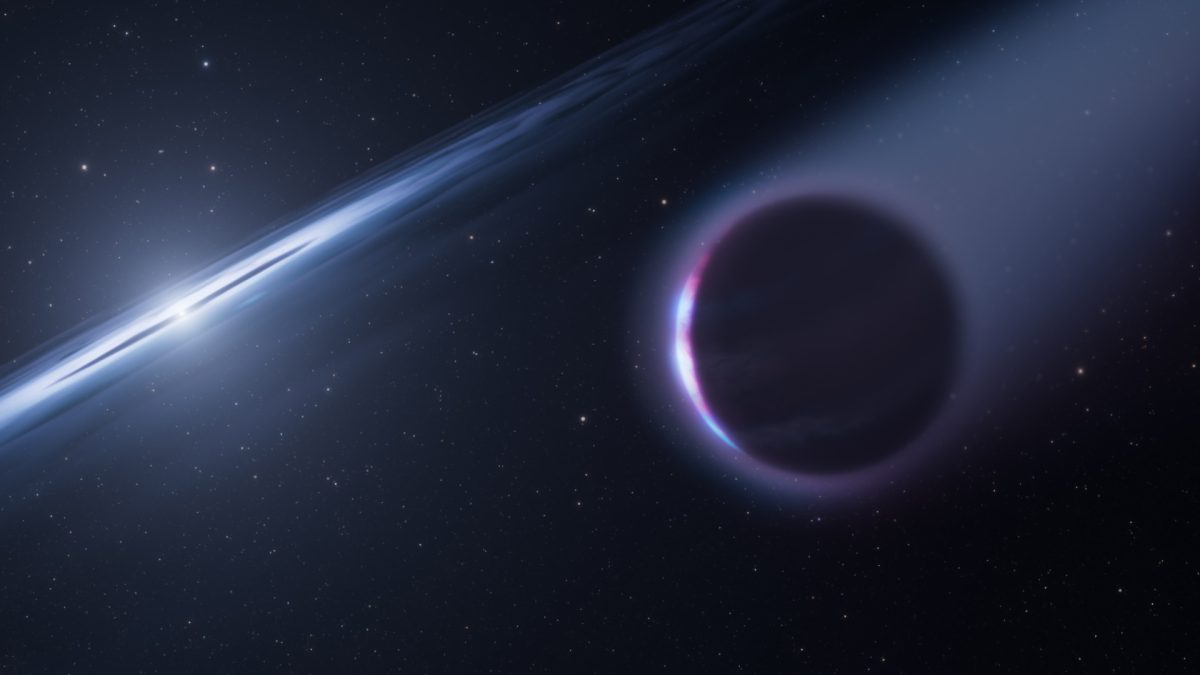
The unusual chemical composition of the atmosphere of the white dwarf HS 0209+0832 has attracted scientists’ attention. They believe it is orbited by a second-generation planet that must have formed after the star had already passed through its red giant phase.
The Unusual Chemistry of a White Dwarf’s Atmosphere
Planets are thought to form alongside their stars, but new research suggests they can also be born later, from the debris of a dying star. According to the science news website www.sci.news, one such unique alien world may lie very close to HS 0209+0832, a hot, young white dwarf located 270 light-years away in the constellation Cetus.
White dwarfs, the dense remnants of stars like the Sun, often show metals in their atmospheres. These metals usually come from shattered asteroids and other rocky bodies, with compositions resembling material found in the Solar System. HS 0209+0832 is a peculiar exception.
“The far-ultraviolet spectrum of HS 0209+0832, obtained in 1999 using the Space Telescope Imaging Spectrograph (STIS) aboard the NASA/ESA Hubble Space Telescope, revealed carbon, aluminum, silicon, calcium, titanium, nickel, and zinc in its atmosphere, along with 100 unidentified lines,” said University of Warwick astronomer Jamie Williams.
Although the presence of helium and metals indicated ongoing accretion, the nature of the external source remained uncertain.
Heavy Elements Point to a Secondary Accretion Disk
In the study, astronomers reanalyzed archival data from Hubble’s STIS instrument, the FUSE and UVES instruments mounted on ESO’s Very Large Telescope, and broadband photometric data from Pan-STARRS and ESA’s Gaia satellite.
The abundance of niobium was more than a thousand times higher than in the Sun. Meanwhile, the researchers found no niobium in any of the 33 other metal-polluted white dwarfs they examined. Nickel appears to be at least twice as abundant as iron, whereas the Sun, Earth, and primitive meteorites contain far more iron than nickel.
These abundances do not match any known meteorite or any other material found accreting onto a white dwarf, and the star is not consuming a body rich in volatile ices either.
“Niobium and other elements heavier than iron are astronomically special because, unlike many common elements, they are not produced through nuclear fusion in stellar cores,” said Dr. Nicholas Stone, a theoretical astrophysicist at the University of Wisconsin–Madison. “Instead, these heavy elements can only be synthesized under exotic conditions that briefly arise in dying stars.”
A Giant Planet Near a White Dwarf
According to the researchers, when a star expands into an asymptotic giant branch red giant, it produces many heavy elements through slow neutron capture—the s-process—and ejects them in stellar winds. They argue that material from these winds, rich in carbon and s-process elements, could have formed a disk around the star late in its life, and that a giant planet could have grown within it.
Models of nucleosynthesis during the AGB phase predict precisely this enrichment in niobium, nickel, copper, and zinc, with only minor changes in oxygen, silicon, calcium, or iron. The white dwarf’s composition indicates that it is accreting matter from a second-generation planet candidate.
Scientists believe that if a second-generation planet is present, it will most likely survive. This would be because the white dwarf will cool and then maintain a stable temperature, while the planet will remain in its stable habitable zone for millions of years.
A New Character in a Star’s Story
Using data from NASA’s Transiting Exoplanet Survey Satellite (TESS), scientists detected recurring brightness variations with a period of approximately 4.4 days. This is considerably longer than a typical white dwarf rotation period of around 1.25 days.
The signal could arise from the contrast between daytime and nighttime temperatures on a giant planet orbiting at approximately 0.04 astronomical units.
“Rather than the white dwarf stage being a kind of epilogue to the story of a star and its planets, this study shows that the systems we know are only the first chapter of a potentially much longer story, with new characters appearing. That is a truly exciting prospect to work on,” Williams said.
