

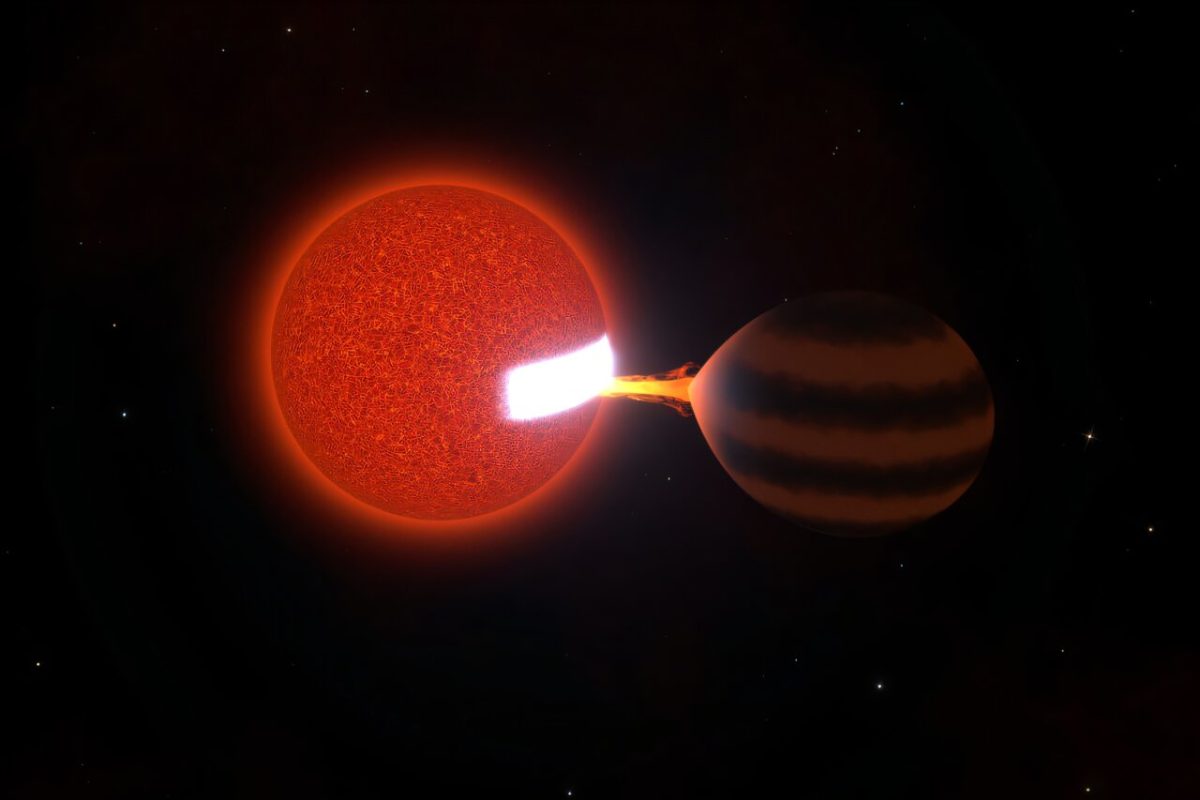
A brown dwarf in an extremely tight orbit is slowly losing material, which flows onto a small neighboring star. The stream of gas strikes the star’s surface directly, heating a bright spot that causes unusual changes in the system’s brightness. This is the first observation of stable mass transfer from such an object to an ordinary star. The process could continue for billions of years.
An Orbit Smaller Than the Sun
The ZTF J0440+2325 system lies in our Galaxy, approximately 300 light-years from Earth. It consists of a red dwarf—a small star—and a brown dwarf. Such objects are more massive than any planet but too light to be fully fledged stars. The pair completes an orbit every 87 minutes, and the entire orbit would fit inside the Sun.
The star has approximately 85 times Jupiter’s mass, or about 8% of the Sun’s mass, while the brown dwarf has about 25 Jupiter masses. The star itself therefore barely exceeds the threshold of approximately 75 to 80 Jupiter masses, below which sustained hydrogen fusion cannot begin in an object’s interior. The findings were published in the peer-reviewed journal Nature Astronomy.
Slow Mass Transfer
Astronomers usually expect a different outcome. As an orbit shrinks or a star expands, a close companion eventually becomes engulfed and is destroyed. Earth is predicted to meet this fate when the Sun becomes a red giant.
Theory also allowed for a slower scenario, but it had never been observed before. According to the authors’ estimate, cited by Phys.org, the brown dwarf loses approximately one hundred-thousandth of Earth’s mass each year. That is less than one thousandth of the Moon’s mass. For such a massive object, this is a very slow rate, so the process could continue for hundreds of thousands or even billions of years.
A Strange Triangle
The system was first noticed in data from the Zwicky Transient Facility sky survey, which uses a camera on a telescope at Palomar Observatory to track rapid changes in brightness. Several years ago, Massachusetts Institute of Technology physicist Kevin Burdge found a brightness curve in the data that formed a triangle, repeating over and over.
Burdge initially suspected that it was a “black widow” binary, in which a neutron star gradually destroys a much smaller companion star. Such systems are identified by a pronounced wobble—periodic shifts in spectral lines caused by the lightweight companion’s rapid motion. No wobble appeared in the initial data, so the signal remained unexplained for years.
Recently, Aaron Householder, a graduate student at the same institute, finally measured the wobble using several telescopes. It turned out to be much weaker than in “black widow” systems. Its amplitude was nevertheless sufficient to identify the pair.
Falling Directly onto the Surface
Accretion—the fall of material onto another object—is usually associated with black holes and neutron stars. Around these objects, material swirls into a disk. The star is much larger in size, so the stream from the brown dwarf strikes its surface directly at high speed, like an asteroid hitting the Moon.
Simulations of the motion of particles in the stream confirmed that they do indeed fall onto the star. As the pair orbits, the hot spot at the impact site alternately turns toward the observer and disappears from view. The peak of the triangle in the brightness curve corresponds to the moment when the spot is most clearly visible.
The paper describes another candidate: ZTF J1444+4820, a binary with a 67-minute orbital period that forms part of a triple system. New searches, which the team has already begun, should reveal how many such pairs exist in the Galaxy.
