

An international team of astronomers led by Indranil Banik of the University of Portsmouth has found a new and original way to calculate the age of the Universe. Instead of looking into deep space, scientists studied our nearest surroundings — “stellar fossils” inside the Milky Way. The new study, whose results were published on the arXiv preprint server, could become a decisive argument in a long-running dispute among physicists and confirm the correctness of the standard cosmological model.
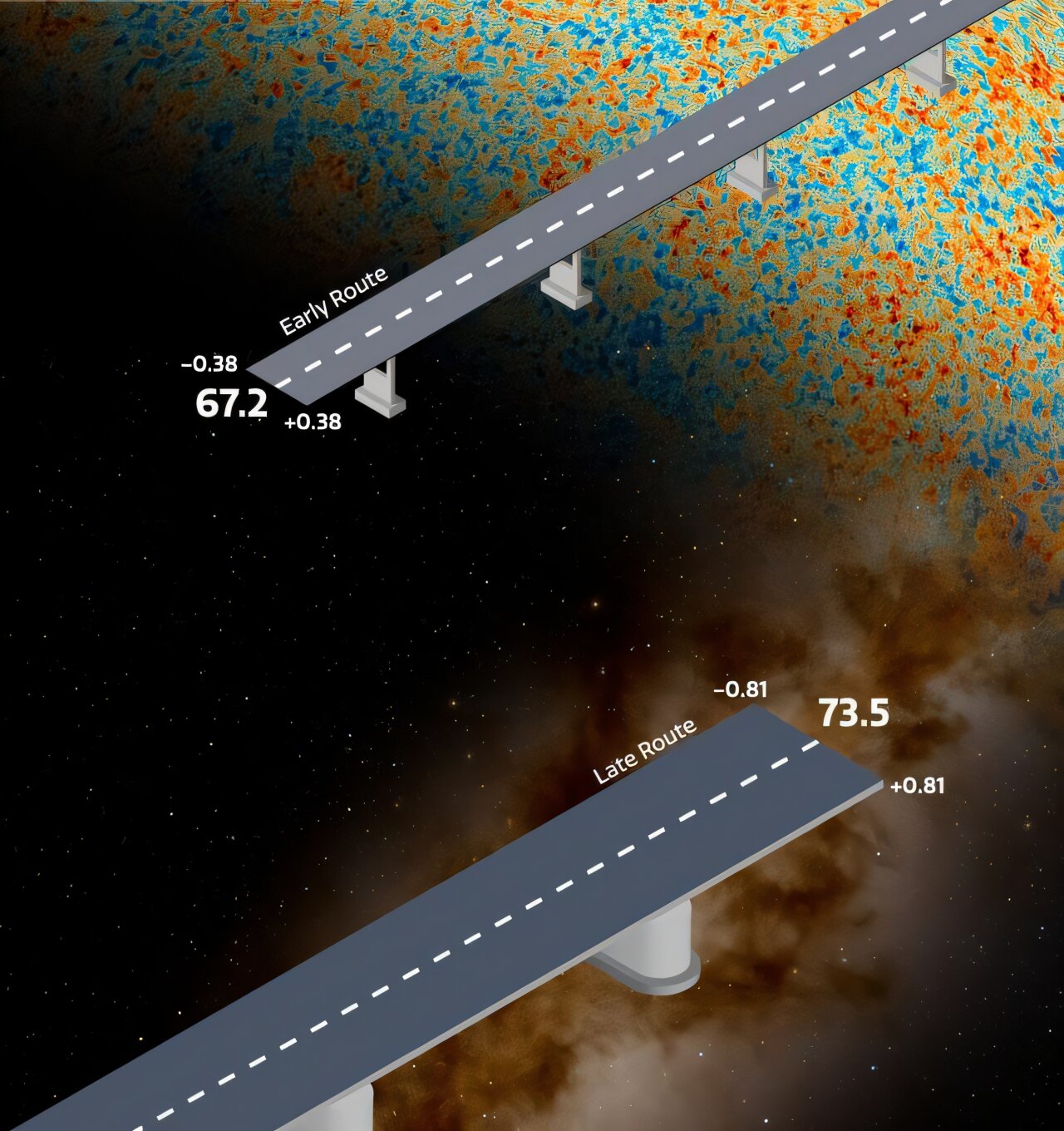
Today in cosmology there is a serious contradiction known as the “Hubble tension.” Astronomers have two main ways of determining the expansion rate of the Universe (the Hubble constant), but they give different results:
The first method is based on the analysis of the cosmic microwave background (CMB), the remnant radiation left over from the Big Bang. Combined with the standard cosmological model ΛCDM, it gives an age of the Universe of about 13.8 billion years.
The second, local method, relies on observations of objects in our cosmic neighborhood, such as pulsating Cepheid stars and Type Ia supernovae. If interpreted within the same ΛCDM model, this would correspond to a slightly younger Universe—only 12.5 to 12.9 billion years old.
The 9% difference has led scientists to theorize about “new physics” that could change the rules of the game in the early universe. The new study doesn’t resolve the Hubble tension, but it does show that the ages of the oldest stars in the Milky Way agree well with the estimate of 13.8 billion years obtained from the analysis of cosmic microwave background radiation.
Stellar archaeology
To settle the matter, the authors of the new study turned to stellar archaeology. If we find a star in space that is 13 billion years old, then logically the Universe itself cannot be younger than that star. Moreover, it needed about another 200 million years after the Big Bang for the first stars to be born at all.
For their analysis, scientists selected subgiants — stars that have just left the main sequence of their life cycle. Their ages can be dated with the highest precision. The initial sample consisted of more than 247,000 stars detected using the ground-based LAMOST telescope and the Gaia space telescope. After carefully cleaning the data of chemical anomalies and checking it with independent methods, the researchers left 155,000 stars for the final analysis.
The verdict of the stellar census
The results of the analysis turned out to be quite interesting: the oldest star in the sample is approximately 13.73 billion years old, with a small uncertainty of +0.18/-0.15 billion years.
If we add the time needed for matter to cool after the Big Bang and for the first stellar nurseries to form, the minimum age of the Universe fits perfectly with the figure of 13.8 billion years. This fully confirms the cosmological predictions obtained from measurements of the relic background radiation.
Why were other instruments wrong?
The obtained age is too great for theories that tried to explain the Hubble tension through exotic processes at the dawn of the cosmos. Instead, astronomers propose two more down-to-earth alternatives:
Evolution of expansion. The acceleration of the Universe may have changed only during the last few billion years under the influence of dark energy.
A giant void. Our Milky Way may be located inside a local cosmic void, a region with an abnormally low density of matter. This factor could create the illusion of faster expansion when measurements are made near our Galaxy, without affecting the global age of the Universe.
Although astronomers emphasize the presence of small systematic uncertainties in stellar modeling, this study significantly strengthens the position of classical cosmology and brings us closer to solving one of the greatest mysteries of modern science.
Earlier, we reported on how the story of the age of the Universe exposed key problems of the Internet.
According to phys.org
