

Two of the greatest mysteries in physics—dark matter and extra dimensions—may turn out to be connected. A new study suggests that the properties of this invisible substance are determined by a hidden fifth dimension. As a result, it interacted actively in the early Universe but later became almost undetectable by instruments.
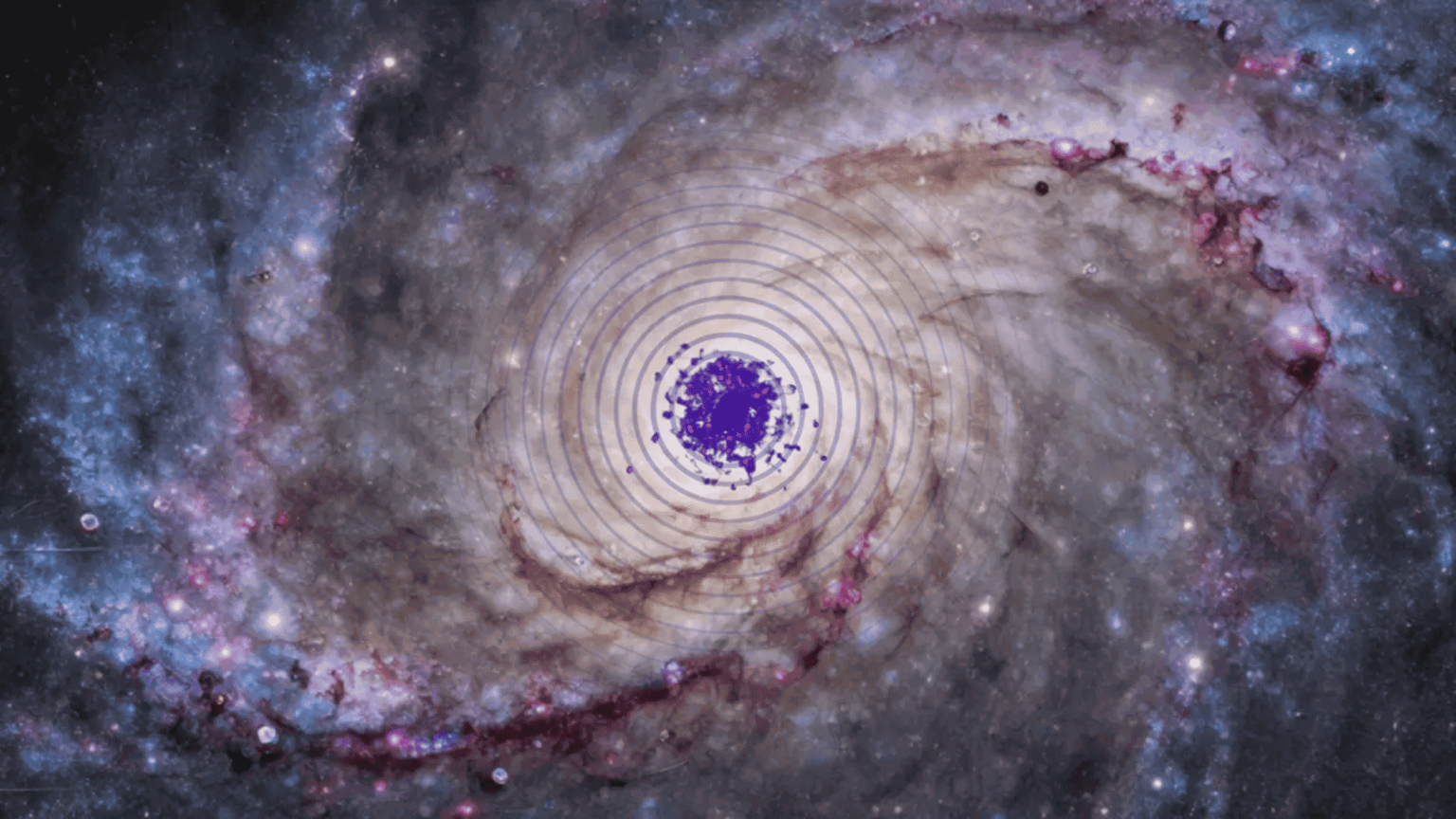
Gravity Without Light
Dark matter neither emits nor absorbs anything, so it cannot be observed directly. Its presence is revealed only through gravity. It prevents galaxies from flying apart and also bends light from distant objects, an effect known as gravitational lensing.
According to current estimates, the mass of dark matter in the Universe is about five times greater than the mass of ordinary matter. At the same time, its particles almost do not interact with ordinary matter, so they can pass through planets, stars, and even the human body without hindrance, leaving virtually no traces.
Extra Dimensions
This does not refer to parallel universes from science fiction. Physicists mean directions that are compactified to microscopic scales and are therefore imperceptible in everyday experience.
The idea itself has a century-long history. As early as the 1920s, Theodore Kaluza and Oscar Klein attempted to unify gravity with electromagnetism by adding a fifth dimension to space-time. Since then, the idea of extra dimensions has become an important component of many modern theories, including string theory and M-theory, which predict the existence of 10 or 11 dimensions of space-time.
Dark Photons and Resonance
Along with dark matter, another component may exist in the fifth dimension, as reported by Space.com. There may be another hypothetical particle, the dark photon. It is a possible carrier of a separate interaction in the dark sector, an analogue of the ordinary photon, which carries the electromagnetic interaction.
The geometry of the extra dimension creates a special spectrum of dark matter particle masses. Under certain conditions, a resonance occurs between them, which the authors compare to the strong sound of a musical instrument on certain notes. It is this effect that may determine the current amount of dark matter in the Universe.
An Explanation for the Early Universe
According to study co-author Yu-Dai Tsai of the University of Sheffield, the resonance could have greatly enhanced dark matter interactions during crucial periods of cosmic history, particularly shortly after the Big Bang. At the same time, the approach explains why dark matter appears inert today and why it is so difficult to detect.
Previous similar models treated this phenomenon as an ad hoc assumption without deeper justification. The authors of the new study derived it directly from the geometry of hidden dimensions.
As a result, physicists now have specific targets for future searches for the invisible substance. The findings were published in the peer-reviewed journal Physical Review D.
