

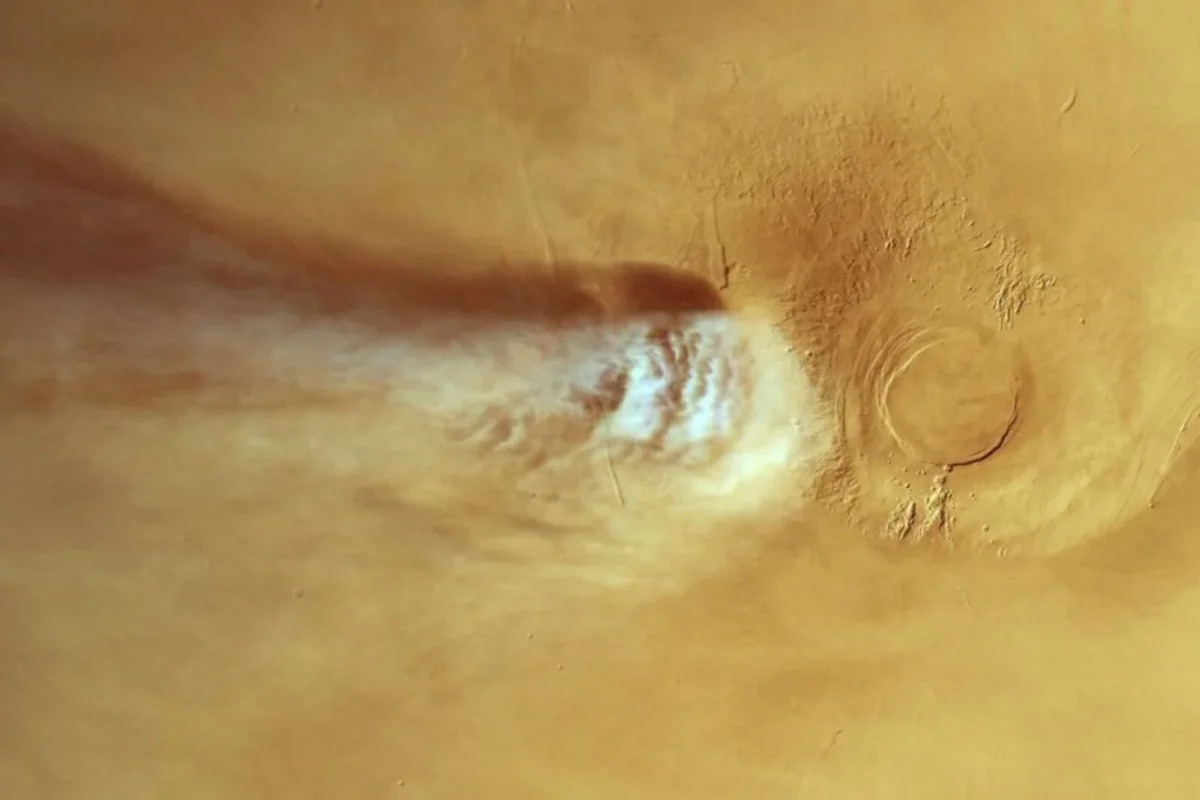
A long, narrow cloud of water ice appears every morning near the Martian volcano Arsia Mons at a certain time of year. For years, scientists could not explain how it forms. Now they have managed to reproduce it in a computer model. To do so, they had to assume that water vapor freezes directly in the air, without the dust particles on which it usually condenses. Until now, such a process was considered impossible in the atmosphere of any planet.
The Cloud’s Morning Appearance
Every year during the dusty season, which falls in spring and summer in Mars’s southern hemisphere, a thin white streak of water ice appears on the leeward side of Arsia Mons. It forms daily at dawn. According to Gizmodo, the cloud stretches to 1,800 kilometers in just three hours before detaching from the mountain and disappearing.
This exceeds Ukraine’s extent from west to east, which is approximately 1,300 kilometers. On average, the streak grows by 600 kilometers every hour.
The Limits of Conventional Models
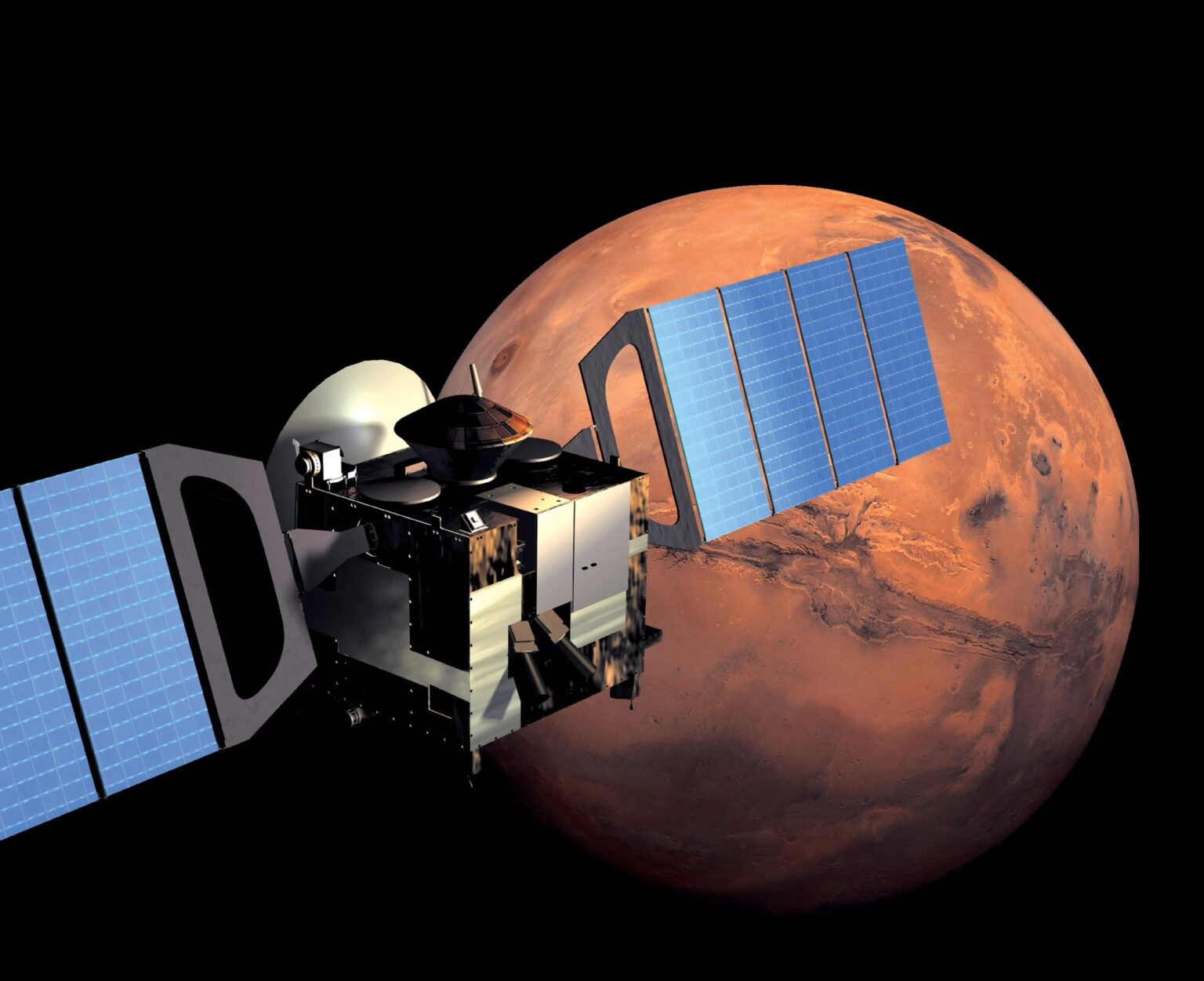
Regular images from the Mars Express orbiter have documented the cloud since 2018, according to ESA. Observations showed that it is an orographic cloud. These clouds form when air encounters elevated terrain and is forced upward, where it cools.
On Earth, the mechanism behind their formation is well understood. Yet for years, models based on this knowledge failed to accurately reproduce the Martian cloud. The calculations were probably missing a physical process that had not previously been taken into account.
Ice Without Dust Particles
Clouds on Earth form through heterogeneous nucleation. Water vapor condenses on microscopic particles of dust, sea salt, and other dry substances. These particles are called condensation nuclei.
In theory, a cloud can also form without them. This process is called homogeneous nucleation. It requires extremely high humidity, so it is not considered a realistic mechanism for cloud formation under terrestrial conditions. Jorge Hernández-Bernal of Sorbonne University, the study’s lead author, explains that the vapor turns directly into ice particles—as though droplets of condensation were appearing in the middle of a room rather than on a windowpane.
When scientists added homogeneous nucleation to a weather model of Mars, the calculations reproduced the distinctive features of the cloud near Arsia Mons. The results were published on October 7 in the peer-reviewed journal Nature Geoscience. The authors describe them as the first evidence that water vapor in a planet’s atmosphere can freeze without condensation nuclei.
Supersaturated Martian Air
Air is described as supersaturated when it contains more water vapor than it can hold at a given temperature. Under ordinary conditions, ice forms on dust particles even at slight supersaturation. For homogeneous nucleation to occur on Mars, previous calculations suggested that the saturation level would need to be approximately 100,000 times higher.
The Martian atmosphere contains plenty of dust. Such extreme values were therefore considered unattainable, because the excess vapor should have condensed on particles long before that point.
However, both observations and models had already indicated that Martian air could be highly supersaturated with water vapor. Jorge Hernández-Bernal notes that such conditions had not previously been observed on Mars, but the new study provides compelling evidence that humidity there can indeed reach these extreme values.
A Wave Above the Volcano
According to the team’s explanation, wind flowing around Arsia Mons generates a powerful atmospheric wave because of the steep rise in the terrain. This wave rapidly lifts moist air to a high altitude. There, it cools abruptly, humidity rises sharply, and the vapor spontaneously freezes into cloud particles.
This hypothesis still needs to be confirmed. The authors note that the finding also has implications for certain clouds on Earth and possibly for the atmospheres of other planets.
