

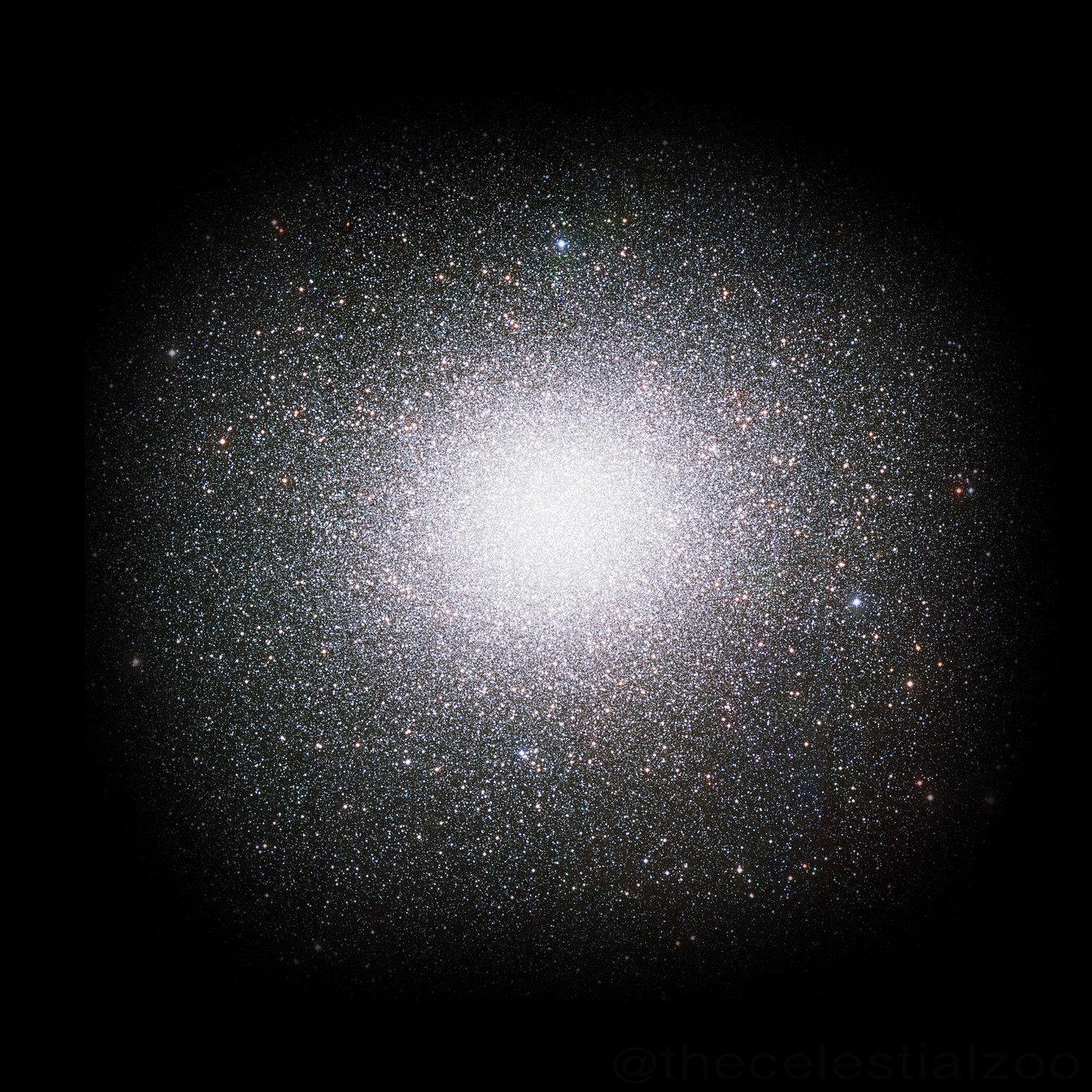
The giant globular star cluster Omega Centauri, which contains about 10 million gravitationally bound stars, has long puzzled scientists. Computer models predicted that about 10,000 stellar-mass black holes should be hiding in this densely stellar environment. However, every attempt to detect even one of them through radio or X-ray emission ended in nothing.
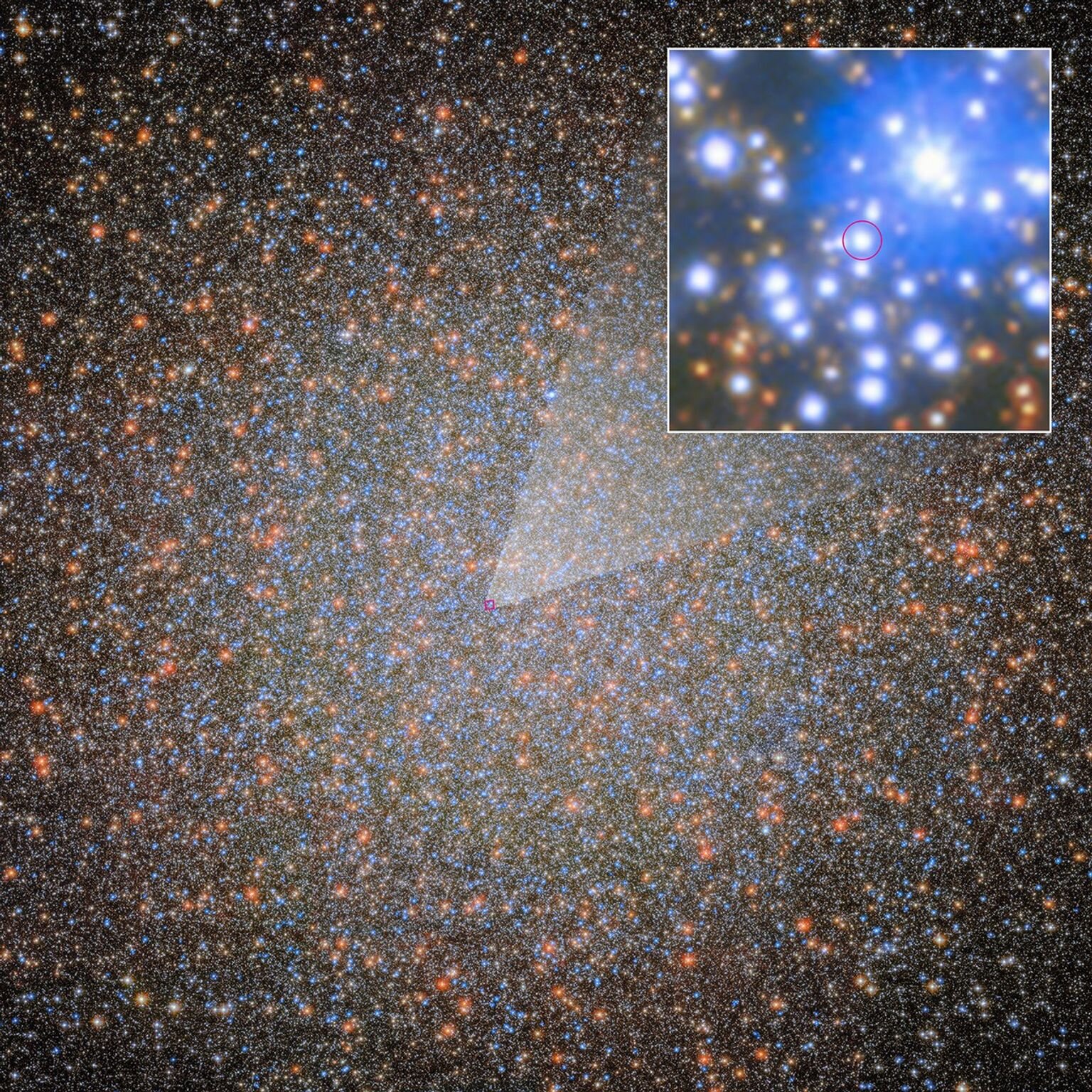
Now an international group of astronomers led by the University of Utah has finally broken this deadlock. Using archival images from the Hubble Space Telescope collected over the past 20 years and the advanced infrared capabilities of the James Webb observatory, the researchers detected the first confirmed stellar-mass black hole in this cluster. The results of the work were published in The Astrophysical Journal Letters.
Hunting ghosts
The success of the study was made possible by astrometry — the tracking of extremely small shifts of cosmic bodies in space over time. Scientists noticed an ordinary star behaving strangely, as if orbiting an invisible ghost.
“The precision of the measurements is simply fantastic — it is measured in fractions of a pixel on the detectors of the Hubble and James Webb telescopes,” said the study’s lead author, Matthew Whitaker. By combining databases from 2002 to 2023, astronomers were able to precisely calculate the trajectory of the star, located 18,000 light-years from Earth.
Previous analyses suggested that the invisible companion in this system could be an ultra-dense neutron star. However, the new high-precision calculations ruled out this version.
The visible star has a mass of 0.78 solar masses, while its dark partner weighs 4.46 Suns. This is too much for a neutron star, but at the same time unexpectedly little for a black hole formed in the metal-poor environment of Omega Centauri. According to study co-author Anil Seth, this discovery challenges existing theoretical models of stellar evolution and will force astrophysicists to reconsider the mechanisms of stellar collapse.
The slowest waltz in the Universe
The newly discovered system, named oMEGACat BH-2, has set an absolute record: the orbital period of the star around the black hole is 94 years. This is the longest orbit among all known binary systems of this type.
Such an enormous distance between the objects indicates that they were not born together. Most likely, the black hole “caught” a random neighboring star during complex gravitational maneuvers inside the cluster. However, this union is temporary: according to scientists’ estimates, the dense environment of Omega Centauri will cause neighboring stars to tear this pair apart within the next billion years.
New horizons for the search
Understanding how black holes form and interact in such clusters is critically important for the study of gravitational waves. Astronomers are expecting even more discoveries ahead. Scientists have high hopes for the future Nancy Grace Roman Space Telescope, which, thanks to its wide field of view and high resolution, will be able to regularly scan the center of our Galaxy and discover new elusive black holes.
Earlier, we reported on how Hubble helped astronomers find an elusive intermediate-mass black hole.
According to phys.org
