

Scientists have discovered a dwarf galaxy—or rather, a star cluster—called Fornax-7. It has a mass of only about 170 solar masses and orbits a dwarf spheroidal galaxy in the constellation Fornax. The latter, in turn, is a satellite of the Milky Way.
The Problem of Dark Matter Halos in Dwarf Galaxies
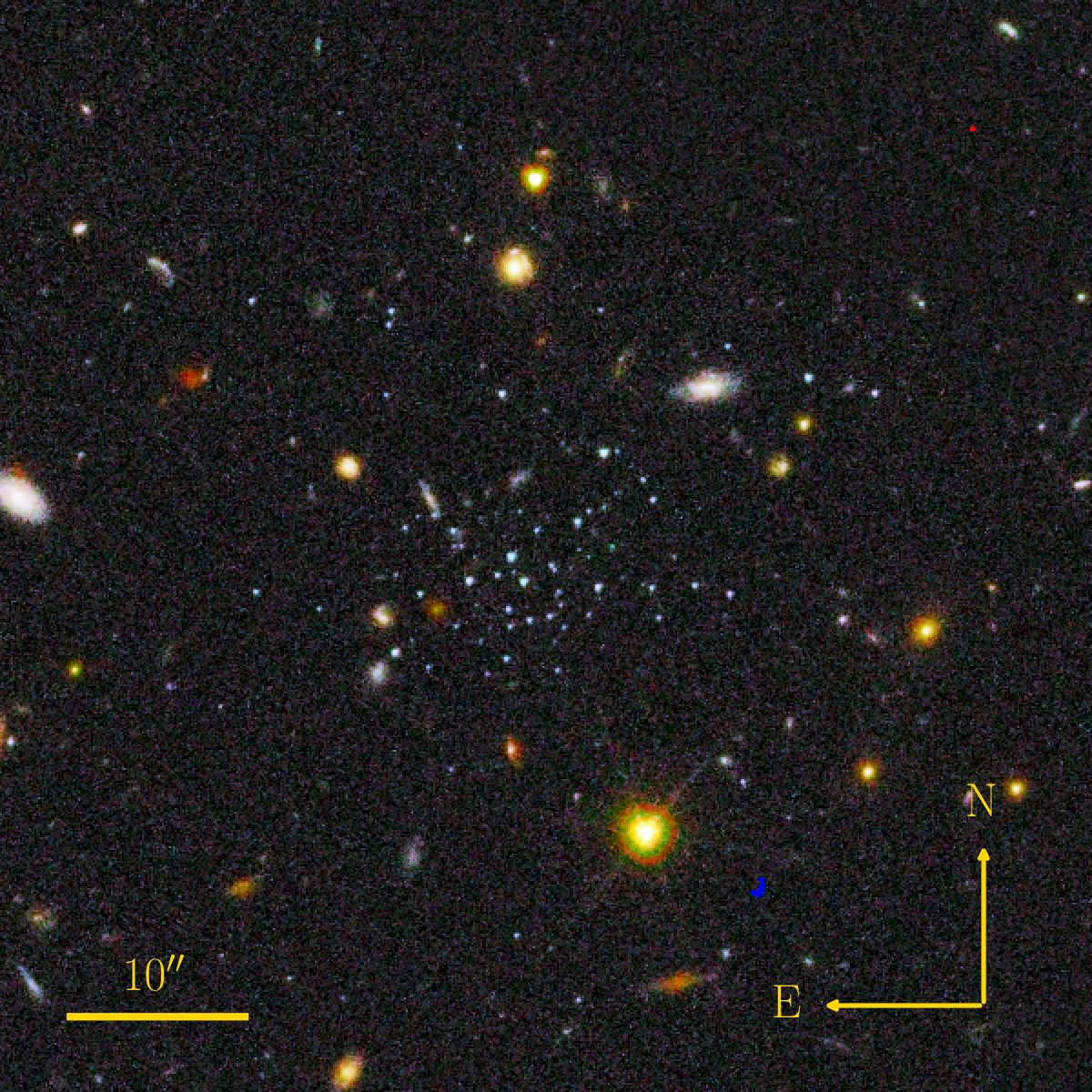
Astronomers using data from the Euclid space telescope have discovered an exceptionally faint stellar system near the Fornax dwarf galaxy. Named Fornax-7, the system appears to be a satellite of Fornax and contains stars with a combined mass of only about 170 times that of the Sun. The discovery is reported by phys.org.
The Lambda cold dark matter model of the universe predicts that dark matter halos of any mass should contain smaller subhalos of their own. This is well established for galaxies with masses similar to that of the Milky Way, which have numerous dwarf satellites, but it has never been confirmed for host galaxies significantly less massive than the Milky Way.
The current record-holder is the Large Magellanic Cloud (LMC), which has candidate ultra-faint satellites. Discovering a satellite around an object as small as the Fornax dwarf spheroidal galaxy, roughly 100 times less massive than the LMC, would extend “the observed hierarchical formation of satellite systems nearly two orders of magnitude below the LMC,” the researchers write in their paper.
Fornax is a dwarf galaxy that orbits the Milky Way at a distance of approximately 470,000 light-years. It hosts six known globular clusters. Five of them are more than 10 billion years old but lie far from the galaxy’s center. Given their masses and ages, calculations suggest that these clusters should already have migrated toward the center. This “timing problem” has prompted debate over whether the dark matter halo surrounding Fornax has a diffuse, low-density “core” rather than the dense central “cusp” predicted by standard cold dark matter models.
A team led by Teymoor Saifollahi of the Strasbourg Observatory serendipitously discovered a tiny, exceptionally faint stellar system called Fornax-7 in new images from the Euclid satellite. The system lies very close to the galaxy itself in the constellation Fornax.
A Galaxy or a Star Cluster?
To determine the properties of Fornax-7 precisely, the team first constructed a color–magnitude diagram using the six brightest and most reliably identified member stars. They filtered out foreground stars belonging to the Milky Way using Gaia motion data and color-selection criteria. Six stars are not enough to determine the system’s age, metallicity, and distance, so the researchers modeled thousands of possible stellar populations and compared each with the observations to find the best match.
They then performed additional calculations to test whether Fornax-7 behaves like a star cluster or a galaxy dominated by dark matter.
The team’s models suggest that Fornax-7 lies at approximately the same distance from Earth as Fornax, providing strong grounds for considering the two objects neighbors. On the sky, Fornax-7 has a projected separation of about 2.8 kiloparsecs, or approximately 9,100 light-years, from the center of Fornax. However, the researchers are not yet certain whether the two objects are gravitationally bound.
A Faint “Satellite of a Satellite”
The system is exceptionally small and approximately 10 billion years old. Its mass is extremely low: its stars have a combined mass of only about 170 solar masses. “Our results show that Fornax-7 is among the faintest and smallest systems ever identified,” the team writes.
The researchers propose two scenarios: Fornax-7 could be a star cluster without dark matter, or a dark matter-dominated satellite galaxy orbiting the Fornax dwarf galaxy. If it is a star cluster, its properties could help resolve the “timing problem” and reveal the nature of the dark matter distribution in its host galaxy. If it is a dwarf satellite galaxy of Fornax, it would be the “first known example of a ‘satellite of a satellite’ around a host galaxy as low in mass as Fornax,” the researchers conclude.
According to the researchers, distinguishing between these scenarios requires measuring the system’s internal velocity dispersion through spectroscopy, likely using next-generation telescopes. A third possibility is that it is an unrelated object in the Milky Way’s halo that happens to lie along the same line of sight.
