

Artificial intelligence has already learned to predict global weather changes with fairly high accuracy thanks to the large volumes of data collected in recent years. However, on a much more local scale, particularly when forecasting hurricanes, it can easily make mistakes. At least, this is what a new study suggests.
Artificial Intelligence and Weather Forecasting
For some time now, weather forecasting has remained one of the fields in which artificial intelligence performs particularly well. It makes it possible to predict with fairly high accuracy how the weather will generally change, for example over Europe in the coming weeks. At the local level, AI has also so far caused few complaints and, at least, has not made mistakes more often than human forecasters. However, as phys.org reports, it is far from all-powerful.
In a new study, scientists examined what its success is based on. The answer is an enormous amount of observational data collected at many locations over the past several years. Even before the AI era, these data were used to build many genuinely high-quality atmospheric models. Therefore, the main challenge was simply to apply them correctly.
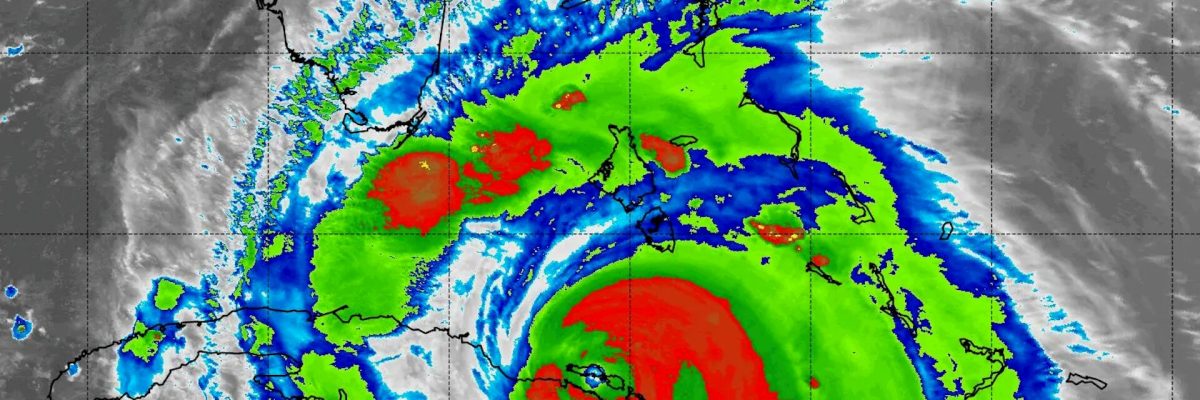
It is a different matter when trying to predict the weather in a specific location. Forecasting storms and other catastrophic phenomena also falls into this category. Their core is local as well, and, as Hurricane Polo showed in September 2026, events involving the transformation of a tropical storm into a natural disaster can develop extremely quickly. Therefore, it is necessary to be able to predict this in advance.
Chaos Inside a Hurricane
Like global forecasts, local AI weather forecasts are based on two things: ground-based data and mathematical models describing how events develop. The problem is that the number of points where such measurements are taken is decreasing. And when it comes to predicting a hurricane, some of these data must be collected at sea. That is not something that can be organized easily.
Moreover, the same mathematical models that describe the behavior of Earth’s atmosphere become fairly approximate at small scales. In other words, in most cases they provide sufficiently accurate forecasts, but they can also be wrong. However, the authors of the study go even further and believe that there is an element of chaos in calculations of hurricane behavior.
Such situations are extremely sensitive to the accuracy of measurements of the initial parameters. This means that neural networks will have difficulty dealing with them, especially when the models themselves are so imprecise. Moreover, some studies suggest that so-called chaotic attractors are present in such situations. That is, chaotic behavior arises only under certain states of the sea.
Recent studies show that the emergence of these states is closely related to water temperature. In other words, the warmer the ocean becomes, the higher the probability that they will occur. For now, it is not even clear whether anything can be done about this by studying storm formation in greater depth, or whether the issue will remain fundamentally uncertain even for AI.