

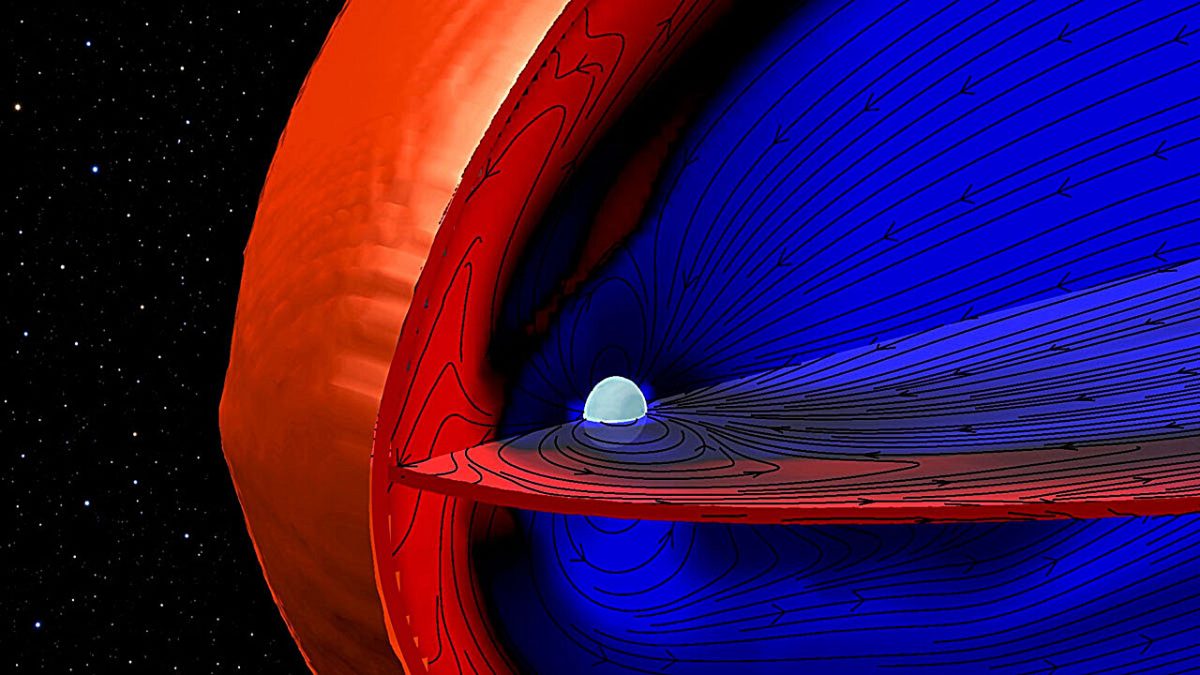
Scientists have studied the interaction of the solar wind with Uranus’s magnetic field. Because of the tilt of the planet’s rotational axis, the bow shock created when charged particles strike its magnetic field constantly changes its shape and size, creating the illusion that the planet “breathes” on a daily cycle.
A Dynamic Bow Shock
Within our Solar System, Uranus is a geometric outlier. Its rotational axis is tilted by more than 90° relative to the plane of its orbit, meaning that the planet essentially rolls through space on its side. Earth and the other planets, by contrast, have only moderate axial tilts or almost none at all. Moreover, the magnetic field of this ice giant is unusually offset and tilted by another 60°.
These extreme asymmetries mean that the interaction between Uranus’s magnetic field and the solar wind—the stream of charged particles constantly flowing outward from the Sun in all directions—is also highly unusual. Near Earth and other planets, the boundary where the solar wind collides with a planet’s magnetic field and abruptly slows down, producing a turbulent shock wave known as a bow shock, is relatively stable. Near Uranus, however, the bow shock is extremely dynamic, changing its shape and size over the course of each Uranian day, much like lungs expanding and contracting during breathing.
Until now, however, the exact scale and main factors responsible for this “breathing” of Uranus’s bow shock had remained unclear. Now, using advanced computer simulations and data from NASA’s Voyager 2 spacecraft, X. Cao and colleagues have quantitatively assessed the characteristics of these daily changes in a paper published in AGU Advances.
What Did the Simulations Show?
The researchers used a three-dimensional multifluid magnetohydrodynamic model, a tool they recently developed to study how planetary magnetospheres interact with the solar wind. For the simulations, they used observations made by Voyager 2 during its 1986 flyby of Uranus. They ran the model under Uranian equinox conditions—the point in the planet’s 84-Earth-year orbit when the Sun is directly above the equator and the expansion and contraction of the bow shock are strongest.
The simulations made it possible to determine precisely how the size and shape of Uranus’s bow shock change over the course of one complete day. To isolate the role of the planet’s rotation, the researchers carried out a series of simulations under steady, unchanging solar-wind conditions. The regular daily pattern remained, indicating that the main factor driving this “breathing” is the daily change in magnetic-field geometry caused by the planet’s rotation rather than fluctuations in the solar wind.
On Earth, by contrast, variations in the solar wind are the main cause of bow-shock variability, while minor daily fluctuations arise only from the small angle between Earth’s rotational axis and its magnetic field.
These findings could prove useful in planning future space missions to Uranus and may also improve our understanding of the bow shocks surrounding the many ice-giant exoplanets discovered throughout the galaxy.
