

In recent weeks, it has been observed that nightfall occurs significantly earlier each day. The underlying cause is not attributable to weather conditions or autumnal clouds; rather, it is due to the rapid diminution of daylight hours, which occurs more swiftly than at any other point during the year. The precise events unfolding on September 23 are as follows.
Night falls earlier
In early September, the external lighting remained considerably brighter at 8:00 p.m. Currently, it begins to darken by 7:30 p.m. Furthermore, by the conclusion of the month, this time will shift an additional thirty minutes earlier.
It is at the end of September that daylight hours diminish most rapidly throughout the entire year. However, in December, as the winter solstice draws near, the circumstances differ. The duration of daylight remains virtually unchanged from one day to the next and persists in this state for several consecutive weeks.

Photo by Ukrinform/NurPhoto
Both facts can be attributed to a single phenomenon. The autumnal equinox for this year is scheduled to occur on September 23 at 3:05 a.m. Kyiv time.
Day and night are not identical
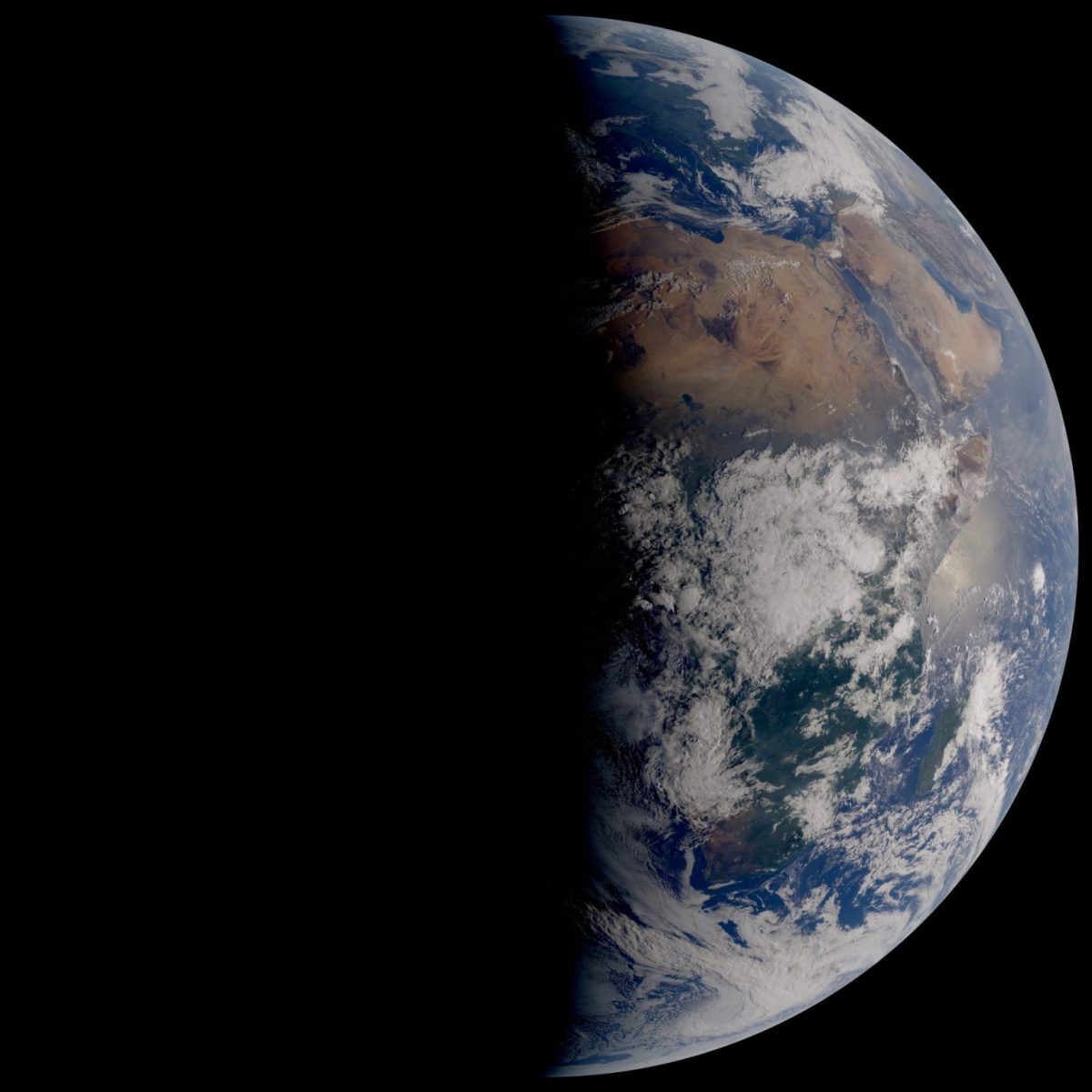
The Sun consistently illuminates approximately half of the Earth’s surface. The demarcation between illumination and darkness, at any given time of the year, effectively divides the planet into two hemispheres. The only variable is its spatial orientation relative to the Earth’s axis of rotation.
The Earth rotates, resulting in any given point on its surface completing a full rotation within a 24-hour period. During this cycle, a portion of the time is spent on the sunlit side, while the remainder is in shadow. The initial segment of this cycle is referred to as ‘the day.’
The Earth’s axis is inclined at an angle of approximately 23 degrees and consistently maintains its orientation in space. During the summer, the northern hemisphere of the planet is inclined toward the Sun. Taking Kyiv as an example, the division between daylight and darkness (terminator) does not distribute evenly across its daily rotation; the illuminated portion is extended, resulting in a prolonged day. Conversely, in winter, Earth occupies the opposite position in its orbit. The axial tilt is now directed away from the Sun, leading to the city being in shadow for the majority of the day.

Source: Encyclopedia Britannica
Twice annually, the axis aligns precisely midway between these two positions. The line traverses both poles exactly and bisects the daily rotation of any point on Earth. This event is known as the equinox. Astronomers determine the precise moment of the equinox based on the Sun’s position relative to the celestial equator — an imaginary line extending the Earth’s equator into outer space — thereby specifying the time with minute accuracy. At this instant, the Sun rises nearly due east and sets nearly due west. This phenomenon is observable worldwide, from Iceland to Kenya.
The transition to darkness occurs most rapidly during the autumn season
The duration in hours that a specific point remains on the sunlit side is contingent upon the angle between the Earth’s axis and the solar direction. The axial tilt remains invariant; however, as the Earth progresses through its orbit, this angle undergoes gradual variation.
It is straightforward to monitor the position directly overhead at noon, which astronomers designate as the zenith. During the summer season, this point reaches its maximum northern extension; in winter, it attains its maximum southern extension; and during the intervening periods, it transitions between these two extreme positions. The movement closely resembles that of a pendulum. Near the extremities, the motion decelerates, halts, and reverses direction, whereas the point traverses the midpoint of the segment at the highest velocity.
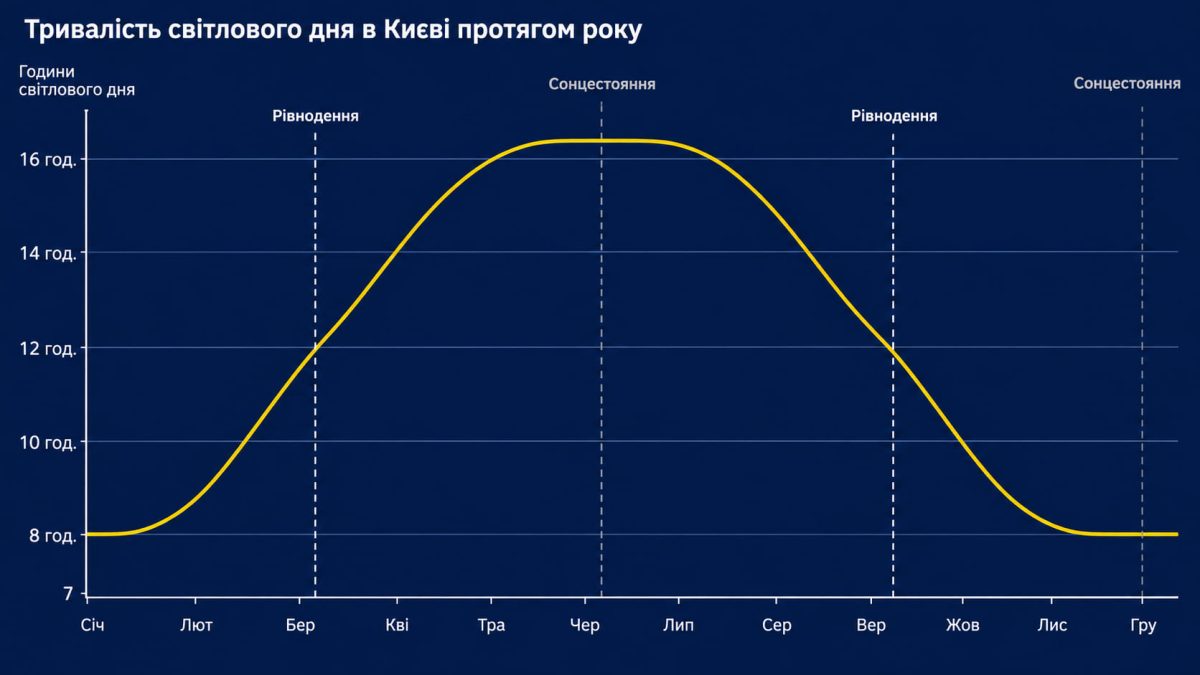
The duration of daylight adheres to a consistent pattern. Near the solstices, it remains relatively constant for several consecutive weeks, hence the designation “solstice.” Conversely, at the equinox — referred to as the midpoint — it undergoes more significant fluctuations than at any other period within the year.
Currently, in Kyiv, each successive day experiences a reduction of nearly four minutes relative to the previous day. In December, prior to the winter solstice, only a further two minutes are added over the span of an entire week, representing the cumulative change for the month. During September, daylight hours in the capital diminish from 13 hours and 34 minutes to 11 hours and 42 minutes, amounting to a decrease of nearly two hours. In December, the increase in daylight hours from the beginning of the month until the solstice is merely twenty minutes.
When day and night are equal
The term “equinox” signifies an occasion when night and day are of approximately equal duration; the Latin term “aequinoctium” literally translates to this concept. In reality, on September 23 in Kyiv, daylight extends for a period slightly exceeding twelve hours, specifically, twelve hours and nine minutes.
These additional minutes occur due to two distinct reasons, neither of which is associated with the tilt of the Earth’s axis. One is attributed to natural phenomena, and the other depends on the conventions established by human agreement regarding the definition of sunrise.
The initial reason pertains to atmospheric conditions. The air bends the rays, functioning as a subtle lens, thereby enabling the Sun to be visible prior to it being geometrically situated above the horizon. The offset is roughly equivalent to the apparent size of the Sun itself.

The second method is more straightforward. Sunrise is defined as the emergence of the upper edge, rather than the center of the disk. This approach introduces an additional half of the diameter.
Both reasons are applicable. The upper edge of the disk becomes visible when the Sun’s center remains approximately one and a half diameters below the horizon. Conversely, in the evening, the situation is reversed. Absent this phenomenon, the day would be evenly divided, consisting of exactly 12 hours of daylight and 12 hours of darkness.
The astronomical equinox occurs on September 23; however, in Kyiv, the day and night will not be precisely equal until the 25th. The closer one approaches the equator, the later this equality is observed. At the equator, day and night are never exactly equal, as daylight hours are slightly longer throughout the year.
How does this impact the observations?
The reduction in daylight hours leads to earlier onset of darkness during the autumn season, consequently shortening the duration of the period preceding nightfall.
Twilight at the end of September lasts approximately thirty-three minutes in Kyiv, and approximately forty-six minutes in June. This period indicates the time during which it remains possible to observe externally without the aid of a flashlight. This phase is referred to as civil twilight and persists until the Sun has descended six degrees below the horizon. Subsequently, navigational twilight occurs, followed by astronomical twilight, which endures until the Sun is eighteen degrees below the horizon. The sky only attains complete darkness thereafter. The underlying reason for this sequence is the speed at which the Sun dips below the horizon.
During the summer season, the Sun’s trajectory is positioned high above the horizon, and following sunset, it persists along this trajectory for an extended period. It descends gradually, resulting in prolonged daylight. Conversely, at the equinox, the Sun’s trajectory is situated lower, and it departs from the horizon at a noticeably quicker rate. It attains the same six-degree position — at which point darkness has set in — approximately fifteen minutes earlier than during summer.

These stages are of practical importance for individuals who observe the sky through a telescope. Faint objects such as galaxies and nebulae become visible only in complete darkness, specifically when the Sun has descended at least eighteen degrees below the horizon. In Kyiv, from late May to mid-July, such darkness is absent, as the sky does not become sufficiently dark. By late September, this darkness persists for approximately eight hours. This period represents the optimal time of year for evening astronomical observations.
The days surrounding September 23 serve as an optimal period for evaluating one’s sense of direction. To accurately identify a celestial object in the sky, it is essential for an observer to precisely determine the cardinal directions of west and east; however, a compass is inadequate for this task, given that it aligns with the magnetic pole and exhibits an error margin of approximately eight degrees in Kyiv. It is during the equinox that the Sun sets nearly exactly along the true western horizon.
From that point onward, the days will decrease in length until December 21. At that time, the night in Kyiv will last approximately sixteen hours, and the latitude where the Sun reaches its zenith at noon will extend to Rio de Janeiro before gradually shifting northward once more.
