

A certain class of binary systems consisting of a white dwarf and an M-type red dwarf has turned out to be a natural source of radio emission. The bursts repeat with clock-like regularity, although the beam itself is narrowly directed and becomes visible only when the system turns the right side toward Earth.
Pulsating Pairs
Radio signals from binary systems containing white and red dwarfs did not fit the familiar picture of known sources. In some cases, bursts repeat at intervals of several minutes over many hours — much more slowly than pulsar pulses, which arrive with periods measured in seconds. At the same time, the repetition is too stable to be explained by random radio bursts. This pointed to the need for a stable physical process within the binary system and required a separate explanation.
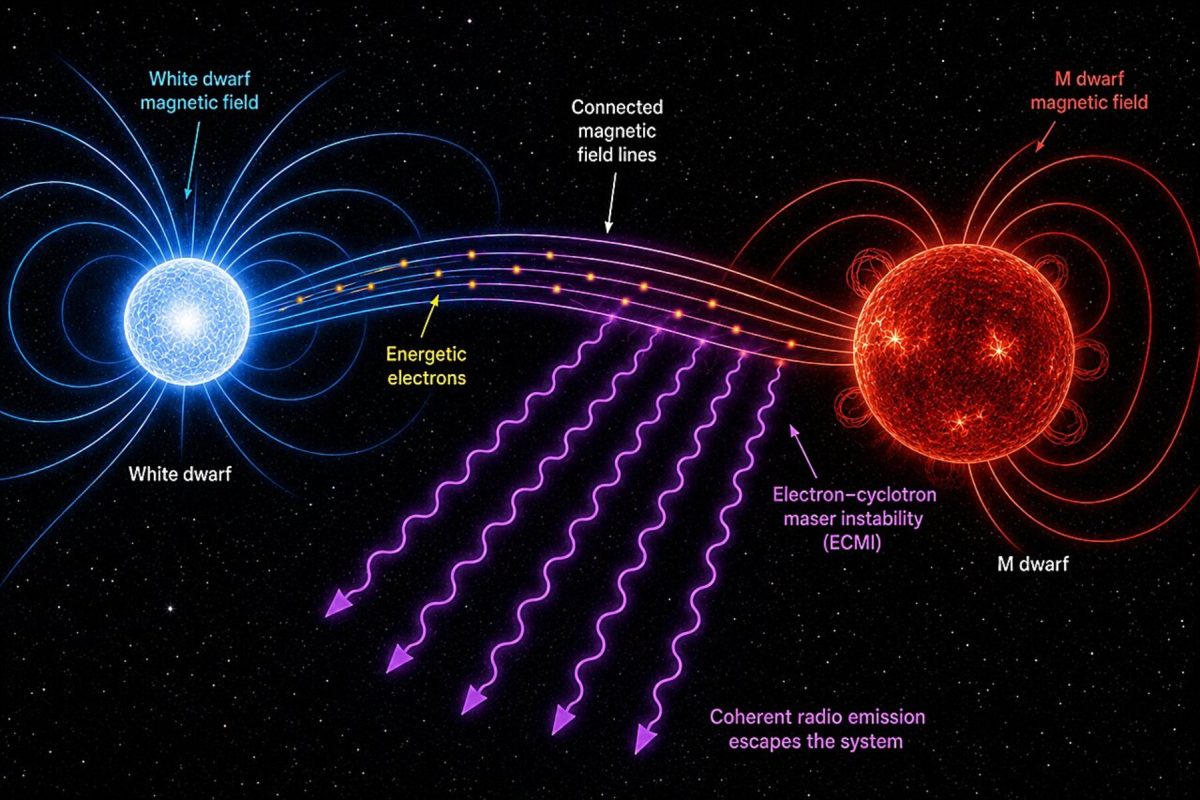
A new study published in the peer-reviewed journal The Astrophysical Journal Letters explains this mechanism through a phenomenon known as electron-cyclotron maser instability. It was first associated with powerful radio emission from the Jupiter–Io system as early as the 1950s.
A similar mechanism operates in the magnetospheres of planets and stars and is also associated with radio emission from Earth’s auroras. The best-known example is the Jupiter–Io system. However, whether the same mechanism could operate in a binary stellar system had remained unclear.
Synchronized Motion of Electrons in the Simulation
Researchers from the California Institute of Technology simulated the interaction between a white dwarf and a red dwarf on a supercomputer, Phys.org reports. They showed that as the stars orbit one another, a powerful electric current arises between them, similar to the one that exists between Jupiter and Io.
Electrons in this current become unstable, their motion becomes organized relative to the magnetic field, and a stream of particles with the properties required for maser instability forms along the magnetic field lines. As study co-author Elias Most explains, they dance around the magnetic field lines in unison, like a Viennese waltz.
It is this collective motion of charged particles that produces the directed radio beam. It is somewhat similar to a laser, except that it operates in the radio range. As long as the electric current between the stars is maintained, the radio-emission mechanism can operate continuously. The periodic bursts that we detect arise because the narrow beam periodically turns toward Earth.
Why the Bursts Appear Periodic
The main surprise is that the maser does not switch on and off. It emits continuously, but the beam rotates together with the system. An observer on Earth sees a burst only when the narrow cone of emission crosses the line of sight.
This explains the long pauses between pulses that had puzzled astronomers. Lead author Yici Zhong notes: “The maser is always on; we just see it when it sweeps past us.” In the system GLEAM-X J0704-37, which had previously been confirmed as a source of such bursts, one rotation takes about three hours. The signals repeat at the same interval.
Radio Emission Efficiency Turned Out to Be Much Higher
The simulations also showed that the emission should be polarized, like the reflection of light from the surface of a lake. If telescopes detect exactly this type of polarization, it will confirm that the model is working correctly.
The mechanism proved to be up to ten times more efficient at converting the energy of charged particles into radio emission than previously thought. If it is indeed this efficient, such systems may be more visible in radio surveys of the sky than earlier estimates predicted. The result confirms the hypothesis proposed by Peter Goldreich and Donald Lynden-Bell in 1969 for the Jupiter–Io system and extends it to objects far beyond the Solar System.