

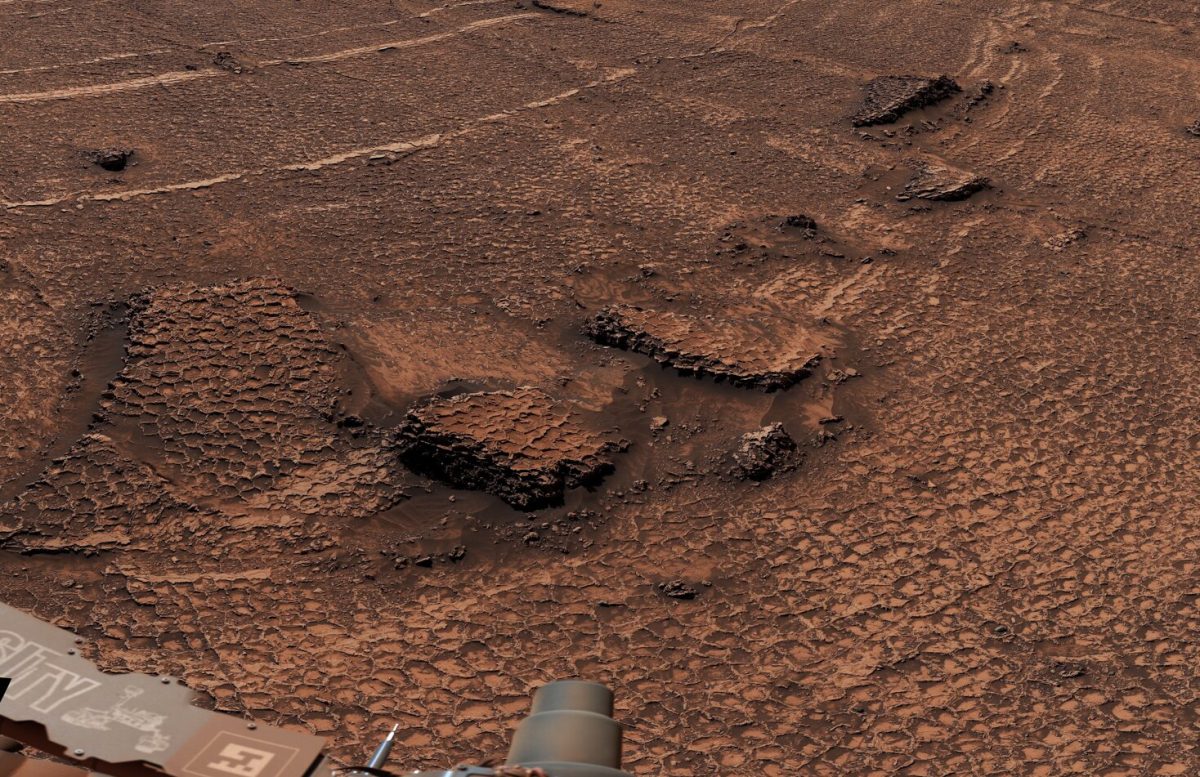
When NASA’s Curiosity rover recently began climbing through a Martian valley nicknamed “Valle Grande,” it sent back images that looked familiar to mission scientists: honeycomb-like textures that turned out to be polygonal cracks, each measuring approximately 4–8 centimeters across. The mission had previously detected several small patches of these geometric shapes, but nothing as extensive as what has now been found in Valle Grande.
A Field of Polygons
A 360-degree panorama taken by the rover on June 19 and 20, during the 4,930th and 4,931st Martian days of the mission, or sols, shows the polygonal formations extending in every direction as far as the rover can see. They even wrap around the sides of a nearby hill nicknamed “Miraflores,” which is 6 meters, or 20 feet, high and topped by a thick cap of sand. This was reported by phys.org.
“We have seen many fascinating landscapes through Curiosity’s eyes, but this sea of polygons simply took our breath away,” said mission project scientist Ashwin Vasavada of NASA’s Jet Propulsion Laboratory in Southern California. “We carefully measured their shapes and chemistry, and we hope the data contain clues about how these structures formed.”
Some of the polygons previously observed by the mission clearly formed as cracks in clay, although several different processes may contribute to their honeycomb-like texture. These include cycles of warm and cold temperatures or compression that squeezed water out of sediment as the surface became buried.
The Chemistry Needed for Life
These newly discovered polygons are among the many surprises Curiosity has encountered since landing on Mars 14 years ago, on August 5, 2012. In addition to sulfur crystals, shiny meteorites, and other unusual geological features, the rover has made important discoveries about the ancient Martian environment—most importantly, that it once contained water, chemical elements, and nutrients capable of supporting microbial life.
Billions of years ago, lakes and streams covered the lower foothills of Mount Sharp, a 3-mile, or 5-kilometer, mountain that Curiosity has been climbing since 2014. The rover previously detected chemical evidence left behind by Mars’s watery history, including carbon-based molecules believed to be precursors of RNA and DNA, the two nucleic acids that carry genetic information. Scientists cannot say with certainty whether these organic molecules were produced by biological or geological processes—both possibilities remain open—but their discovery once again confirmed that ancient Mars possessed the chemistry needed to support life.
