

Astronomers have discovered a unique cosmic object from an era when the Universe was less than 1 billion years old. At the center of the red quasar J1440+0019, at a redshift of z ≈ 6.55, lies a supermassive black hole approximately 1.1 billion times the Sun’s mass, rapidly consuming surrounding matter. The study has been published on the arXiv preprint server.
Hidden in a Dusty Cocoon
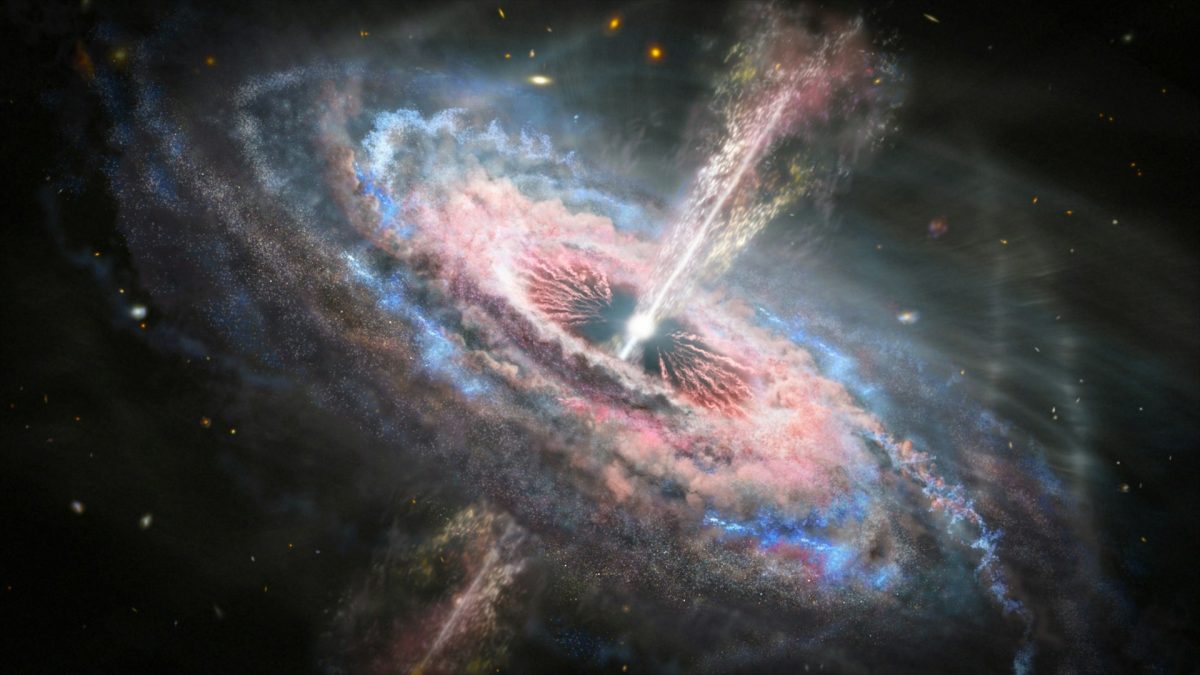
The epoch of cosmic reionization lasted roughly from 600 million to 1 billion years after the Big Bang. During this period, energetic ultraviolet radiation from the first stars and galaxies ionized neutral hydrogen. Studying quasars from that era helps refine the timeline of this process.
Most known quasars from this period were discovered through their bright ultraviolet light. However, this method does not work for objects hidden behind dust clouds that block ultraviolet radiation. Astronomers suspect that a substantial proportion of early active galactic nuclei are such “obscured” systems.
To study J1440+0019, discovered as part of the SHELLQs survey, a team led by Daming Yang of Leiden Observatory combined the capabilities of two powerful instruments. The researchers used the JWST space telescope’s NIRSpec infrared spectrograph to analyze the nucleus and the ALMA radio interferometer to observe cold gas and dust in the host galaxy.
A High-Speed Outflow
Spectral analysis revealed dust attenuation characteristic of so-called type 1 red quasars. This means astronomers can see the quasar’s nucleus directly, but through a moderate layer of cosmic dust along the line of sight.
The spectrum also revealed three blueshifted components—a sign of material moving toward us. These nuclear outflows reach speeds of 3,600 km/s.
After correcting for dust absorption, the researchers found that the quasar radiates at approximately 80% of its Eddington luminosity limit, indicating an exceptionally high rate of matter accretion onto the black hole.
A Rich Host Galaxy
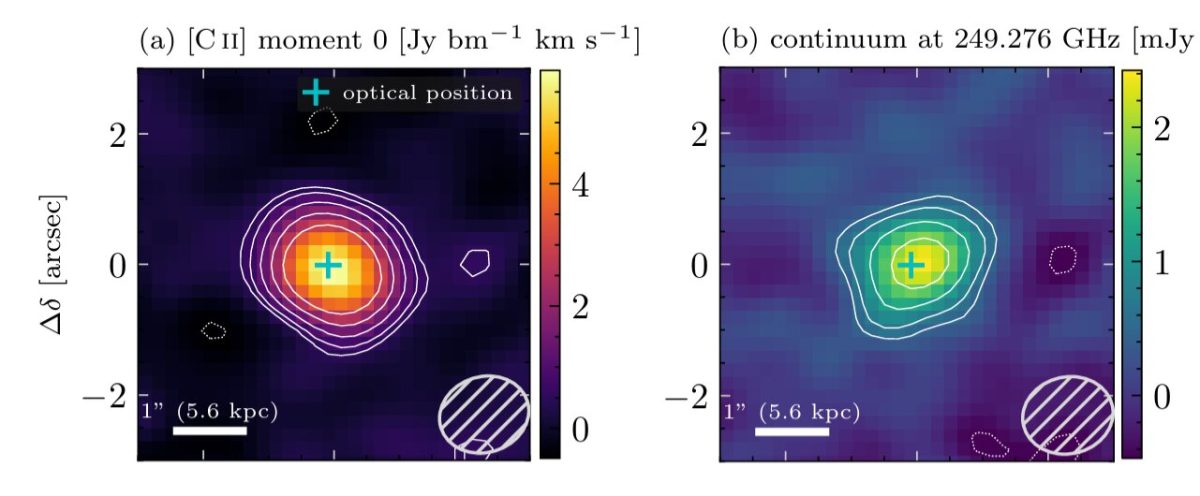
According to ALMA data, the host galaxy is one of the brightest known sources of ionized carbon emission at redshifts above z ≈ 6. It is estimated to contain approximately 400 million solar masses of dust. The upper limit on its star formation rate is striking: as many as 1,330 Sun-like stars could be born there each year.
The scientists note that the dust composition around the nucleus resembles that of moderately dusty quasars in the nearby Universe, while the total dust reserves are comparable to those of extremely obscured systems. This demonstrates that red objects in the early Universe exhibit a broad range of properties and accretion states.
ALMA needed just 5.5 minutes of observing time to obtain the initial gas and dust data. This confirms the method’s efficiency for rapidly identifying dusty quasar candidates. In the future, the new Euclid and Roman space telescopes will help build a more complete catalog of such objects.
We previously explored the history of quasar discoveries and their diversity.
Based on material from phys.org.
