

The largest canyon in the Solar System, known as Valles Marineris on Mars, remains seismically active. New fractures continue to form beneath it. Researchers reached this conclusion by studying marsquake recordings made by the InSight lander.
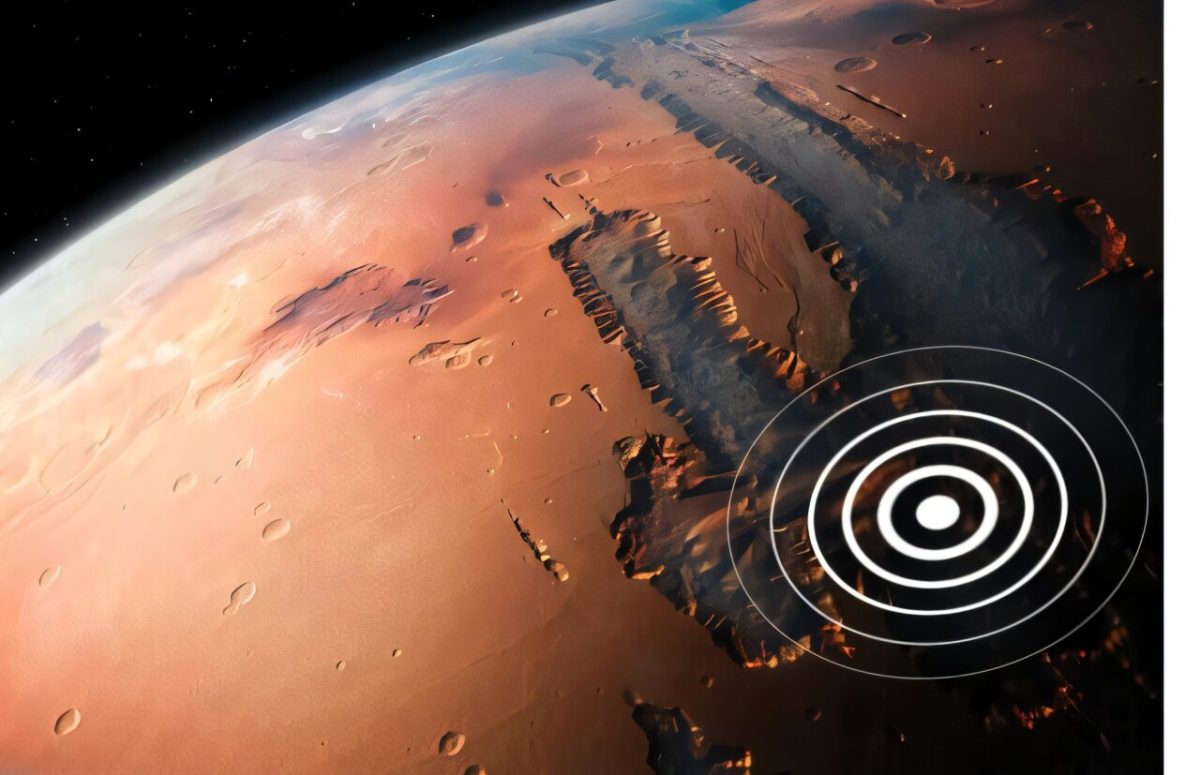
Valles Marineris
Valles Marineris remains seismically active and continues to grow slowly. According to Phys.org, researchers from Columbia University and Imperial College London examined InSight data and found evidence that the largest canyon system on any planet did not stop forming hundreds of millions of years ago.
A paper published in Nature Communications describes an analysis of event S0976a, recorded by the lander’s seismometer on August 25, 2021. InSight, which is no longer operational but was functioning successfully at the time, sits on the opposite side of the planet from Valles Marineris. However, the vibrations traveled through the planet’s interior, allowing researchers to pinpoint their origin at a depth of 20–40 kilometers beneath the giant valley. The valley is actually an entire network of canyons stretching 3,900 kilometers in total and reaching depths of 9 kilometers. It is so vast that small countries could fit inside it.
The Geology of Valles Marineris
Valles Marineris did not form on Mars by chance. Like Earth, Mars once contained molten rock that exerted pressure on its crust. The difference is that Earth’s crust is divided into tectonic plates, so this energy drives their movement, whereas Mars’s crust is continuous and can only fracture.
Valles Marineris is precisely such a giant rift. If Mars were still seismically active, this region would indeed be a logical place to look for quakes. However, the planet’s interior is thought to have long since lost much of its heat, meaning the giant canyon should no longer be expanding.
Thanks to the InSight mission, we know this is not entirely the case. Geological processes continue on Mars, albeit very slowly. Each recorded event needs to be investigated, since it could, for example, have resulted from a meteorite impact. However, analysis of event S0976a showed that it occurred in the same crustal layers that underwent deformation hundreds of millions of years ago.
A new fracture formed there, and it may have been far from the first. Valles Marineris continues to grow, but only further research can reveal how quickly this is happening.
