

A nearly 75-meter-thick sequence of rock on the rim of Jezero Crater turned out to have been formed not by a volcanic eruption, but by repeated asteroid impacts. This succession of deposits consists of fragments, molten droplets, and dust that settled on the planet’s surface more than 3.9 billion years ago.
Six Types of Rock in One Location
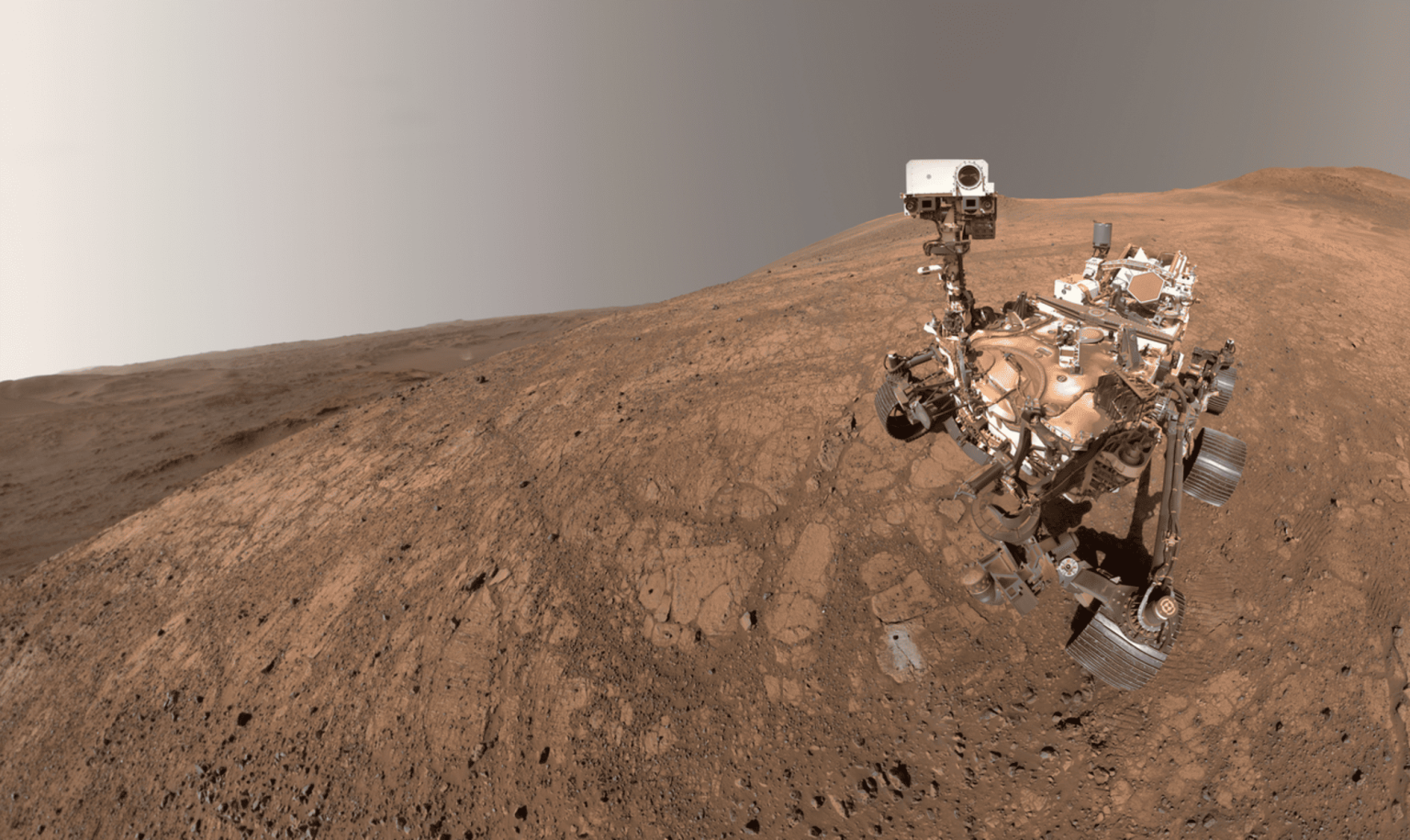
Using the Perseverance rover, scientists studied the geological layer known as the Broom Point member after the rover climbed onto the outer rim of the crater in late 2024, NASA reports. These deposits are older than the crater itself and date back to an ancient period in Mars’s history.
Six distinct types of rock were identified within the 75-meter-thick sequence. They include breccias—rocks composed of cemented, sharp-edged fragments—alternating with thin layers of pulverized dust. The fragments contain numerous gas bubbles, indicating that they were once in a molten state.
Dark Glass Beads as the Main Clue
The main clue came from tiny dark glass spheres found within the deposits. Although volcanoes sometimes eject similar droplets, the concentration observed here is unusual for volcanic activity. The largest spheres are comparable in size to those scattered across Earth by the Chicxulub asteroid, which probably caused the extinction of the dinosaurs.
The repeated occurrence of the same types of material points to multiple high-energy impacts. According to Alex Jones, a doctoral student at Imperial College London and lead author of the study published in the Journal of Geophysical Research: Planets, the deposits reflect impacts of varying intensity and at different distances. Debris from large, distant impacts and smaller, nearby collisions accumulated in the same location, gradually building this sequence.
A Double Impact and Evidence of Water
Some layers of the Broom Point member are tilted at angles greater than 80 degrees, meaning that they stand almost vertically. Such a steep inclination cannot be explained by the formation of Jezero Crater alone. The researchers propose that two cosmic collisions were involved.
First, an enormous asteroid excavated the Isidis basin, which is approximately 1,900 kilometers in diameter. The impact overturned and tilted rock layers that had once been horizontal. Later, a second asteroid formed Jezero Crater itself, which is 45 kilometers in diameter, fracturing and uplifting the already tilted deposits into their present form.
Evidence of water or ice was also found in this geological record. Several layers appear to have been formed by rapid debris flows moving just beneath the surface. On Earth, such powerful waves of fluidized debris occur when molten material comes into contact with water or ice, causing it to turn instantly into steam.
Samples Await Analysis in Laboratories on Earth
Perseverance collected two core samples from this area. They were named Bell Island and Main River. Should a future mission return them to Earth, laboratory dating could determine when the impacts occurred and how frequently they took place on early Mars.
This could also shed light on the bombardment of the young Earth, whose early geological record was erased by billions of years of plate tectonics. According to Alex Jones, during that era, what fell from the Martian sky was neither rain nor snow, but an almost continuous stream of molten rock droplets and pulverized dust thrown upward by asteroid impacts. Reading this sequence of layers means looking back at the cosmic weather that prevailed on Mars four billion years ago.
