

The radio galaxy TXS 2354+015 lies 12.5 billion light-years away from us. As in all similar systems, the gas and dust surrounding it emit large amounts of energy invisible to the human eye, thanks to a supermassive black hole that ionizes them. However, scientists were struck by just how powerful it is.
Active Galactic Nuclei Can Be Heard at Radio Wavelengths
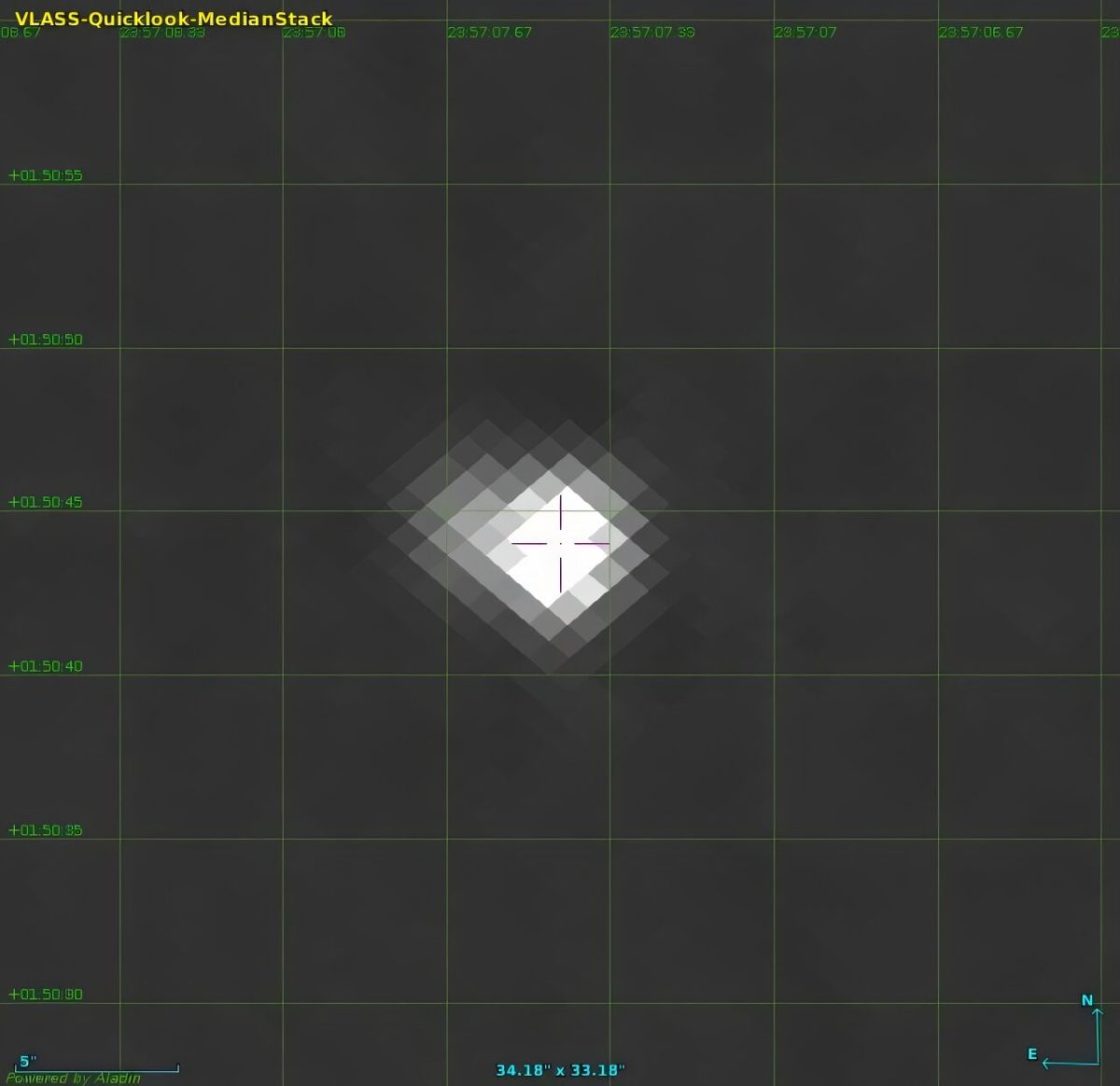
According to phys.org, astronomers have confirmed the existence of a powerful radio galaxy that is almost 12.5 billion years old. The source, designated TXS 2354+015, was initially identified as a high-redshift object based on a characteristic drop in the intensity of its optical emission, and subsequent spectroscopic observations established its redshift at 4.946. This means that the radio galaxy is extremely far away from us.
When matter falls onto a supermassive black hole at the center of a galaxy, the resulting accretion activity can produce an active galactic nucleus (AGN) and launch powerful relativistic jets of plasma that generate large amounts of radio waves. Such a galaxy is classified as a radio-loud active galactic nucleus (RLAGN). The energy carried by these jets can affect star formation within the galaxy and heat the surrounding gas.
This “AGN feedback” is incorporated into simulations to accurately predict the number of galaxies in the Universe. Such powerful galaxies in the early Universe—known as high-redshift RLAGNs—typically mark the locations of the most massive galaxies and the earliest-forming galaxy clusters.
However, the central black hole and nearby regions of the most powerful RLAGNs in the early Universe are concealed within a bubble of dusty gas, and only the radio jet can break through and become directly observable. In particular, a 2024 study suggests that as many as 90% of these sources at redshifts above 3.5 may be obscured at ultraviolet and optical wavelengths. Because they are hidden, they are difficult to detect and confirm spectroscopically.
The Most Distant Radio Galaxies
The dominant approach to finding radio sources, which relies on identifying unusually steep spectra, appears to miss a substantial fraction of the actual population. To overcome this problem, astronomers instead combined deep optical imaging with radio catalogs, searching for galaxies whose light displayed a characteristic “dropout” signature—evidence of extreme distance. This method is known as the Lyman-break technique: clouds of neutral hydrogen between the galaxy and the observer absorb ultraviolet light, producing a sharp drop in the galaxy’s observed optical spectrum at such high redshifts.
In this study, a team led by Barbara Balmaverde of the INAF Astrophysical Observatory of Turin combined deep optical imaging from the Subaru telescope’s Hyper Suprime-Cam Subaru Strategic Program survey with radio catalogs such as TGSS at 150 MHz and VLASS at 3 GHz. Their aim was to identify radio sources whose optical counterparts exhibit a characteristic dropout feature in the redshift range of 4.5 to 5.3, when the Universe was between 1.1 and 1.3 billion years old.
During their search, they identified an intriguing candidate: TXS 2354+015, whose optical spectrum contained a prominent Lyman-alpha emission line. They checked the redshift using a second, weaker emission line. Based on the position of the emission line, the team confirmed a redshift of 4.946, corresponding to a time when the Universe was less than 1.2 billion years old. This makes it the second-most distant radio galaxy ever discovered.
They also checked whether the match could have been a chance coincidence. The precise positional alignment in the optical and radio data, the exceptionally rare radio brightness, and the expected ratio between radio and optical emission all supported the conclusion that this was a genuine radio source with an optical counterpart.
The Most Powerful Radio Galaxy Discovered
When the scientists calculated its intrinsic radio power, TXS 2354+015 proved to be more powerful than any other known high-redshift radio galaxy described in the existing literature. Its estimated radio power at 500 MHz exceeds that of the previous record holder identified in a 2008 survey.
The researchers also estimated the possible mass of the host galaxy at approximately 2 trillion solar masses. This figure makes it one of the brightest known galaxies. “This estimate certainly comes with several significant uncertainties, particularly regarding the age of the stellar population,” the team notes.
The researchers found that TXS 2354+015 does not meet the usual selection criteria for galaxies with ultra-steep spectra. Its discovery using the optical dropout method supports the view that the standard radio-selection technique is incomplete and likely misses a substantial fraction of the true population of obscured radio galaxies in the early Universe.